Business strategy often feels like navigating a dense fog without a compass. Leaders face pressure to innovate, scale, and remain competitive while managing intricate operational details. This complexity frequently leads to misalignment, wasted resources, and stalled growth. To cut through the noise, organizations need a structured approach that visualizes the core logic of how they create and capture value. The Business Model Canvas offers exactly that—a strategic management template for developing new or documenting existing business models. This guide explores how to leverage this framework to streamline decision-making and clarify your organizational vision.
Understanding the Strategic Framework 🧩
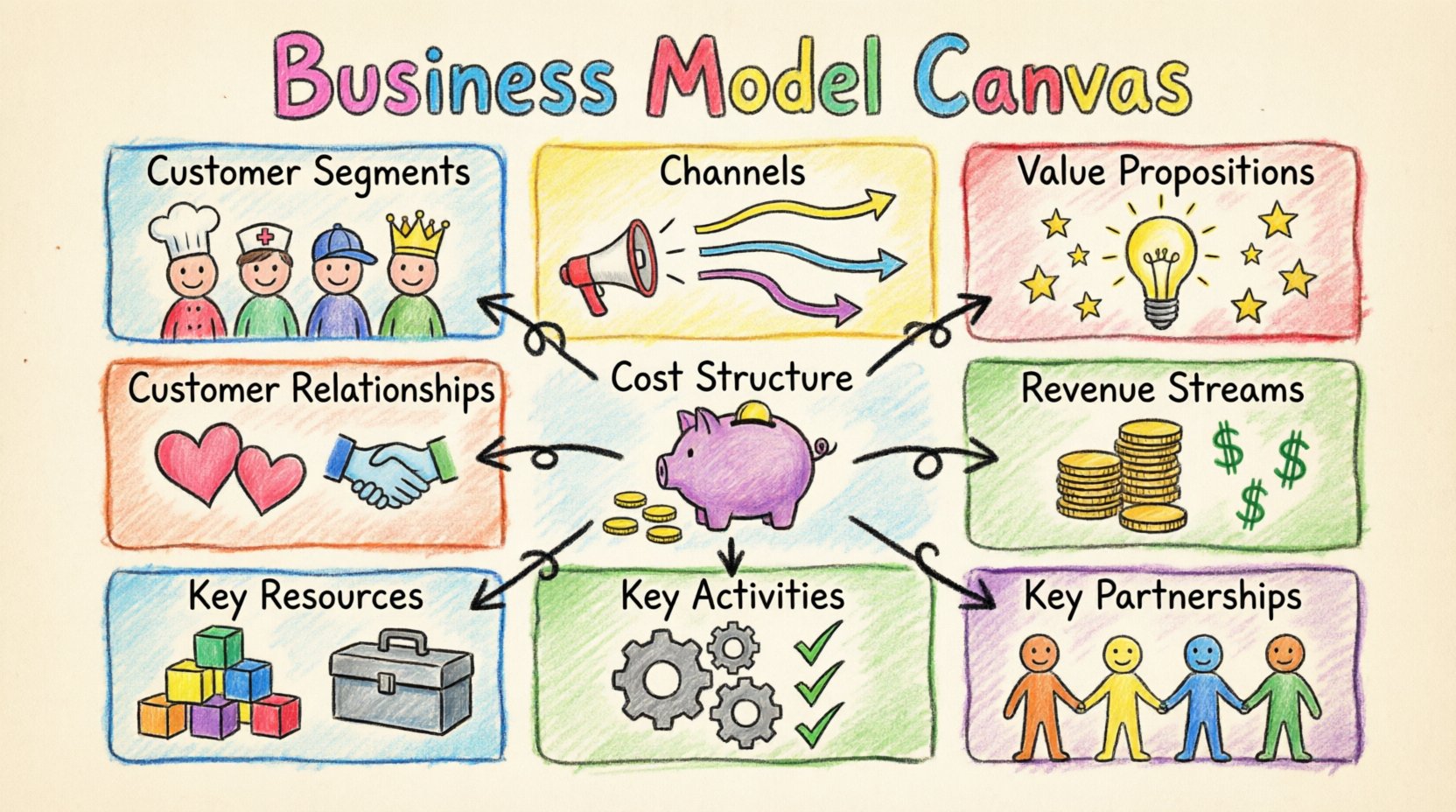
The Business Model Canvas was introduced by Alexander Osterwalder and Yves Pigneur in their seminal work on value creation. It shifts the focus from traditional business plans, which are often static documents filled with projections, to a dynamic visual chart. This tool decomposes the business into nine fundamental building blocks. By mapping these elements onto a single page, stakeholders gain a holistic view of the enterprise.
Why does this matter for strategy? Complex strategies often fail because they are communicated poorly. A one-page visual allows teams to see the connections between different parts of the operation. It forces clarity on assumptions and highlights dependencies. When everyone sees the same picture, alignment becomes significantly easier to achieve. This shared understanding is the bedrock of effective execution.
The 9 Building Blocks Explained 🔍
At the heart of this framework lie nine distinct elements. Each block represents a fundamental question about the business. Understanding each component deeply is crucial before attempting to connect them. Below is a detailed breakdown of what each block entails and the strategic questions it addresses.
| Building Block | Focus Area | Strategic Question |
|---|---|---|
| Customer Segments | Who are we serving? | For whom are we creating value? |
| Value Propositions | What problem are we solving? | What bundle of products and services do we offer? |
| Channels | How do we reach them? | Through which channels do our customers want to be reached? |
| Customer Relationships | How do we interact? | What type of relationship does each segment expect? |
| Revenue Streams | How do we earn money? | For what value are our customers willing to pay? |
| Key Resources | What assets do we need? | What physical, intellectual, or human resources are required? |
| Key Activities | What actions are critical? | What key activities do our value propositions require? |
| Key Partnerships | Who helps us succeed? | Who are our key suppliers and partners? |
| Cost Structure | What does it cost? | What are the most important costs inherent in our model? |
1. Customer Segments 👥
Every business exists to serve someone. Defining your customer segments is the starting point for any strategic initiative. It is not enough to say “everyone.” You must identify specific groups of people or organizations you intend to reach and serve.
- Mass Market: A broad group of people without significant differentiation.
- Niche Market: A specialized segment with specific needs or preferences.
- Segmented: Different groups based on distinct needs or behaviors.
- Diversified: Two distinct customer groups with different needs.
- Multi-sided Platforms: Two or more interdependent customer groups.
Strategically, this block dictates where you allocate your marketing budget and product development resources. If you try to serve everyone, you often end up serving no one effectively. Precision here ensures that value propositions resonate deeply with the intended audience.
2. Value Propositions 💡
This is the core reason why customers turn to your company over competitors. It is a package of products and services that create value for a specific customer segment. A strong value proposition answers the question: Why should a customer choose you?
Common types of value propositions include:
- Innovation: Offering something new or unique to the market.
- Performance: Delivering superior speed, reliability, or usability.
- Customization: Tailoring solutions to individual client needs.
- Design: Aesthetic appeal or user experience focus.
- Price: Offering the best value for the lowest cost.
- Convenience: Making the process easier or faster.
Clarity in this area prevents feature creep. It keeps the team focused on what actually matters to the customer, rather than internal desires to build complex systems that add no external value.
3. Channels 📢
Channels are the touchpoints where the company interacts with its customers. They serve five distinct stages of the customer journey: awareness, evaluation, purchase, delivery, and after-sales support.
Decisions regarding channels impact both the customer experience and the cost structure. You must determine whether to use:
- Owned Channels: Direct sales forces, company websites, or physical stores.
- Partner Channels: Distributors, affiliates, or resellers.
A robust strategy often involves a mix of both. Owned channels offer control and margin, while partner channels offer reach and scale. The choice depends on where your customers prefer to interact.
4. Customer Relationships 🤝
This block defines the type of relationship each customer segment expects. Relationships can range from automated self-service to personal assistance. They are crucial for customer acquisition, retention, and upselling.
Key relationship types include:
- Personal Assistance: Direct human interaction.
- Self-Service: Automated interactions without human help.
- Automated Services: Digital tools that handle the customer journey.
- Communities: Building a network of users who interact with each other.
- Co-creation: Engaging customers in the design or improvement of the product.
Aligning this expectation with the value proposition is vital. A high-touch luxury service requires a different relationship model than a utility-based subscription service.
5. Revenue Streams 💰
This represents the cash a company generates from each customer segment. It is the financial engine of the business model. There are various ways to capture value, and the choice affects the overall financial health.
Common revenue models include:
- Asset Sale: Selling ownership of a physical product.
- Usage Fee: Charging based on how much a service is used.
- Subscription Fees: Recurring revenue for continued access.
- Lending/Renting/Leasing: Temporary access rights.
- Advertising: Charging for space or attention.
- Affiliate Fees: Commission for referring customers.
Strategic planning here involves balancing volume against margin. A high-volume, low-margin model requires different operational efficiencies than a low-volume, high-margin model.
6. Key Resources 🏗️
These are the most important assets required to make the business model work. Without them, the value proposition cannot be delivered. Resources are generally categorized into four types:
- Physical: Buildings, vehicles, machines, and IT infrastructure.
- Intellectual: Brands, patents, copyrights, and customer databases.
- Human: The workforce, including specialized skills and knowledge.
- Financial: Cash, lines of credit, and equity.
Identifying key resources helps prioritize investment. It highlights where the company needs to build capacity or acquire assets to sustain its operations.
7. Key Activities ⚙️
These are the most important things a company must do to make its business model work. Activities depend heavily on the value proposition and customer segments.
Major categories of activities include:
- Production: Designing, making, and delivering a product.
- Problem Solving: Creating new solutions for individual customer problems.
- Platform/Network: Maintaining and improving the platform or network.
Understanding these activities allows leadership to streamline operations. It ensures that time and money are spent on tasks that directly impact the delivery of value.
8. Key Partnerships 🤝
No business operates in isolation. Partnerships are networks of suppliers and partners that make the business model work. They are often formed to optimize efficiency, reduce risk, or acquire resources.
Types of partnerships include:
- Strategic Alliances: Cooperation between non-competitors.
- Coopetition: Strategic partnerships between competitors.
- Joint Ventures: Developing new businesses together.
- Buyer-Supplier Relationships: Ensuring reliable supply chains.
Strategically, this block encourages outsourcing non-core functions. It allows the organization to focus its internal energy on its competitive advantage while relying on partners for specialized support.
9. Cost Structure 💸
This describes all costs incurred to operate a business model. Costs can be driven by value drivers or cost drivers. Understanding this structure is essential for profitability.
Key considerations include:
- Fixed Costs: Costs that remain constant regardless of output.
- Variable Costs: Costs that fluctuate with production volume.
- Economies of Scale: Cost advantages due to increased output.
- Economies of Scope: Cost advantages due to variety of products.
Mapping costs against revenue streams reveals the profitability of specific segments. It helps identify areas where efficiency improvements will have the most significant impact on the bottom line.
Integrating Strategy and Execution 🚀
Filling out the canvas is only the beginning. The true power lies in the iterative process of testing and refining. Strategy is not a static document; it is a hypothesis that must be validated in the market.
To integrate this into your workflow, consider the following steps:
- Start with the Value Proposition: Ensure you understand the problem you are solving before defining the mechanics.
- Map Dependencies: Draw lines between blocks to show how changes in one area affect others. For example, a change in customer segments might require new key resources.
- Validate Assumptions: Identify the riskiest assumptions. These are usually found in the customer segments and value propositions. Test them with real data.
- Review Regularly: Business environments change. Schedule periodic reviews to update the canvas based on new market intelligence.
This approach prevents the common pitfall of building a business based on internal assumptions rather than market reality. It creates a living document that evolves with the company.
Avoiding Common Strategic Traps ⚠️
Even with a solid framework, organizations can make mistakes. Recognizing these pitfalls early can save significant time and capital.
- Focus Too Much on Technology: Technology is an enabler, not the strategy itself. Do not let the tool dictate the business model.
- Neglecting the Customer: It is easy to get lost in internal processes. Always return to the customer segments block to ensure alignment.
- Ignoring the Cost Structure: A great product with no viable cost structure is not a business. Ensure the math works.
- One-Size-Fits-All: Avoid assuming one canvas works for every department. Different business units may require different models.
Iterating for Market Fit 🔄
Market fit is rarely achieved on the first attempt. The canvas is designed to facilitate pivots. When data suggests a segment is not responding, or a cost structure is unsustainable, the framework allows you to adjust quickly.
This iterative cycle is often described as Build-Measure-Learn. The canvas serves as the “Measure” and “Build” foundation. It provides the structure to hypothesize, execute, and analyze. By keeping the model visual and accessible, teams can iterate faster than with traditional planning documents.
Frequently Asked Questions ❓
Q: How long does it take to complete a Business Model Canvas?
A: It depends on the complexity of the business. A simple startup might take a few hours, while a large enterprise undergoing transformation may take weeks of workshops.
Q: Can this be used for non-profit organizations?
A: Yes. The value proposition shifts from profit to social impact, but the logic of resources, activities, and partners remains identical.
Q: Is this tool only for new businesses?
A: No. Established companies use it to innovate new lines of business or to analyze legacy models for optimization.
Q: How does this differ from a SWOT analysis?
A: SWOT focuses on internal strengths/weaknesses and external opportunities/threats. The Business Model Canvas focuses on the internal architecture of how value is created and captured. They complement each other well.
Final Thoughts on Strategic Clarity 🧭
Complexity is the enemy of execution. By breaking down the business into nine manageable components, the Business Model Canvas provides a pathway to clarity. It encourages teams to think critically about every aspect of their operations. It moves the conversation from abstract ideas to concrete mechanics.
Adopting this framework requires discipline. It demands that leaders confront difficult questions about value, cost, and customer needs. However, the reward is a sharper strategy and a more resilient organization. When the logic of the business is clear, execution becomes inevitable. This is the essence of simplifying complex strategies.