The Business Model Canvas (BMC) provides a structured way to visualize, design, and reinvent business models. Within this framework, the Distribution Channels block serves as the critical bridge between your Value Proposition and your Customer Segments. Without an effective channel strategy, even the most innovative products struggle to reach the people who need them. Selecting distribution channels that convert is not merely about availability; it is about alignment with customer behavior, cost structures, and the overall value delivered.
When constructing this block, the goal is to identify the most efficient path for customer acquisition and retention. This involves analyzing how customers want to be reached, how they prefer to purchase, and how they expect to receive the product or service. A channel that converts effectively minimizes friction and maximizes the likelihood of a transaction. This guide explores the strategic selection process, ensuring your distribution model supports sustainable growth.
🚀 The Strategic Role of Distribution in the Canvas
Distribution channels are the touchpoints through which a company communicates with and delivers value to its customer segments. They are not just logistical pipelines but are integral to the customer experience. In the Business Model Canvas, this block interacts directly with Customer Relationships and Revenue Streams.
- Communication: How do you inform customers about your offering? Social media, email, sales teams, or physical signage?
- Access: How do customers purchase? Online storefronts, direct sales, third-party retailers, or mobile apps?
- Delivery: How does the product arrive? Digital downloads, shipping services, subscription boxes, or in-person pickup?
Understanding these three stages is vital. A channel might be excellent for communication but poor for delivery, creating a bottleneck in the conversion funnel. The selection process requires a deep dive into customer journey mapping. You must understand where your customers are physically and digitally when they are ready to engage.
🏗️ Anatomy of a High-Performing Channel
Not all channels are created equal. Some offer high reach but low conversion rates, while others provide deep engagement with higher acquisition costs. To select channels that convert, you must evaluate them against specific performance metrics.
1. Reach and Frequency
Reach refers to the number of potential customers exposed to the channel. Frequency is how often they encounter the message. High reach with low frequency might result in brand awareness but not immediate sales. Conversely, high frequency with low reach might saturate a small audience.
- High Reach Channels: Mass media, search engines, social media platforms.
- High Frequency Channels: Email newsletters, retargeting ads, loyalty programs.
2. Cost Efficiency
Every channel has a cost associated with it. This includes direct costs (ad spend, commissions) and indirect costs (time, management overhead). A channel that converts well must yield a positive return on investment. If the cost to acquire a customer (CAC) exceeds the lifetime value (LTV), the channel is unsustainable.
- Fixed Costs: Building a website, setting up a retail space.
- Variable Costs: Per-click advertising, sales commissions, shipping fees.
3. Customer Convenience
Modern consumers prioritize convenience. If a channel requires excessive steps to complete a purchase, drop-off rates increase. The friction points must be minimized.
- Is the checkout process simple?
- Is the payment method familiar?
- Is the information clear and accessible?
🔍 Types of Channels: Owned vs. Partnered
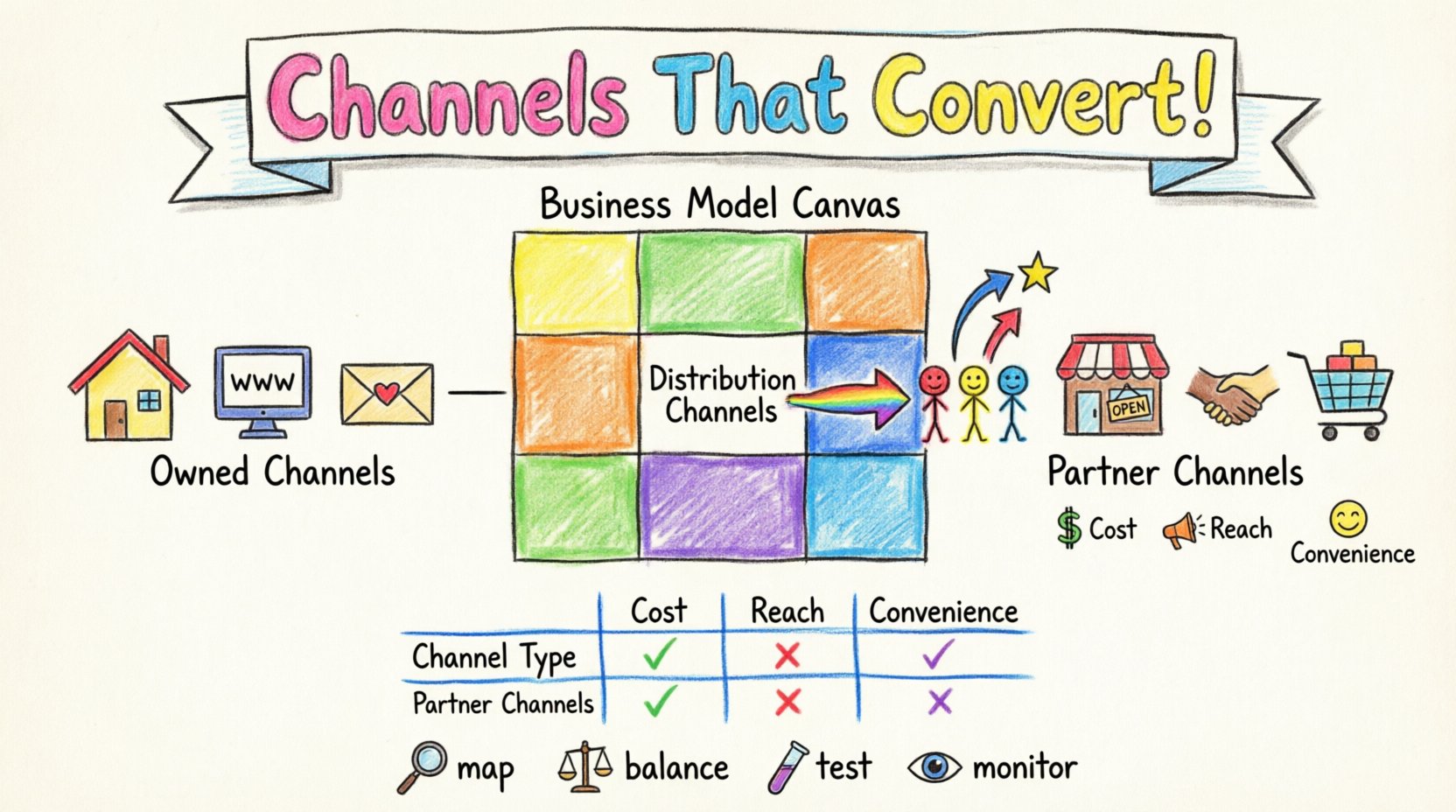
When populating the Distribution Channels block, you generally choose between owned channels and partner channels. Each has distinct advantages regarding control, cost, and conversion potential.
Owned Channels
These are channels you control completely. You own the data, the customer relationship, and the user experience.
- Website/E-commerce Platform: Direct control over branding and sales process.
- Email Lists: Direct communication without algorithm interference.
- Physical Stores: Full control over the environment and staff interaction.
- Mobile Apps: Direct engagement and push notifications.
Pros: High margins (no middleman), full data ownership, brand consistency.
Cons: High upfront investment, requires significant traffic generation effort, full responsibility for maintenance.
Partner Channels
These leverage existing networks to access customers you might not reach alone.
- Retailers: Physical shelf space in established stores.
- Affiliates: Third parties who promote your product for a commission.
- Marketplaces: Platforms like general marketplaces where buyers already congregate.
- Resellers: Partners who add value by bundling or customizing.
Pros: Immediate access to audience, lower upfront cost, established trust.
Cons: Lower margins (commission fees), less control over customer experience, potential dependency.
📋 Selection Matrix: Comparing Channel Performance
To make an informed decision, compare potential channels against key conversion criteria. The table below outlines how different channel types typically perform across critical metrics.
| Channel Type | Control Level | Cost | Reach Speed | Conversion Potential |
|---|---|---|---|---|
| Direct Website | High | Medium | Slow | High (if traffic exists) |
| Email Marketing | High | Low | Fast | Very High (existing leads) |
| Retail Partners | Low | High | Fast | Medium (impulse buys) |
| Social Media Ads | Medium | Variable | Very Fast | Medium (depends on targeting) |
| Marketplaces | Low | Medium | Fast | High (high intent users) |
| Direct Sales Team | High | Very High | Slow | Very High (B2B) |
Use this matrix to identify gaps. If your primary channel is slow to reach but has high conversion, you may need a partner channel for speed. If you rely heavily on marketplaces, you might need an owned channel to build brand equity.
🎯 Aligning Channels with Customer Segments
A distribution channel is only effective if it matches the preferences of the specific customer segment. A strategy that works for one segment may fail for another. This alignment is the core of the BMC’s “Customer Segments” and “Channels” blocks interaction.
Demographic Alignment
Different age groups and income levels prefer different channels. For example, younger demographics often discover products through social media and mobile apps. Older demographics might prefer traditional search engines or physical catalogs.
Behavioral Alignment
Consider how your customers buy. Do they research extensively before purchasing? If so, content marketing and SEO channels are vital. Do they buy on impulse? Social media and retail displays are more effective.
Geographic Alignment
Physical presence matters in some regions. A digital-first strategy might fail in markets where trust is built through face-to-face interaction. Conversely, global digital products require online-only channels.
- Segment A: Digital Native, values speed. Channel: Mobile App, Social Commerce.
- Segment B: Traditional, values trust. Channel: Phone Sales, Physical Dealers.
- Segment C: Cost Conscious. Channel: Marketplaces, Discount Retailers.
💰 Cost vs. Reach Analysis
Financial viability determines which channels survive in the long term. You must calculate the Cost of Goods Sold (COGS) plus the Cost of Distribution. If the distribution cost eats too much margin, the business model breaks.
Fixed vs. Variable Costs
Owned channels often have high fixed costs (development, staffing) but low variable costs per customer. Partner channels often have low fixed costs but high variable costs (commissions, wholesale discounts).
- Scaling Owned Channels: As volume increases, the cost per unit decreases significantly.
- Scaling Partner Channels: Costs increase linearly with sales volume.
Break-Even Analysis
Before committing to a channel, determine how many units must be sold to cover the costs. This helps in setting realistic conversion targets.
- Calculate total monthly channel cost.
- Determine average profit per unit.
- Divide cost by profit to find the break-even volume.
🔄 Integration with Customer Relationships
Channels are not isolated; they dictate the type of relationship you can maintain. The “Customer Relationships” block of the BMC defines whether you use self-service, personal assistance, or automated services.
- Self-Service Channels: E-commerce sites, apps. Best for low-touch, high-volume relationships.
- Personal Assistance: Sales teams, call centers. Best for high-value, complex sales.
- Automated Services: Chatbots, FAQs. Best for troubleshooting and support.
- Communities: Forums, user groups. Best for brand loyalty and feedback.
If you select a channel that demands personal support but you plan to use self-service automation, you will create friction. Ensure the channel capability matches the relationship expectation.
🧪 Testing and Validation Strategies
Never assume a channel will work without testing. The BMC is a living document; distribution channels should evolve based on data.
Minimum Viable Channel
Start with a small subset of your chosen channel. Test the messaging, the offer, and the delivery mechanism. Do not roll out a full-scale campaign immediately.
- A/B Testing: Test two different landing pages or ad creatives.
- Pilot Programs: Launch in a specific region or demographic first.
- Feedback Loops: Collect data on why customers abandon the process.
Key Performance Indicators (KPIs)
Track specific metrics to measure success. Generic traffic numbers are less useful than conversion metrics.
- Conversion Rate: Percentage of visitors who become buyers.
- Customer Acquisition Cost (CAC): Total spend divided by new customers.
- Churn Rate: Percentage of customers who stop using the service.
- Customer Lifetime Value (CLV): Total revenue expected from a customer.
⚠️ Common Pitfalls in Channel Selection
Even well-planned strategies can fail due to common oversights. Awareness of these pitfalls helps in maintaining a robust distribution model.
1. Channel Conflict
When selling through multiple channels, they may compete against each other. For example, a direct online price might be lower than a retail partner’s price, causing partners to drop the product.
- Solution: Differentiate products or pricing by channel.
- Solution: Ensure retail partners receive value beyond just product margin.
2. Overextension
Trying to be everywhere at once dilutes resources. A small team cannot effectively manage a website, three social platforms, a physical store, and a retail partnership simultaneously.
- Solution: Focus on the 20% of channels that drive 80% of revenue.
- Solution: Prioritize quality of execution over quantity of channels.
3. Ignoring Customer Feedback
Assuming you know what customers want without asking leads to misalignment. Customers may prefer a channel you haven’t considered.
- Solution: Regularly survey customers about their purchasing journey.
- Solution: Monitor support tickets for channel-related complaints.
🛠️ Optimizing for Long-Term Growth
Once channels are selected and tested, the focus shifts to optimization. This involves refining the user experience and improving the efficiency of the distribution flow.
Streamlining the Journey
Map the entire customer journey for each channel. Identify where they hesitate and remove obstacles.
- Reduce the number of clicks to purchase.
- Optimize page load speeds for mobile devices.
- Clarify return policies and shipping costs early.
Data-Driven Decisions
Use analytics to guide future investments. If a channel shows high engagement but low conversion, the issue might be the offer, not the channel itself.
- Attribution Modeling: Understand which channel touches lead to a sale.
- Cohort Analysis: Compare behavior of customers acquired through different channels.
- Trend Monitoring: Watch for shifts in customer behavior over time.
🔗 Final Considerations for the Business Model Canvas
Integrating distribution channels into the Business Model Canvas is a dynamic process. It requires constant review as market conditions change. The selected channels must remain aligned with the value proposition. If your value proposition shifts from “low cost” to “premium experience,” your channels must shift from discount retailers to boutique partners.
Success lies in the coherence of the entire canvas. The channel should not contradict the customer relationship or the revenue model. By carefully selecting channels that convert, you create a reliable path for value exchange. This path reduces uncertainty and builds a foundation for scalable growth.
Remember that the best channel is the one that fits your specific context. There is no universal solution. Continuous testing, measurement, and adaptation are the keys to maintaining an effective distribution strategy. Keep the customer at the center of every decision, and the conversion rates will follow naturally.
Summary of Key Actions
- Map Customer Touchpoints: Understand where and how customers interact.
- Balance Costs and Reach: Ensure financial viability across all channels.
- Maintain Control: Own the relationship where possible to protect data.
- Test Rigorously: Validate assumptions before scaling.
- Monitor Performance: Track KPIs to identify optimization opportunities.
By adhering to these principles, you ensure that your distribution channels serve as a powerful engine for business growth rather than a bottleneck. The Business Model Canvas becomes a true strategic tool, guiding decisions that drive tangible results.