Enterprise architecture is fundamentally about communication. While the underlying models provide the structural integrity of an organization’s strategy and operations, their value is realized only when stakeholders can understand and act upon the information presented. The ArchiMate® framework offers a comprehensive language for modeling, but the sheer volume of possible views can overwhelm rather than inform. The critical task lies in selecting the right ArchiMate viewpoint for specific stakeholders. This decision dictates clarity, alignment, and the speed of decision-making within the enterprise.
This guide explores the mechanics of viewpoint selection. We will move beyond generic definitions to examine how different roles interact with architectural data. By focusing on stakeholder concerns, we ensure that models serve their purpose: facilitating understanding and driving change.
🧩 What is an ArchiMate Viewpoint?
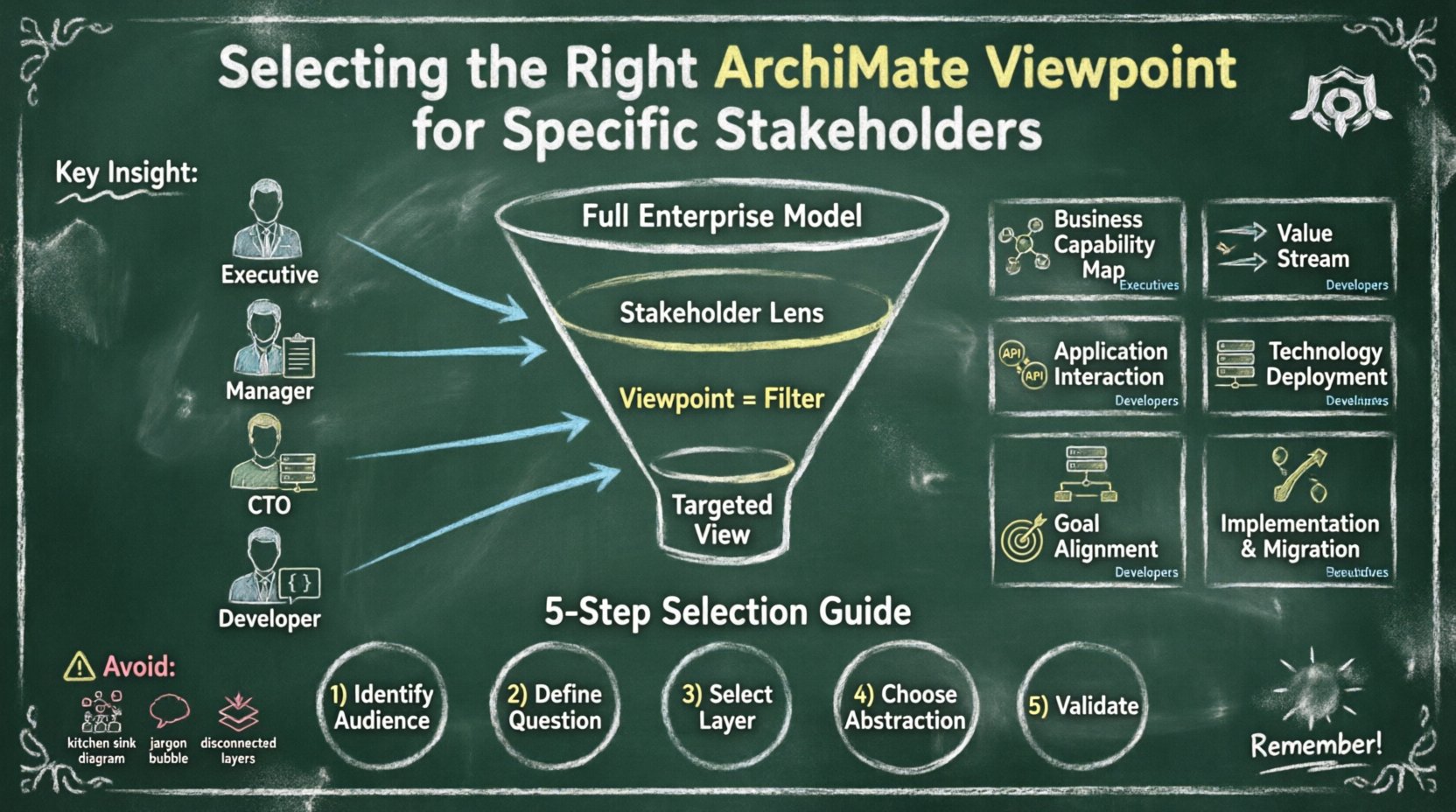
A viewpoint defines a perspective from which an architecture is viewed. It is a template that determines which elements, relationships, and concepts are visible to a specific audience. Think of it as a filter applied to the complete enterprise architecture model.
- Abstraction Level: Viewpoints decide how much detail is shown. A strategic leader needs high-level capabilities, while a developer needs interface definitions.
- Focus Area: Viewpoints isolate specific layers. The Business Layer focuses on processes and actors. The Technology Layer focuses on infrastructure and nodes.
- Communication Goal: Viewpoints address specific concerns. Some address cost, others address risk, and some address innovation potential.
Without a defined viewpoint, a model is simply a diagram. With a viewpoint, it becomes a targeted communication tool tailored to the recipient’s needs.
👥 Understanding Stakeholder Concerns
Before selecting a viewpoint, one must understand the stakeholder. Different roles within an organization hold different priorities. A mismatch between the viewpoint and the stakeholder leads to confusion, disengagement, or incorrect decisions.
1. Strategic Leadership
- Primary Concern: Value realization, investment, and long-term viability.
- Needed Insight: How does IT support the business strategy? What are the cost drivers? Where are the risks?
- Preferred Viewpoint: Motivation Layer, Business Capability Map, Value Stream.
2. Business Managers
- Primary Concern: Process efficiency, customer experience, and operational agility.
- Needed Insight: How does a change in process affect the customer? What are the dependencies between departments?
- Preferred Viewpoint: Business Process, Business Service, Business Actor.
3. Technical Management (CIO / CTO)
- Primary Concern: System stability, security, integration, and technical debt.
- Needed Insight: How do applications interact? Where is the data stored? What are the technology standards?
- Preferred Viewpoint: Application Component, Infrastructure, Technology Node.
4. Developers and Architects
- Primary Concern: Implementation details, interfaces, and data structures.
- Needed Insight: API specifications, database schemas, and deployment logic.
- Preferred Viewpoint: Application Service, Interface, Data Object.
📊 Mapping Viewpoints to Stakeholders
The following table provides a structured overview of common ArchiMate viewpoints and the stakeholders who benefit most from them. This matrix helps architects quickly identify the appropriate model slice for a given conversation.
| Viewpoint Name | Primary Layer | Target Audience | Key Question Addressed |
|---|---|---|---|
| Business Capability Viewpoint | Business | Strategic Leaders, Business Managers | What capabilities does the organization need to deliver value? |
| Value Stream Viewpoint | Business | Process Owners, Customer Experience Leads | How do we deliver value to the customer step-by-step? |
| Application Interaction Viewpoint | Application | System Architects, Developers | How do systems exchange data and services? |
| Technology Deployment Viewpoint | Technology | Infrastructure Managers, Ops Teams | Where are the software components physically running? |
| Goal Alignment Viewpoint | Motivation | Executive Sponsors, Governance Boards | Does this change support our strategic goals? |
| Implementation & Migration Viewpoint | Implementation | Project Managers, Delivery Teams | What is the sequence of changes required to reach the target state? |
🏗️ Deep Dive: Business Layer Viewpoints
The Business Layer is often the entry point for enterprise architecture discussions. It describes the organization’s core activities. Selecting the correct viewpoint here ensures that business stakeholders remain engaged.
Business Capability Map
This is perhaps the most recognized business viewpoint. It organizes capabilities in a hierarchical structure. It answers the question: “What can the organization do?”
- Use Case: Identifying gaps between current and future capabilities.
- Benefit: High-level overview that abstracts away processes and systems.
- Stakeholder: CFO, COO, Strategy Director.
Value Stream
While capabilities describe “what,” value streams describe “how.” A value stream maps the flow of activities from an initial state to a final state of value for a stakeholder.
- Use Case: Optimizing customer journeys or internal operational flows.
- Benefit: Highlights waste, bottlenecks, and handoff points.
- Stakeholder: Process Owners, Quality Managers.
Business Process Viewpoint
This viewpoint focuses on the detailed execution of tasks. It is more granular than the capability map.
- Use Case: Defining roles and responsibilities for specific workflows.
- Benefit: Clarifies who does what within a specific context.
- Stakeholder: Team Leads, Operations Managers.
💻 Deep Dive: Application & Technology Viewpoints
As the focus shifts from business strategy to execution, the viewpoints must reflect the complexity of the IT landscape. These layers are where the rubber meets the road.
Application Portfolio Viewpoint
This view aggregates applications into categories based on their function or business service support.
- Use Case: Rationalizing software licenses and reducing redundancy.
- Benefit: Provides a clear picture of the application landscape.
- Stakeholder: Application Portfolio Managers, CIO.
Application Interaction Viewpoint
Applications do not exist in isolation. This viewpoint shows how they communicate via interfaces and services.
- Use Case: Planning integration projects or API governance.
- Benefit: Visualizes dependencies and data flow between systems.
- Stakeholder: Integration Architects, API Owners.
Technology Deployment Viewpoint
This viewpoint maps software components to physical hardware. It is essential for infrastructure planning.
- Use Case: Cloud migration planning or disaster recovery setup.
- Benefit: Shows the physical topology of the environment.
- Stakeholder: Infrastructure Managers, Security Officers.
🧠 The Motivation Layer: Often Overlooked
Many modeling efforts skip the Motivation Layer. However, this layer provides the context for why changes are happening. It includes goals, drivers, and assessments.
Goal Alignment Viewpoint
This is critical for governance. It connects technical changes back to business objectives.
- Use Case: Justifying a new investment to the board.
- Benefit: Demonstrates traceability from execution to strategy.
- Stakeholder: Board Members, Governance Committee.
Assessment Viewpoint
When a change is proposed, this viewpoint analyzes the impact against current capabilities.
- Use Case: Risk analysis before implementation.
- Benefit: Quantifies the impact of potential changes.
- Stakeholder: Risk Managers, Compliance Officers.
By including the Motivation Layer, architects ensure that technical decisions are never made in a vacuum. They are always tied to the strategic intent of the organization.
🚀 Practical Steps for Selection
How do you decide which viewpoint to use in a given meeting or document? Follow this structured approach.
- Identify the Audience: Who is reading this model? Is it a developer, a manager, or an investor?
- Define the Question: What specific question are they trying to answer? Do they need to know cost, risk, or functionality?
- Select the Layer: Does the answer lie in the business logic, the application logic, or the technology infrastructure?
- Choose the Abstraction: Do they need a high-level map (Capabilities) or a detailed flow (Processes)?
- Review for Clarity: Does this viewpoint hide unnecessary complexity? Remove elements that do not answer the defined question.
- Validate: Ask a representative stakeholder if the model makes sense to them.
⚠️ Common Mistakes in Viewpoint Definition
Even experienced architects can fall into traps when defining viewpoints. Awareness of these pitfalls helps maintain quality.
1. The “Kitchen Sink” Approach
Attempting to show everything in one diagram. This overwhelms the reader and obscures the main message. A viewpoint must be selective.
2. Ignoring the Motivation Layer
Modeling processes and systems without explaining why they exist. This leads to a disconnect between IT and Business.
3. Using Technical Jargon for Business Audiences
Showing interface diagrams to a CFO. They care about value streams and capabilities, not API endpoints. Adapt the vocabulary.
4. Inconsistent Naming
Using different names for the same concept across different viewpoints. This breaks traceability and creates confusion.
5. Static Modeling
Creating a viewpoint that does not account for change. Architecture is dynamic. Viewpoints should support the story of evolution, not just the current state.
🔍 Ensuring Consistency Across Models
When multiple viewpoints exist for the same organization, consistency is key. Stakeholders often move between different models during a project. If the definitions shift, trust erodes.
- Standardize Definitions: Ensure that a “Business Process” means the same thing in the Business Viewpoint and the Application Viewpoint.
- Link Concepts: Use relationships to link elements across viewpoints. A Business Service should link to the Application Services that implement it.
- Version Control: Track changes to viewpoints. If a capability is renamed, ensure all views are updated.
- Documentation: Maintain a glossary of terms used in the viewpoints. This serves as a single source of truth.
❓ Frequently Asked Questions
Q: Can one stakeholder have multiple viewpoints?
A: Yes. A CIO might need a high-level capability map for strategy meetings and a detailed technology deployment view for infrastructure planning. Tailor the view to the specific meeting context.
Q: Is it better to use standard ArchiMate viewpoints or create custom ones?
A: Standard viewpoints provide a common language. Custom viewpoints should only be used if the standard options do not address a unique organizational need. Customization should be minimal.
Q: How do I handle conflicting requirements between stakeholders?
A: This is a stakeholder management issue, not just a modeling issue. Use the Motivation Layer to show how different views support the same overarching goal. Facilitate a workshop to align on the priority.
Q: Does the size of the model matter for viewpoint selection?
A: Yes. Large models require more granular filtering. A small model might fit into a single overview. As the model grows, the need for specific viewpoints increases to manage complexity.
Q: How often should viewpoints be reviewed?
A: Viewpoints should be reviewed whenever the underlying architecture changes significantly or when a new stakeholder group is introduced. Regular reviews prevent model drift.
🏁 Final Thoughts on Architectural Communication
The selection of an ArchiMate viewpoint is an exercise in empathy. It requires understanding what the audience needs to know to make decisions. It is not about displaying the full depth of the architecture, but about revealing the depth that matters to the specific person looking at it.
By carefully mapping stakeholders to viewpoints, architects transform complex models into actionable intelligence. This alignment reduces friction, speeds up governance, and ensures that the enterprise architecture remains a living asset rather than a static repository. The goal is clarity. When clarity is achieved, alignment follows naturally.
Remember that every diagram has a purpose. Define the purpose first, then select the viewpoint that best serves it. This disciplined approach is the foundation of successful enterprise architecture.