
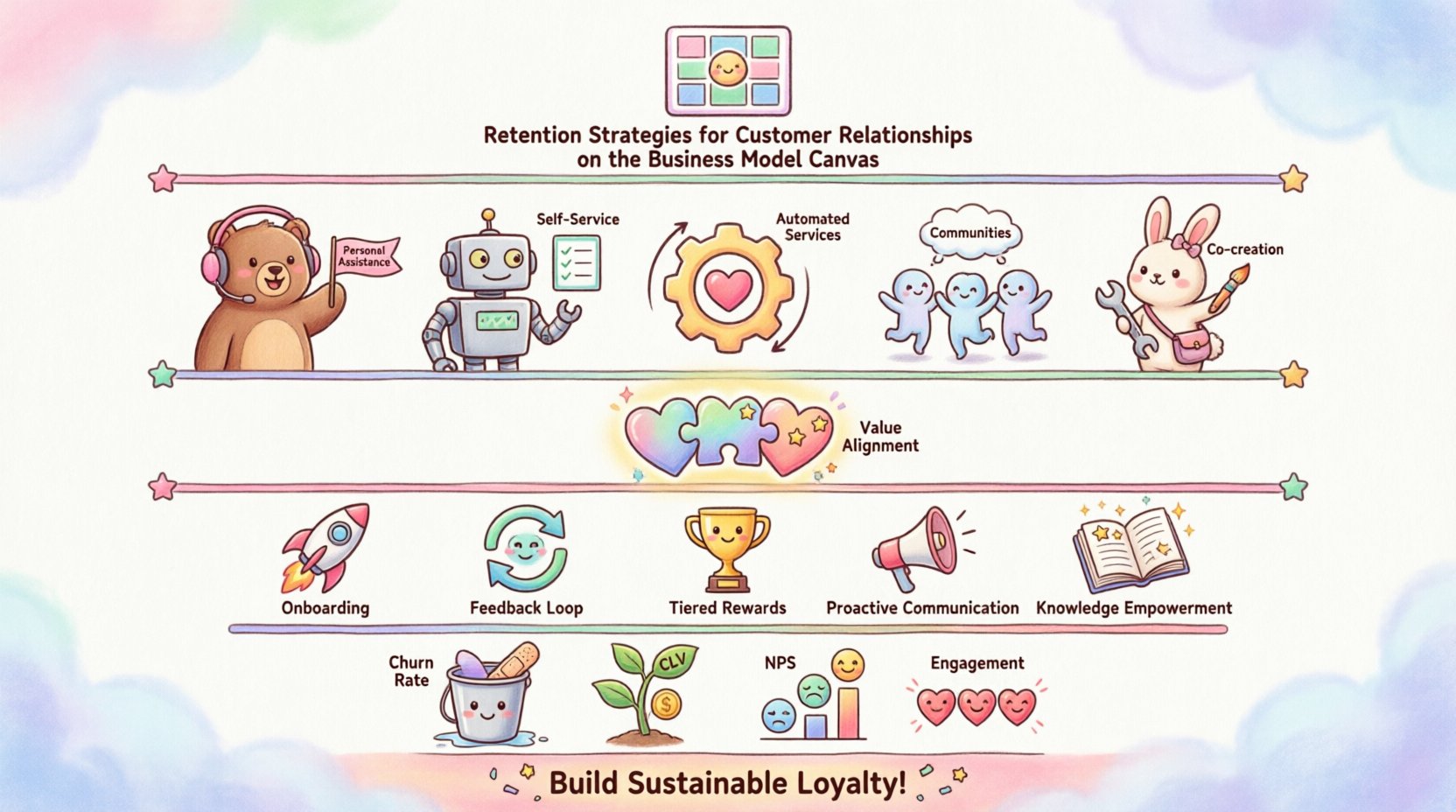
Building a sustainable business requires more than just acquiring new clients. It demands a robust framework for keeping them engaged and loyal over time. Within the Business Model Canvas, the Customer Relationship block plays a pivotal role in defining how a company interacts with its user base. This section of the canvas dictates the type of relationship established with each customer segment. It influences whether interactions are automated, personal, or community-driven.
Effective retention strategies are not merely about support tickets or discount codes. They are deeply embedded in the structural design of the business model. When the Customer Relationship block aligns with the Value Proposition and Revenue Streams, the organization creates a sticky ecosystem where clients choose to stay. This guide explores how to leverage the Business Model Canvas to foster long-term loyalty without relying on external hype or fleeting trends.
🧩 Understanding the Customer Relationship Block in BMC
The Customer Relationship block answers a fundamental question: What type of relationship does each customer segment expect the company to establish and maintain with them? This is not just a marketing decision; it is an operational one. It dictates resource allocation, staff training, and process design.
- Establishment: How do you attract customers to the business?
- Retention: How do you keep them coming back?
- Upselling: How do you increase their spend over time?
In the context of the Business Model Canvas, this block must be treated as a strategic asset. If the relationship type is misaligned with the value proposition, churn rates will inevitably rise. For example, offering high-touch personal assistance for a low-cost self-service product creates inefficiency and customer dissatisfaction.
To optimize retention, you must first audit the current relationship model. Is it transactional or relational? Is it reactive or proactive? The canvas provides the visual structure to map these interactions against other building blocks, ensuring that retention is not an afterthought but a core function of the business design.
🔗 The Five Types of Customer Relationships
The Business Model Canvas framework categorizes relationships into five distinct types. Each type serves different customer needs and requires different operational capabilities. Understanding these categories allows you to select the most effective strategy for your specific market segment.
1. Personal Assistance 🙋♂️
This involves direct human interaction. Customers expect to speak to a representative who understands their specific needs. This is common in high-value B2B services, luxury retail, or complex financial products. Retention here relies on trust, expertise, and the quality of the individual relationship.
2. Self-Service 🤖
No direct human interaction is provided. Customers rely on automated systems, knowledge bases, and intuitive interfaces. This is typical for utility providers, software-as-a-service platforms, and mass-market e-commerce. Retention depends on usability, reliability, and speed.
3. Automated Services ⚙️
This combines self-service with automated personalization. The system recognizes the customer and offers tailored recommendations or solutions without human intervention. It is often used in streaming services or e-commerce platforms that track purchase history.
4. Communities 👥
The company creates a platform for customers to interact with each other. This builds a sense of belonging and peer support. Retention is driven by network effects and social capital. Users stay because their connections are on the platform.
5. Co-creation 🛠️
Customers actively participate in designing the product or service. This is common in open-source software, consulting, or niche manufacturing. Retention is high because the product is uniquely tailored to the user’s input.
Most successful businesses utilize a hybrid approach. However, the primary relationship type must be clearly defined in the canvas to ensure consistency across all touchpoints.
Comparison of Relationship Types
| Relationship Type | Primary Driver | Best For | Retention Focus |
|---|---|---|---|
| Personal Assistance | Human Connection | High-Value B2B | Account Management Quality |
| Self-Service | Usability | Mass Market | System Reliability |
| Automated Services | Personalization | Content/Subscription | Algorithm Relevance |
| Communities | Belonging | Platform/Marketplace | Engagement Levels |
| Co-creation | Collaboration | Custom Solutions | Participation Incentives |
🎯 Aligning Retention with Value Propositions
The Customer Relationship block does not exist in isolation. It is intrinsically linked to the Value Proposition block. The way you treat a customer must reinforce the promise you made about your product or service. If you promise speed, slow support kills retention. If you promise customization, rigid processes hinder loyalty.
1. Value Consistency
Every interaction must validate the core value provided. If a customer signs up for a premium service, the relationship management should reflect that status. This might mean faster response times or dedicated resources. Inconsistency creates cognitive dissonance, leading customers to question the value of the subscription.
2. Pain Point Resolution
Retention is often about how you handle problems. The Customer Relationship block defines the mechanism for support. A robust retention strategy anticipates friction points. For instance, if the value proposition is “peace of mind,” the relationship strategy must include proactive monitoring and immediate resolution of issues.
3. Emotional Connection
Functional value keeps customers for a while; emotional value keeps them for years. The relationship block can be designed to foster this connection. This could involve personalized communications, recognition of milestones, or exclusive access for loyal members. The goal is to move the relationship from transactional to relational.
🛡️ Tactics to Enhance Customer Loyalty
Once the relationship type and value alignment are clear, specific tactics can be implemented. These strategies should be mapped to the Business Model Canvas to ensure they are feasible within your operational structure.
1. Structured Onboarding 🚀
The first few interactions are critical. A structured onboarding process ensures the customer realizes value quickly. This reduces early churn. The process should include:
- Clear setup instructions.
- Access to educational resources.
- Initial success milestone tracking.
Without a successful onboarding, the customer may never understand the product’s utility, regardless of how good the product is.
2. Feedback Loops 🔄
Continuous improvement relies on customer input. Implementing regular feedback mechanisms shows the customer that their opinion matters. This can be done through:
- Post-interaction surveys.
- Quarterly business reviews.
- Public roadmaps showing requested features.
When customers see their feedback implemented, they feel a sense of ownership, which increases retention.
3. Tiered Incentive Structures 🏆
Recognizing loyalty is a powerful motivator. A tiered system rewards continued engagement without devaluing the core product. Benefits for higher tiers might include:
- Priority support access.
- Exclusive content or events.
- Extended service periods.
This creates a clear path for customers to invest more in the relationship to unlock better benefits.
4. Proactive Engagement 📢
Do not wait for the customer to reach out. Use data to identify when a customer might be at risk of churning. If usage drops, initiate a check-in. If a renewal date is approaching, start the conversation early. This demonstrates care and prevents the relationship from becoming dormant.
5. Knowledge Sharing 📚
Empower customers to be experts on your product. By providing advanced training, webinars, and documentation, you increase their dependency on the ecosystem. A customer who knows how to maximize the product is less likely to leave.
📊 Measuring Success and Metrics
You cannot improve what you do not measure. While the Business Model Canvas is a qualitative tool, the Customer Relationship block requires quantitative tracking to validate retention strategies. The following metrics should be monitored regularly.
1. Churn Rate
This is the percentage of customers who stop using the service over a given period. A rising churn rate indicates a failure in the relationship strategy. It is crucial to segment this data by customer type to identify specific pain points.
2. Customer Lifetime Value (CLV)
This metric calculates the total revenue a customer generates during their relationship with the company. Increasing CLV is the ultimate goal of retention. Strategies that increase CLV are those that extend the lifespan of the customer and increase the average spend.
3. Net Promoter Score (NPS)
This measures customer loyalty and satisfaction. It asks how likely a customer is to recommend the product to others. A high NPS often correlates with high retention, as satisfied customers become advocates.
4. Engagement Frequency
How often does the customer interact with the product or service? High engagement frequency usually indicates high perceived value. Low engagement is an early warning sign of disinterest.
5. Support Ticket Volume
An increase in support tickets can indicate confusion or product issues. A decrease might indicate good onboarding, but it could also mean customers have given up. Monitoring the nature of the tickets is essential.
⚠️ Common Pitfalls to Avoid
Even with a solid plan, execution errors can undermine retention efforts. Being aware of common mistakes helps in maintaining a healthy business model.
- Overpromising: Defining a relationship in the canvas that the operations cannot deliver creates disappointment. Ensure the relationship type matches your capacity.
- Inconsistency: Changing the relationship style frequently confuses customers. Stick to the defined model.
- Neglecting Feedback: Ignoring negative feedback signals leads to silent churn. Customers leave without complaining.
- One-Size-Fits-All: Applying the same retention strategy to all customer segments ignores their unique needs. Segment the canvas where necessary.
- Focus on Acquisition Only: Many businesses pour resources into acquiring new clients while neglecting existing ones. The canvas must balance these efforts.
🔄 Implementation Steps for the Business Model
To integrate these strategies into your business model, follow a structured approach. This ensures that retention becomes a systemic feature rather than an ad-hoc activity.
- Define the Relationship: Explicitly state the relationship type in the Customer Relationship block of your canvas. Be specific about the mode of interaction.
- Map Touchpoints: Identify every point where the customer interacts with the business. Ensure each touchpoint aligns with the defined relationship type.
- Allocate Resources: Assign the necessary staff, technology, and budget to support the relationship model. Do not underinvest in this block.
- Train the Team: Ensure all employees understand the importance of the Customer Relationship block. Frontline staff should be empowered to resolve issues.
- Monitor and Iterate: Regularly review retention metrics. Adjust the relationship strategy based on data and feedback.
By treating the Customer Relationship block as a dynamic component of the business model, you create a foundation for long-term growth. Retention is not a separate department; it is woven into the fabric of how the company operates.
🌱 Building a Sustainable Cycle
Retention strategies on the Business Model Canvas are about creating a sustainable cycle. When customers are retained, they generate revenue that funds innovation. This innovation improves the value proposition, which in turn strengthens the relationship. It is a virtuous cycle that drives stability.
Conversely, neglecting this block creates a leaky bucket. No amount of acquisition spending can fill a bucket with holes. The Business Model Canvas provides the blueprint to patch those holes. It forces a holistic view of the business, ensuring that customer loyalty is supported by value, operations, and finance.
Ultimately, the goal is to build a business where customers stay because it is in their best interest to do so. This requires a deep understanding of their needs and a commitment to delivering value consistently. By applying the frameworks outlined here, organizations can transform customer relationships from a cost center into a competitive advantage.