The Business Model Canvas (BMC) provides a structured layout for describing, designing, challenging, and pivoting a business model. While the canvas consists of nine building blocks, the Key Activities block often determines whether a strategy remains theoretical or becomes operational reality. Prioritizing these activities is not merely an administrative task; it is a strategic imperative that dictates resource allocation, operational focus, and ultimately, value delivery.
This guide explores the mechanics of identifying, categorizing, and prioritizing Key Activities. It focuses on aligning daily operations with long-term strategic goals without relying on external software or hypothetical hype. The objective is to establish a clear, actionable framework for organizational efficiency.
🔍 Understanding the Role of Key Activities
Key Activities represent the most important things a company must do to make its business model work. They are the actions required to execute the value proposition, reach markets, maintain customer relationships, and generate revenue. Without a clear understanding of these activities, a business cannot effectively manage its Key Resources or optimize its Cost Structure.
Consider the difference between a manufacturing firm and a consulting agency. Both require activities to function, but the nature of those activities differs fundamentally. Prioritization ensures that the organization focuses energy on what drives value rather than what is merely convenient.
📋 The Three Categories of Key Activities
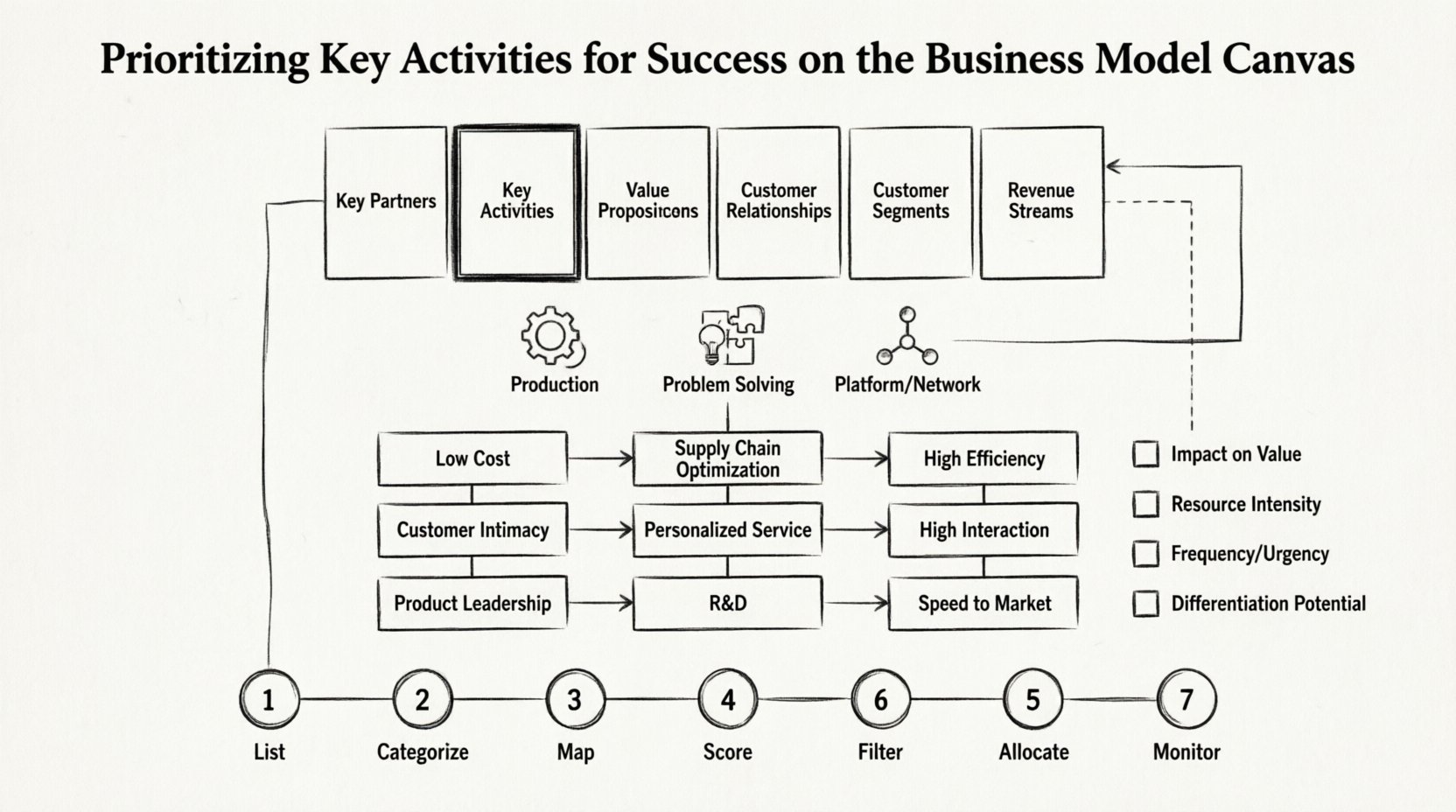
To prioritize effectively, one must first understand the types of activities involved. Generally, these fall into three distinct categories:
- Production: Designing, making, and delivering a product in substantial quantities and/or of superior quality. This is common in manufacturing, food processing, and automotive industries.
- Problem Solving: Creating new solutions to individual customer problems. This applies to consulting firms, hospitals, and law firms where every client interaction requires a customized approach.
- Platform/Network: Managing and maintaining platforms or networks. This is characteristic of software companies, payment processors, and social media platforms where the value lies in the connectivity and uptime of the system.
Identifying which category dominates your model is the first step in prioritization. A company cannot excel in all three simultaneously without significant resource dilution.
🧭 Alignment with Value Proposition
The most critical relationship in the Business Model Canvas is between Key Activities and the Value Proposition. Every activity listed should directly support the promise made to the customer. If an activity does not contribute to delivering value, it is a candidate for elimination or automation.
📊 Alignment Matrix
| Value Proposition | Required Key Activities | Prioritization Focus |
|---|---|---|
| Low Cost | Supply chain optimization, efficient manufacturing, lean staffing | High efficiency, low waste |
| Customer Intimacy | Personalized service, CRM management, direct feedback loops | High interaction, quality time |
| Product Leadership | R&D, innovation management, rapid prototyping | Speed to market, technical excellence |
When a business shifts its value proposition, the Key Activities must shift accordingly. For instance, moving from product leadership to low cost requires a drastic reduction in R&D activities and an increase in supply chain management activities. Failure to adjust the activity list leads to strategic dissonance.
🏗️ Strategic Prioritization Framework
Prioritization is the process of ranking activities based on their impact on the business model. This requires a disciplined approach to decision-making. Below is a framework for evaluating each potential activity.
1. Impact on Value Delivery
Does this activity directly result in the customer receiving the promised value? If the answer is no, the activity might be a support function rather than a key activity. Support functions (like HR or Accounting) are necessary but should not consume the majority of strategic bandwidth unless they are the source of the competitive advantage.
2. Resource Intensity
Every activity consumes resources. High-impact activities that require minimal resources are the highest priority. High-impact activities requiring massive resources must be scrutinized for efficiency. Low-impact activities that consume high resources are immediate candidates for outsourcing or removal.
3. Frequency and Urgency
Some activities are one-time events (e.g., launching a new product line), while others are continuous (e.g., server maintenance). Continuous activities require ongoing management and budgeting. One-time activities require project management structures. Prioritizing based on frequency helps in workforce planning.
4. Differentiation Potential
Does this activity allow the business to distinguish itself from competitors? If the activity is standard across the industry (e.g., basic logistics), it is a baseline requirement, not a differentiator. Prioritize activities that offer a unique competitive edge.
🔄 Integration with Other Canvas Blocks
Key Activities do not exist in isolation. They interact dynamically with other blocks on the canvas. Understanding these interactions is vital for holistic planning.
🔗 Key Activities and Key Resources
Key Activities determine the type of Key Resources needed. If the primary activity is Problem Solving, the key resource is human capital (skilled employees). If the primary activity is Production, the key resource is physical assets (machinery, facilities). Prioritizing activities clarifies investment priorities in resources.
🔗 Key Activities and Cost Structure
Costs are the result of performing activities. A cost structure is driven by the nature of Key Activities. Cost-driven businesses focus on minimizing costs in Key Activities (e.g., automation). Value-driven businesses focus on maximizing value in Key Activities (e.g., high-touch service). Knowing the priority of activities helps in predicting cost behavior.
🔗 Key Activities and Customer Relationships
Activities dictate the nature of customer interaction. Automated activities lead to self-service relationships. Personalized activities lead to personal assistance. Prioritizing the type of relationship desired dictates the activity mix.
🚧 Common Pitfalls in Activity Management
Even with a clear framework, organizations often stumble during execution. Awareness of common pitfalls helps in maintaining strategic focus.
- Activity Creep: Over time, non-essential tasks migrate into the Key Activities list. Regular audits are necessary to prune the list.
- Resource Misallocation: Spending too much time on low-impact activities. This often happens because low-impact activities are easier to measure or complete quickly.
- Ignoring External Dependencies: Focusing only on internal activities while neglecting supply chain or partner activities that are critical to the value chain.
- Static Planning: Treating the activity list as permanent. Market conditions change, requiring the pivot of key activities.
📉 Outsourcing vs. In-House Prioritization
One of the hardest decisions in prioritization is determining which activities to keep in-house and which to outsource. The decision should be based on core competency.
🟢 Keep In-House
- Activities that provide a competitive advantage.
- Activities that involve proprietary data or technology.
- Activities that require deep integration with the customer experience.
🔴 Outsource
- Commodity activities that do not differentiate the brand.
- Activities that require specialized skills not core to the business.
- Activities that are costlier to perform internally than by a specialist.
Outsourcing allows a company to focus its prioritization efforts on the activities that matter most to its specific value proposition. It is a strategic lever, not just a cost-saving measure.
📈 Measurement and Iteration
Once priorities are set, they must be measured. Without metrics, prioritization is merely opinion. Key Performance Indicators (KPIs) should be tied directly to the prioritized activities.
- Efficiency Metrics: Time to complete, cost per unit, error rates.
- Effectiveness Metrics: Customer satisfaction scores, retention rates, adoption rates.
- Strategic Metrics: Market share growth, innovation output, brand perception.
Regular reviews of these metrics allow the organization to iterate. If a prioritized activity is underperforming, the strategy must be adjusted. This creates a feedback loop that keeps the Business Model Canvas relevant over time.
🌐 Future-Proofing the Activity List
The business environment is volatile. Prioritization must account for future shifts, not just current needs. This involves scenario planning.
Ask the following questions to stress-test the activity list:
- How will automation change this activity?
- What happens if a key supplier fails?
- How will customer expectations evolve in the next 3-5 years?
- Are there regulatory changes that will impact this activity?
Building flexibility into the activity structure allows the business to adapt without a complete overhaul of the model. This might mean maintaining a hybrid approach (in-house + outsourced) to ensure resilience.
🛠️ Implementation Steps
To move from theory to practice, follow this structured approach:
- List All Activities: Brainstorm every action taken to deliver value.
- Categorize: Sort them into Production, Problem Solving, or Platform/Network.
- Map to Value Prop: Ensure each activity links to a value proposition statement.
- Score: Rate each activity based on Impact and Resource Intensity.
- Filter: Remove low-impact, high-cost activities.
- Allocate: Assign resources and responsibilities to the remaining prioritized activities.
- Monitor: Establish KPIs and schedule regular review cycles.
🤝 The Human Element
Finally, prioritize activities with the team in mind. Employees need clarity on what is important. If priorities are unclear, engagement drops. Communicating the prioritization logic helps align the workforce. It transforms the Business Model Canvas from a document into a shared roadmap.
Leadership must model the behavior. If leadership prioritizes speed in meetings but the Key Activities prioritize quality, confusion ensues. Consistency between stated priorities and actual behavior reinforces the strategic focus.
🏁 Summary of Strategic Focus
Prioritizing Key Activities is the bridge between strategy and execution. It requires a clear understanding of the business model’s core value, a disciplined framework for evaluation, and the courage to eliminate non-essential tasks. By aligning activities with the Value Proposition and managing the trade-offs between resources and impact, organizations can build a resilient and efficient operational model.
The process is iterative. As the market evolves, so too must the prioritization of activities. This dynamic approach ensures long-term viability and sustained performance without the need for constant reinvention.