Enterprise architecture provides the structural backbone for organizational change. When initiating a transformation, clarity regarding the sequence of changes is critical. ArchiMate offers a standardized language to describe these changes. Specifically, Implementation Events serve as the bridge between the abstract motivation layer and the concrete execution of business, application, and technology changes. This guide details how to utilize these events for effective planning.
Transformation is rarely a single action. It is a series of coordinated steps. Without a clear model, projects drift. Dependencies become hidden. Stakeholders lose alignment. Using a structured approach ensures that every initiative contributes to the overarching goals. This document explores the mechanics of Implementation Events and how they fit into the broader planning lifecycle.
Understanding the Motivation Layer 🎯
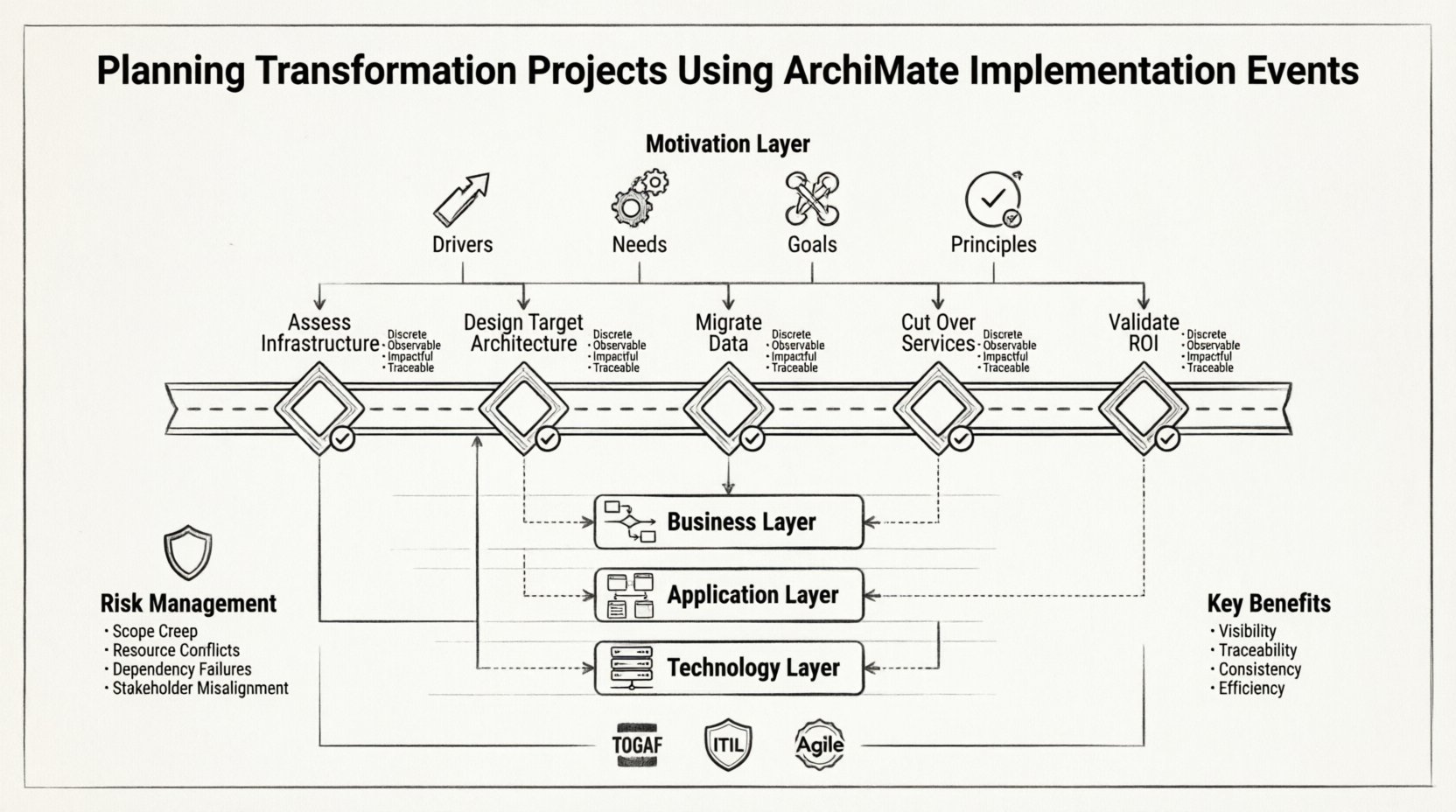
Before defining specific events, one must understand the drivers. The Motivation Layer in ArchiMate captures the reasons behind change. It includes principles, goals, needs, and drivers. These elements provide the context for why a transformation is necessary.
- Drivers: External or internal forces requiring action, such as regulatory changes or market shifts.
- Needs: Specific requirements that must be met to address the drivers.
- Goals: Measurable outcomes that address the needs.
- Principles: Rules and guidelines that constrain the design and execution.
Implementation Events are not isolated. They are realized by goals and driven by the underlying needs. A clear mapping ensures that every event has a purpose. If an event does not link back to a Goal or Need, it risks becoming unnecessary work.
The Role of Implementation Events 🚀
Implementation Events represent significant milestones in a transformation program. They are the moments where the state of the architecture changes. Unlike standard business processes, which describe daily operations, Implementation Events describe the transition itself.
These events are typically modeled in the Motivation Layer or the Application Layer. They act as triggers for other architectural elements. For example, an event might trigger the deployment of a new software module or the migration of a database.
Characteristics of a Valid Event
To be effective, an Implementation Event must possess specific attributes. It should be:
- Discrete: It marks a specific point in time.
- Observable: Its completion can be verified.
- Impactful: It causes a change in the architecture.
- Traceable: It links back to business goals.
When planning, architects must avoid vague milestones. “Complete the project” is too broad. “Deploy the payment gateway to production” is specific. The latter serves as a better Implementation Event.
Sequencing and Dependencies ⏳
Planning is fundamentally about sequence. Transformation projects involve multiple work streams. These streams cannot proceed in isolation. Dependencies dictate the order of operations. ArchiMate modeling helps visualize these relationships.
There are two primary types of relationships to consider:
- Realization: An Implementation Event realizes a Goal.
- Assignment: An Implementation Event is assigned to a specific resource or capability.
Dependencies between events are often represented using flow relationships. If Event A must finish before Event B begins, a flow connects them. This creates a roadmap. The roadmap allows project managers to identify critical paths.
Consider the following scenario regarding a cloud migration:
- Event 1: Assess current infrastructure.
- Event 2: Design target architecture.
- Event 3: Migrate data.
- Event 4: Cut over services.
Each step relies on the success of the previous one. Modeling this flow prevents scheduling conflicts. It also highlights where resources are concentrated. This visibility is essential for risk management.
Mapping Events to Architecture Layers 📊
Implementation Events do not exist in a vacuum. They impact the Business, Application, and Technology layers. Understanding the ripple effect is crucial for stability.
The table below illustrates how a single event can affect multiple layers simultaneously.
| Layer | Impact of Implementation Event | Example Activity |
|---|---|---|
| Business | Process changes or organizational restructuring | Training staff on new workflows |
| Application | Software updates or integration changes | Deploying new API endpoints |
| Technology | Infrastructure configuration or hardware updates | Provisioning new servers |
| Strategy | Alignment with business goals | Validating ROI on the change |
When planning, architects must verify that the Implementation Event supports the Business Layer. If the Technology Layer changes without Business Layer support, the investment may not yield value. The Motivation Layer acts as the anchor here.
Risk Management in Architecture 🛡️
Every transformation carries risk. Poor planning amplifies these risks. ArchiMate modeling helps identify potential failure points before execution begins.
Key risks associated with Implementation Events include:
- Scope Creep: Adding unconnected events to the plan.
- Resource Conflicts: Multiple events requiring the same team simultaneously.
- Dependency Failures: One event blocking others due to technical debt.
- Stakeholder Misalignment: Different groups expecting different outcomes.
To mitigate these risks, architects should conduct regular reviews of the model. This involves checking if the events still align with current business needs. Markets change. Technology evolves. The plan must adapt.
Identification of Risks
Risk identification is a systematic process. It involves:
- Reviewing the dependency graph for single points of failure.
- Analyzing the resources assigned to each event.
- Consulting with technical leads regarding feasibility.
- Validating goals against the budget available.
Documenting these risks allows for contingency planning. If Event A fails, what is the fallback? The model should reflect alternative paths where possible.
Integration with Existing Standards 📐
Transformation does not happen in isolation. It integrates with existing standards and frameworks. ArchiMate is designed to be compatible with other methodologies.
- TOGAF: The Architecture Development Method (ADM) often uses ArchiMate for visualization.
- ITIL: Service management processes can be linked to Implementation Events.
- Agile: Events can be broken down into sprints and iterations.
Aligning with these standards ensures consistency. It allows for better communication with project management offices. It also facilitates audit trails. Compliance requirements often demand evidence of planning. The ArchiMate model serves as that evidence.
Practical Considerations for Architects 🛠️
Creating a model is one task. Maintaining it is another. Architects must ensure the model remains accurate throughout the project lifecycle.
Model Maintenance
Static models become obsolete quickly. Implementation Events should be updated as the project progresses. Changes in scope must be reflected in the diagram. This ensures that everyone is looking at the same reality.
- Version Control: Keep records of model changes.
- Access Control: Ensure only authorized personnel can modify the architecture.
- Reviews: Schedule periodic reviews with stakeholders.
Communication
The model is a communication tool. It must be understandable to non-technical stakeholders. Avoid unnecessary complexity. Use standard notation. Ensure that the Motivation Layer is visible to business leaders.
When presenting the plan, focus on the value. Explain how the events drive goals. Do not get bogged down in technical details unless requested. Keep the narrative focused on business outcomes.
Common Pitfalls to Avoid ⚠️
Experience shows that certain mistakes occur frequently during planning. Being aware of them helps prevent delays.
- Over-Modeling: Creating too many events for small changes.
- Under-Modeling: Missing critical dependencies between layers.
- Ignoring the Motivation Layer: Focusing only on technology and missing the “why”.
- Lack of Ownership: No clear assignment of events to teams.
Balance is key. The model should be detailed enough to be useful, but simple enough to be manageable. Start with the high-level goals. Then refine the events as more information becomes available.
Summary of Benefits ✅
Using ArchiMate Implementation Events for planning offers distinct advantages. It provides clarity. It reduces risk. It aligns stakeholders. It ensures that every change serves a purpose.
- Visibility: Everyone sees the roadmap.
- Traceability: Every event links to a goal.
- Consistency: Standard notation across the organization.
- Efficiency: Reduced rework due to better planning.
Transformations are complex. They require rigorous planning. ArchiMate provides the tools to manage this complexity. By focusing on Implementation Events, architects can guide organizations through change with confidence.
The path forward involves continuous improvement. As projects complete, lessons should be fed back into the model. This creates a living architecture that evolves with the business. It turns the planning process into a strategic asset rather than a bureaucratic hurdle.
Adopting this approach requires discipline. It requires a commitment to accuracy. However, the reward is a transformation that is delivered on time, within budget, and aligned with business needs. This is the essence of effective enterprise architecture.
Start by reviewing your current goals. Identify the gaps. Define the events needed to close them. Map the dependencies. Assign the resources. Then execute. The structure is there. The responsibility is yours.