Startups operate in environments defined by volatility and uncertainty. What works today may fail tomorrow. The ability to recognize these shifts and adapt quickly is often the difference between survival and failure. This adaptation is known as a pivot. It is not a sign of weakness, but a strategic maneuver based on data and learning.
To navigate this process effectively, founders need a structured framework. The Business Model Canvas (BMC) provides this structure. It visualizes the logic of how a company creates, delivers, and captures value. By using the BMC as a living document rather than a static artifact, teams can systematically test new hypotheses and reconfigure their business model without losing sight of the core mission.
This guide explores how to leverage the Business Model Canvas to execute a pivot. We will examine the nine building blocks, identify signals for a shift, and outline a methodical approach to changing direction while maintaining operational stability.
🧩 Understanding the Business Model Canvas Structure
Before executing a pivot, it is essential to understand the components that make up the canvas. The framework consists of nine distinct building blocks. Each block represents a critical aspect of the business. When a pivot occurs, usually only one or two blocks change significantly, but the impact ripples across the entire model.
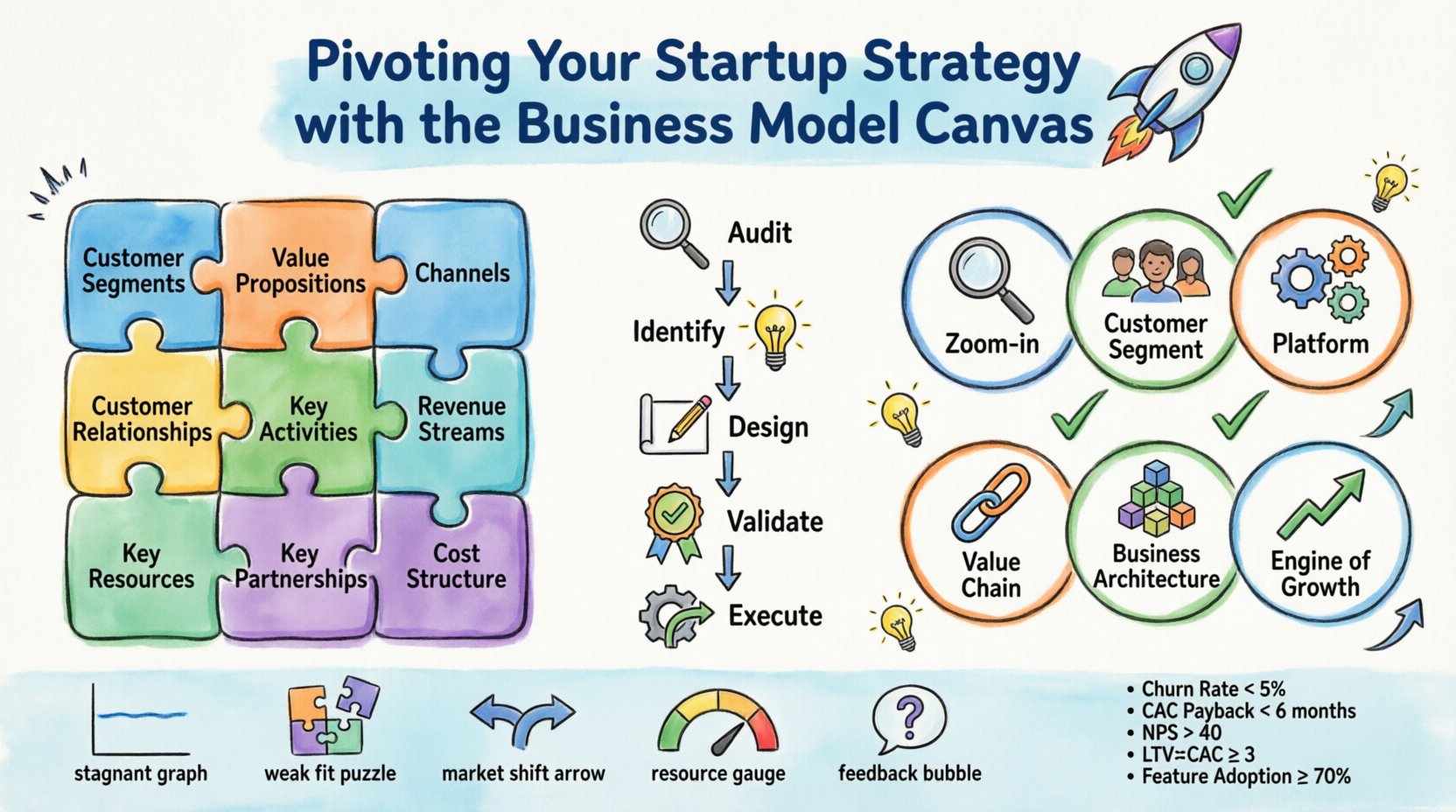
Customer Segments: Who are you creating value for? Is it a mass market, a niche, or an enterprise client?
Value Propositions: What problem are you solving? What bundle of products and services are you offering?
Channels: How do you reach your customer segments? Is it direct sales, online platforms, or retail partners?
Customer Relationships: What type of relationship does each segment expect? Is it personal assistance, self-service, or automated?
Revenue Streams: How does the business earn money? Through asset sales, subscription fees, licensing, or advertising?
Key Activities: What strategic actions are required to make the business model work? Production, problem-solving, or platform management?
Key Resources: What physical, intellectual, human, or financial assets are required? Data, patents, or skilled staff?
Key Partnerships: Who are your suppliers and partners? What resources can you acquire from them?
Cost Structure: What are the most important costs inherent in your business model? Fixed costs, variable costs, or economies of scale?
A pivot typically involves changing the Value Proposition to fit a different Customer Segment, or altering the Revenue Stream to better match the Cost Structure. Understanding these connections is vital for a successful transition.
🚩 Recognizing the Need for a Pivot
Deciding to pivot is rarely a single moment. It is often the result of accumulating evidence that the current strategy is not meeting expectations. Waiting too long can drain resources and morale. Waiting too soon can lead to unnecessary disruption.
Here are the primary indicators that suggest a strategic shift is necessary:
Stagnant Growth Metrics: Customer acquisition costs are rising while retention remains flat. Engagement rates have plateaued despite increased marketing spend.
Weak Product-Market Fit: Users adopt the product initially but do not continue using it. Churn rates are higher than industry benchmarks.
Market Shifts: Competitors introduce features that render your offering obsolete. Regulatory changes impact your cost structure or access to certain customer segments.
Resource Constraints: The current model requires capital that is unavailable or too expensive to sustain.
Feedback Loops: Direct feedback from early adopters indicates they are using the product in a way you did not anticipate, often suggesting a better opportunity lies there.
When these signals appear, the Business Model Canvas becomes a diagnostic tool. You map your current reality onto the nine blocks to identify exactly where the friction lies.
🛠 The Pivot Process Using the Canvas
A pivot is not a random change. It requires a hypothesis-driven approach. You assume a specific part of the model is broken and propose a fix. The canvas allows you to visualize this hypothesis before committing resources.
Step 1: Audit the Current Model
Fill out the canvas with your current reality. Be honest about where the model is failing. Use data to inform each block. Do not guess. If you are unsure about your Cost Structure, analyze your burn rate. If you are unsure about Channels, look at your conversion rates.
Step 2: Identify the Core Assumption to Test
Which block is holding the model back? Is it the Value Proposition that is not resonating? Or perhaps the Customer Segment is too small to sustain growth. Isolate this variable. This becomes your pivot focus.
Step 3: Design the New Hypothesis
Create a second canvas. This represents the future state. Keep the blocks that are working. Modify the blocks that need change. Ensure the connections between the blocks remain logical. For example, if you change the Customer Segment, you must also adjust the Channels and Value Proposition to match their new needs.
Step 4: Validate Before Full Implementation
Do not switch the entire business overnight. Test the new configuration with a subset of the market. Use landing pages, mockups, or limited beta releases to gauge interest. Measure the results against your original metrics.
Step 5: Execute the Shift
Once validation confirms the new model has potential, reallocate resources. Update internal documentation. Communicate the change to the team and stakeholders. Update the canvas to reflect the new operational reality.
📊 Common Pivot Types Mapped to Canvas Blocks
There are several recognized patterns for pivoting. Each pattern targets specific blocks within the Business Model Canvas. Understanding these patterns helps in categorizing the strategic shift.
Pivot Type | Focus Block Change | Description |
|---|---|---|
Zoom-in Pivot | Value Proposition / Key Activities | A single feature becomes the whole product. The team realizes a specific feature solves the problem better than the full suite. |
Customer Segment Pivot | Customer Segments | The product works, but the original target audience is not adopting it. You shift focus to a different group that finds value. |
Platform Pivot | Key Activities / Channels | Changing from a product to a platform, or vice versa. This alters the Key Activities and Revenue Streams significantly. |
Value Chain Pivot | Key Partnerships / Key Activities | Moving upstream or downstream in the supply chain. Taking control of distribution or manufacturing that was previously outsourced. |
Business Architecture Pivot | Cost Structure / Revenue Streams | Switching from high-touch, high-cost to low-touch, low-cost models (or vice versa). Often changes the operational scale. |
Engine of Growth Pivot | Channels / Customer Relationships | Shifting from a viral growth engine to a sticky customer engine, or from paid acquisition to organic search. |
When selecting a pivot type, refer to the table above to ensure you are addressing the root cause. A Zoom-in pivot might solve a Value Proposition issue, but it will not fix a problem related to Customer Segments.
🎯 Validating the New Model
After designing the new canvas, validation is critical. You must prove that the new configuration generates value. This phase is about risk reduction.
Define Success Metrics: What does success look like? Is it a specific conversion rate? A certain monthly recurring revenue? Define these clearly.
Run Experiments: Create minimal viable tests. If you are pivoting the Customer Segment, run targeted marketing campaigns to that group. If you are pivoting the Revenue Stream, test a pricing page.
Analyze Feedback: Collect qualitative data. Why did they say yes? Why did they say no? Use this to refine the canvas blocks further.
Compare Costs: Ensure the new Cost Structure is sustainable. A new Value Proposition might require different Key Resources, impacting the bottom line.
Validation is not a one-time event. It is a continuous loop. As you gather data, update the canvas. The document should evolve alongside the business.
🤝 Managing Team Dynamics During a Pivot
A pivot can be disorienting for a team. People build emotional attachments to the original idea. Communication is the bridge between the old model and the new one.
Transparency is key. Share the data that prompted the pivot. Explain the reasoning behind the change in the Business Model Canvas. When team members understand the why, they are more likely to embrace the how.
Realign Roles: If Key Activities change, job descriptions may need to update. Ensure everyone knows their new responsibilities.
Preserve Culture: While strategy changes, the core values of the organization should remain stable. This provides continuity during the transition.
Celebrate Small Wins: Validation experiments may yield small results initially. Acknowledge these. It builds momentum for the larger shift.
⚠️ Risks and Mitigation Strategies
Pivoting carries inherent risks. The new model might fail. Resources spent on the old model might be sunk costs. It is important to manage these risks proactively.
Risk: Loss of Core Competency. Moving away from what the team does best can be dangerous. If your team excels at engineering but you pivot to a sales-heavy model, you may struggle. Mitigate this by retaining core strengths in the new model.
Risk: Brand Confusion. Changing the Value Proposition can confuse customers. They might not understand what you do now. Mitigate this by maintaining clear communication through your Channels.
Risk: Cash Runway. A pivot often requires upfront investment. Validate quickly to avoid burning through capital. Keep the Cost Structure lean during the testing phase.
Risk: Team Burnout. Constant strategy shifts can exhaust staff. Ensure there is a clear timeline for the pivot process. Once the decision is made, commit to the new path for a defined period before re-evaluating.
📈 Measuring Success Post-Pivot
How do you know the pivot worked? You need to monitor the new Business Model Canvas over time. This involves tracking specific metrics tied to the blocks that changed.
Customer Segments: Track acquisition, activation, and retention rates for the new group.
Value Propositions: Monitor Net Promoter Score (NPS) and feature adoption rates.
Revenue Streams: Watch for changes in Average Revenue Per User (ARPU) and Lifetime Value (LTV).
Key Activities: Measure efficiency and output quality.
Cost Structure: Monitor burn rate and unit economics.
Set regular review intervals. Monthly or quarterly reviews allow you to spot trends early. If the metrics do not improve within a set timeframe, you may need to iterate on the canvas again. The business model is never truly finished; it is always a work in progress.
💡 Practical Application: A Scenario
Consider a software startup that built a project management tool for large enterprises. They struggled to get sales and churn was high. The Cost Structure was high due to heavy sales teams.
Using the canvas, they identified the issue. The Value Proposition was too complex for the intended Customer Segment. They decided to pivot to the Customer Segment Pivot.
They shifted focus to small remote teams. This changed the Channels to digital marketing. It changed the Revenue Stream to a self-service subscription. It altered the Key Activities from enterprise support to product development.
They tested this on a beta group. Engagement doubled. They updated the canvas and reallocated the sales team to customer success. This shift saved the company from insolvency and positioned them for growth.
🌟 Conclusion on Strategic Agility
The Business Model Canvas is more than a planning tool. It is a dynamic map for navigating uncertainty. When a startup pivots, it is not abandoning its vision; it is refining the path to achieve it. By systematically analyzing the nine blocks, validating changes, and managing team dynamics, founders can steer their companies through complex market shifts.
Success lies in the willingness to learn and the discipline to test. Keep the canvas visible. Update it often. Let the data guide the strategy. In the volatile world of startups, adaptability is the most valuable asset you possess.
📝 Frequently Asked Questions
Can I pivot multiple times?
Yes. Startups often pivot more than once. However, frequent pivoting without validation can lead to a lack of focus. Ensure each pivot is data-driven and addresses a specific bottleneck.
Does pivoting mean the original idea was wrong?
Not necessarily. The original idea might have been valid, but the market context changed, or the initial assumptions about the customer were incomplete. A pivot is an evolution, not a failure.
How often should I update the Business Model Canvas?
Update it whenever there is a significant change in strategy, customer feedback, or market conditions. For early-stage startups, a monthly review is recommended.
What if the team resists the pivot?
Involve the team in the process. Use the canvas as a collaborative tool. When everyone contributes to the new model, ownership increases. Explain the data that supports the change to reduce emotional resistance.
Is a pivot different from a rebrand?
Yes. A rebrand changes the visual identity. A pivot changes the underlying business model. You can do both, but a pivot requires structural changes to how value is created and captured.