Organizations often face a fragmented landscape where departments operate in isolation. Business units develop strategies without understanding technical constraints, while IT teams build systems without clear alignment to business goals. This disconnect creates inefficiencies, delays, and redundant efforts. To bridge this gap, enterprises turn to structured frameworks. The Open Group Architecture Framework (TOGAF) offers a robust methodology for aligning diverse teams. It provides a common language and a repeatable process that facilitates deep cooperation across functions. This guide explores how TOGAF serves as a catalyst for cross-functional team collaboration.
🔗 The Role of Enterprise Architecture in Breaking Silos
Enterprise Architecture (EA) is often misunderstood as a bureaucratic exercise in documentation. In reality, it is a discipline focused on the alignment of strategy and execution. When implemented correctly, TOGAF transforms architecture from a gatekeeping function into a collaborative engine. It enables stakeholders from finance, operations, development, and security to see the big picture.
The core value lies in the shared vision. TOGAF establishes a standardized way to describe the organization’s current state and its desired future state. This standardization removes ambiguity. When a product manager speaks about a new feature, and an architect speaks about the same feature using TOGAF artifacts, they are discussing the same concept. This shared vocabulary is the foundation of effective collaboration.
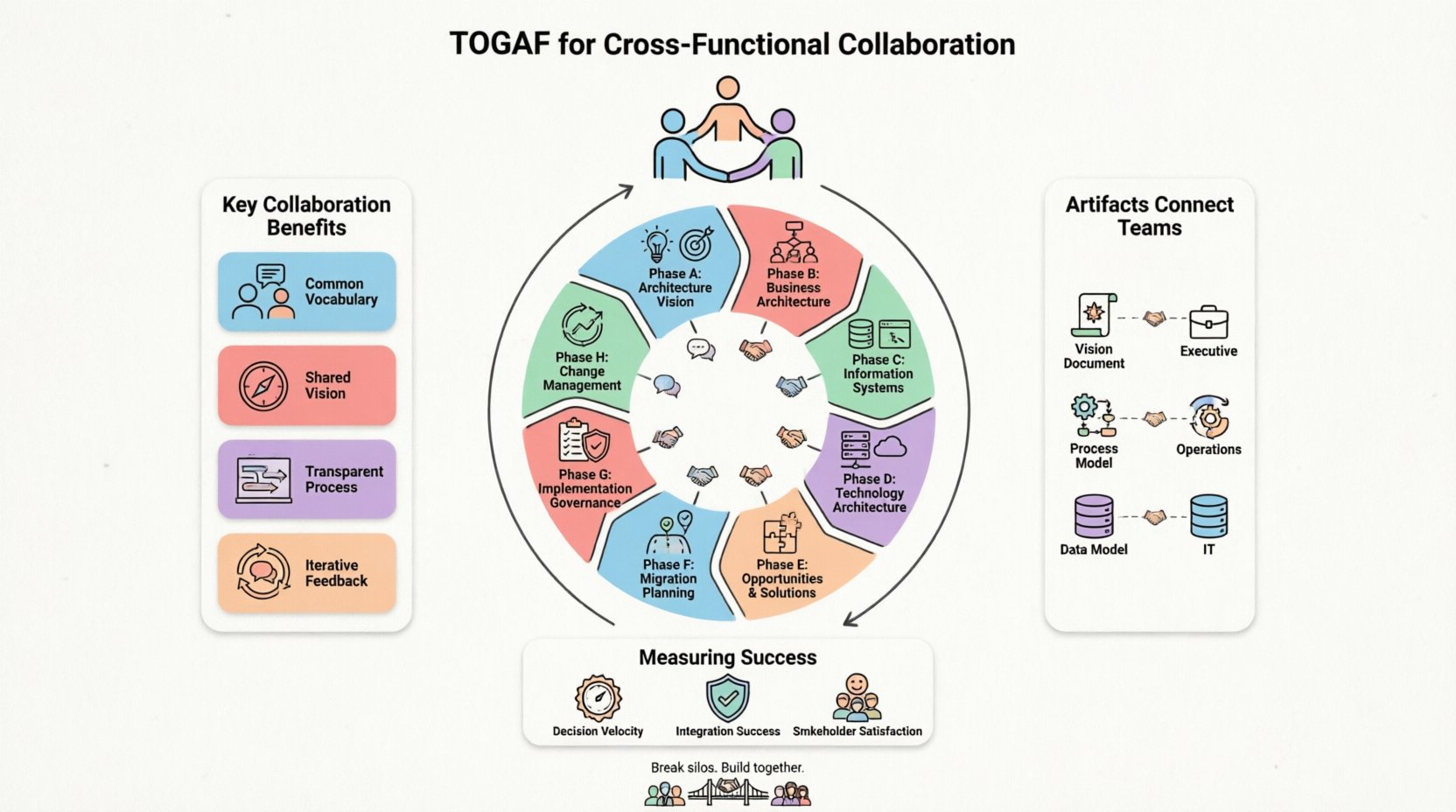
- Common Vocabulary: Reduces miscommunication between technical and non-technical staff.
- Shared Vision: Ensures all departments move toward the same strategic goals.
- Transparent Process: Makes decision-making visible to all relevant stakeholders.
- Iterative Feedback: Allows teams to adjust plans based on input from other functions.
🔄 The Architecture Development Method (ADM) as a Collaboration Engine
The Architecture Development Method (ADM) is the heart of TOGAF. It is a cyclical process used to develop, manage, and maintain an enterprise architecture. While often viewed as a technical workflow, the ADM is fundamentally a project management and governance tool that requires constant interaction between cross-functional teams. Each phase of the ADM mandates specific stakeholder engagements, ensuring that no group is left out of the decision-making loop.
Phase A: Architecture Vision
This phase sets the scope and context for the project. It is critical for establishing buy-in from senior leadership and key business stakeholders. The goal is to define what the organization wants to achieve and why. Collaboration here is essential to validate the business need against available resources.
- Stakeholder Engagement: Leaders from various departments review the vision statement.
- Scope Definition: Determines which business units are in scope and which are out.
- Constraints Identification: Legal, regulatory, and budgetary limits are identified early.
Phase B: Business Architecture
Here, the focus shifts to defining the business strategy, governance, function, and business processes. This requires deep involvement from business analysts and operational managers. The architecture team works alongside business units to map out how the organization creates value.
- Process Mapping: Collaborates with operations to understand current workflows.
- Capability Analysis: Identifies gaps in current business capabilities.
- Strategy Alignment: Ensures business goals are feasible within the current structure.
Phase C: Information Systems Architectures
This phase is divided into Data Architecture and Application Architecture. It is where the collaboration between IT teams and business units becomes most granular. Data teams must understand how information flows through the business, while application teams determine what software supports those flows.
- Data Standards: Finance and IT agree on data definitions and ownership.
- Application Rationalization: Identifies redundant systems across different departments.
- Integration Planning: Ensures new apps can talk to legacy systems securely.
Phase D: Technology Architecture
The Technology Architecture defines the hardware, software, and network infrastructure required to support the data and application architectures. This phase heavily involves infrastructure teams, security officers, and procurement.
- Infrastructure Capacity: Operations teams assess if current hardware supports the new design.
- Security Compliance: Security teams validate that the architecture meets safety standards.
- Vendor Management: Procurement works with architects to select compatible technology.
Phase E: Opportunities and Solutions
This phase involves identifying major implementation projects and defining the migration strategy. It requires coordination between project management offices (PMO), finance, and delivery teams. The goal is to prioritize work based on business value and technical readiness.
- Project Prioritization: Business and IT agree on which initiatives deliver the most value first.
- Resource Allocation: Finance and HR align on staffing and budgeting.
- Risk Assessment: All teams contribute to identifying potential project blockers.
Phase F: Migration Planning
Migration planning details the transition from the baseline architecture to the target architecture. This is a complex logistical exercise that requires input from change management, training, and operations teams.
- Transition Roadmaps: Project managers create timelines that respect business cycles.
- Impact Analysis: Operations teams assess how changes will affect daily work.
- Training Needs: HR and Learning & Development identify skill gaps.
Phase G: Implementation Governance
During implementation, the architecture must be monitored to ensure compliance with the design. This involves ongoing collaboration between the architecture team and the delivery teams. It is a feedback loop that ensures the build matches the plan.
- Compliance Audits: Architects review deliverables against standards.
- Deviation Management: If teams deviate from the plan, they must justify and document the change.
- Quality Assurance: Ensures the final product meets architectural requirements.
Phase H: Architecture Change Management
The final phase deals with changes to the architecture after implementation. It ensures that the architecture evolves as the business evolves. This requires a governance board that includes representatives from all key functions.
- Change Requests: Any modification to the architecture must go through a review process.
- Impact Assessment: Evaluates the cost and risk of proposed changes.
- Continuous Improvement: Updates the architecture repository with lessons learned.
📋 Mapping Artifacts to Stakeholder Groups
One of the strongest aspects of TOGAF is its repository of artifacts. These documents and diagrams serve as communication tools. They translate complex architectural concepts into formats that specific stakeholder groups can understand. Using a table to map these artifacts helps clarify responsibilities.
| Artifact Category | Primary Audience | Purpose in Collaboration |
|---|---|---|
| Architecture Vision Document | Executive Leadership | Aligns high-level strategy across departments. |
| Business Process Model | Operations & Business Analysts | Clarifies workflow dependencies between teams. |
| Data Model | Data Engineers & Analysts | Ensures consistent data definitions across systems. |
| Application Portfolio | IT Managers & Developers | Identifies software redundancies and gaps. |
| Technology Infrastructure Map | Infrastructure & Security Teams | Visualizes network and hardware dependencies. |
| Migration Plan | Project Managers | Schedules work to minimize business disruption. |
| Implementation Governance Plan | QA & Compliance Officers | Defines rules for adherence during build phases. |
🛡️ Governance and Compliance Across Functions
Collaboration does not happen in a vacuum. It requires governance structures that enforce accountability without stifling innovation. TOGAF provides an Architecture Governance Framework that defines how decisions are made and who has the authority to make them. This framework ensures that cross-functional teams adhere to agreed-upon standards.
Governance in TOGAF is not about saying “no.” It is about ensuring that decisions made by one team do not negatively impact another. For example, a marketing team might want to launch a campaign that requires a new data platform. The architecture governance board ensures that this platform aligns with security policies and data privacy regulations managed by the legal and security teams.
- Decision Rights: Clearly defines who approves what, preventing bottlenecks.
- Compliance Checks: Regular audits ensure all teams follow standards.
- Conflict Resolution: Provides a mechanism to resolve disputes between departments.
- Transparency: Decisions and rationales are documented and accessible.
🌱 Building a Collaborative Culture with Architecture
Tools and processes are only effective if the culture supports them. TOGAF encourages a culture of shared responsibility. When teams understand that their work is part of a larger ecosystem, they become more mindful of how their decisions affect others. This cultural shift is often more difficult than implementing the technical framework.
Architecture communities of practice are a great way to foster this culture. These are groups where architects from different domains meet regularly to discuss challenges and share knowledge. They act as a bridge between the formal process and the daily work of the teams.
Key Cultural Drivers
- Open Communication: Encourages teams to share problems early rather than hiding them.
- Shared Ownership: Teams view the architecture as a collective asset rather than a personal project.
- Continuous Learning: Regular workshops and training keep skills up to date across functions.
- Feedback Loops: Post-implementation reviews allow teams to learn from successes and failures.
⚠️ Overcoming Common Barriers to Collaboration
Even with a robust framework like TOGAF, organizations face barriers to collaboration. Understanding these challenges allows leaders to proactively address them. Common issues include resistance to change, lack of visibility, and resource constraints.
1. Resistance to Standardization
Teams often prefer their own ways of working. TOGAF introduces standards that may feel restrictive. To overcome this, emphasize how standards reduce rework and technical debt. Show teams how following the framework saves time in the long run.
2. Lack of Visibility
If teams cannot see the impact of their work on others, they will not collaborate. Use the architecture repository to make information accessible. Dashboards and visualizations can help non-technical staff understand the architecture.
3. Resource Constraints
Collaboration takes time. If teams are understaffed, they may view architecture activities as overhead. Secure executive sponsorship to ensure that architecture time is recognized as billable or productive work.
4. Siloed Knowledge
Knowledge often resides in the heads of individuals rather than in the repository. Encourage documentation as part of the delivery process. Use peer reviews to ensure knowledge is transferred.
📈 Measuring Collaboration Success
To ensure that TOGAF is effectively driving collaboration, organizations need metrics. These metrics should reflect improved communication, reduced redundancy, and faster delivery. Tracking these indicators helps demonstrate the value of the framework.
- Decision Velocity: How long does it take to get approval for architectural changes?
- Rework Rate: How often is work done because it did not align with standards?
- Stakeholder Satisfaction: Surveys from business and IT leaders on their experience with the process.
- Integration Success: Percentage of projects that integrate smoothly with existing systems.
- Documentation Adherence: Rate of compliance with required architecture artifacts.
🚀 Conclusion
Leveraging TOGAF for cross-functional team collaboration is about more than just drawing diagrams. It is about creating a structured environment where diverse teams can work together effectively. By using the Architecture Development Method, organizations can ensure that every phase of a project involves the right people. By utilizing standard artifacts, they can ensure that everyone is speaking the same language. By establishing governance, they can ensure that decisions are made transparently.
The journey toward better collaboration is continuous. It requires commitment from leadership and participation from all levels of the organization. When TOGAF is applied with a focus on people and process, it becomes a powerful tool for organizational alignment. It turns fragmented efforts into a cohesive strategy, driving value and efficiency across the enterprise.
Start by assessing your current collaboration maturity. Identify where silos exist and where communication breaks down. Apply the relevant phases of the ADM to those areas. Engage stakeholders early and often. Over time, the structure provided by TOGAF will become second nature, enabling your teams to innovate faster and with greater confidence.