
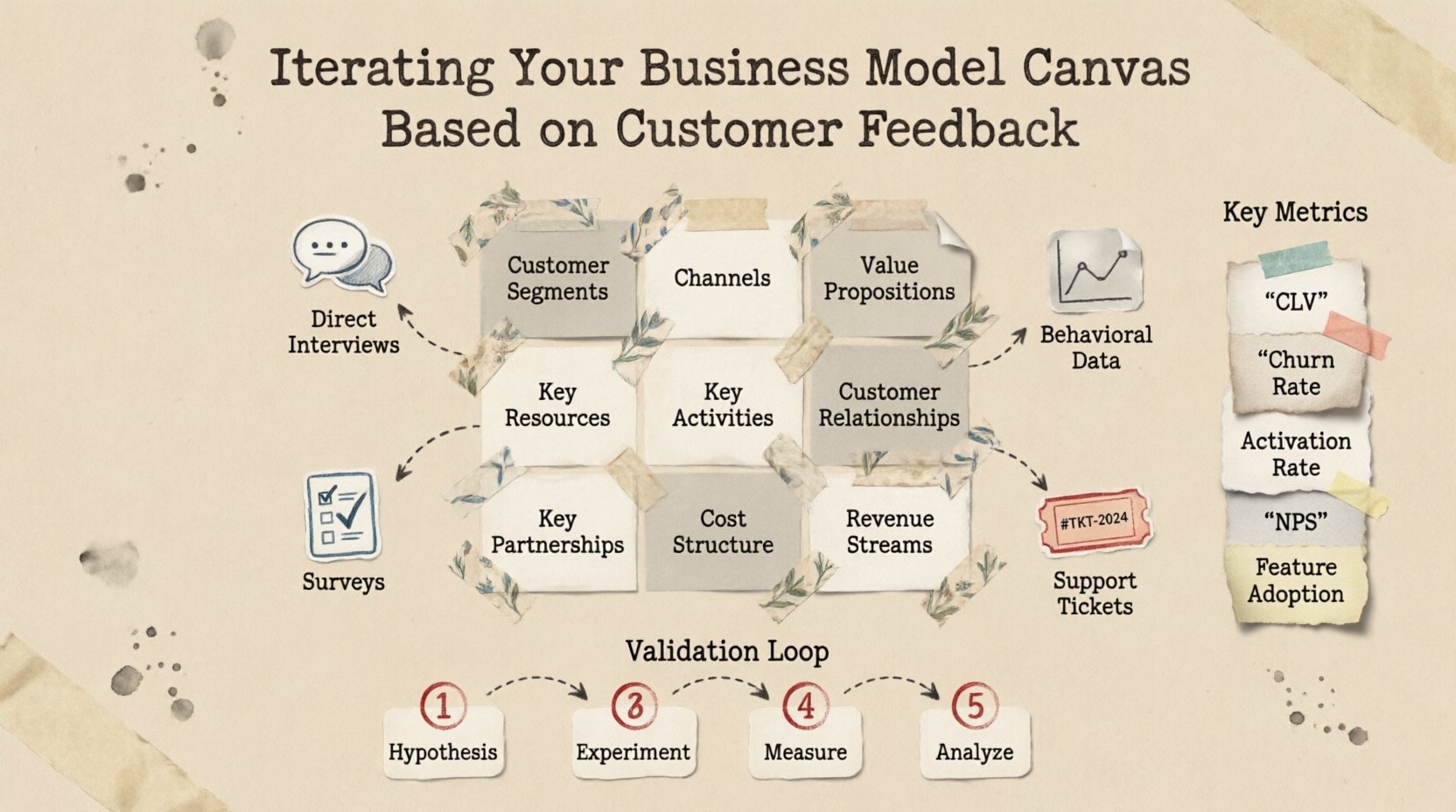
Building a sustainable business requires more than just a great idea. It demands a structure that can bend without breaking. The Business Model Canvas (BMC) provides that structure, a visual chart with elements describing a firm’s value proposition, infrastructure, customers, and finances. However, a canvas is rarely static. It is a living document that must evolve alongside market realities. When customer feedback enters the equation, the canvas shifts from a planning tool into a strategic compass.
This guide explores how to systematically iterate your Business Model Canvas using real-world data. We will look at the mechanics of feedback loops, how to map insights to specific canvas blocks, and the steps required to validate changes without losing momentum. By the end of this process, you will have a framework for continuous improvement grounded in actual user behavior rather than assumptions.
🧩 Understanding the Foundation: The Nine Blocks
Before diving into iteration, it is necessary to revisit the core components. The BMC consists of nine building blocks. Each block represents a key aspect of your business model. When feedback arrives, it usually targets one or more of these specific areas. Knowing which block is affected allows for precise adjustments.
- Customer Segments: Who are you creating value for? Which needs are you satisfying?
- Value Propositions: What bundle of products and services are you offering to a specific customer segment?
- Channels: How do you reach your customer segments to deliver your value proposition?
- Customer Relationships: What type of relationship does each customer segment expect you to establish?
- Revenue Streams: For what value are your customers really willing to pay?
- Key Resources: What key resources are required to make a business model work?
- Key Activities: What key activities does your value proposition require?
- Key Partnerships: Who are your key suppliers and partners?
- Cost Structure: What are the most important costs inherent in your business model?
Iterating the canvas means revisiting these blocks not based on intuition, but on evidence. When a customer says, “I wish this feature was easier to find,” you are receiving data regarding Channels or Value Proposition. When they say, “The price is too high for the value,” that targets Revenue Streams and Value Propositions simultaneously.
📡 Gathering Feedback: Methods and Sources
Feedback is data. The quality of your iteration depends on the quality of your data collection. Relying on a single source can lead to bias. A robust approach involves triangulating information from various touchpoints. Here are the primary methods for gathering actionable insights.
1. Direct Interviews
One-on-one conversations provide depth. They allow you to ask “why” multiple times. This method is excellent for understanding the emotional drivers behind customer decisions.
- Schedule sessions with both active and churned users.
- Focus on their goals, not your product features.
- Record the conversation (with permission) to catch nuances.
2. Behavioral Data
What users say often differs from what they do. Analyzing usage patterns reveals friction points that interviews might miss.
- Track drop-off points in your user journey.
- Monitor feature adoption rates.
- Review session duration and frequency.
3. Surveys and Questionnaires
Quantitative data helps validate qualitative findings. Use surveys to measure sentiment across a larger population.
- Keep questions short and focused.
- Ask about satisfaction scores (NPS) and specific usability issues.
- Segment results by user type to find specific pain points.
4. Support Tickets and Logs
Customer support interactions are goldmines for identifying recurring problems. These logs represent users who encountered a barrier strong enough to seek help.
- Categorize tickets by topic (billing, technical, feature request).
- Look for trends rather than individual outliers.
- Identify the root cause of frequent complaints.
🗺️ Mapping Feedback to Canvas Blocks
Once feedback is collected, the next step is categorization. Not all feedback is equal. Some points require minor tweaks, while others necessitate a pivot in the entire model. The following table illustrates how specific types of feedback map to the nine blocks of the Business Model Canvas.
| Feedback Type | Impact on BMC Block | Example Insight |
|---|---|---|
| Price Sensitivity | Revenue Streams | Users feel the tier is too expensive for the features provided. |
| Feature Complexity | Value Proposition | Customers want a simplified version of the core offering. |
| Discovery Issues | Channels | Users cannot find the sign-up page despite ads. |
| Support Delays | Customer Relationships | Users expect immediate help during business hours. |
| Integration Needs | Key Activities | The product must connect with existing internal tools. |
| Reliability Concerns | Key Resources | Users require higher uptime guarantees than currently offered. |
| Partner Limitations | Key Partnerships | Current vendors cannot scale with the user base. |
| Cost Overruns | Cost Structure | Operational costs are eating into margins due to inefficiency. |
Using this mapping, you can prioritize which parts of the canvas need immediate attention. A change in Value Proposition might require a corresponding shift in Channels or Customer Relationships. The blocks are interconnected.
🛠️ Deep Dive: Iterating Specific Blocks
Let us examine how to iterate specific blocks based on feedback scenarios. This section breaks down the practical application of these changes.
Iterating Value Propositions
The value proposition is the heart of the business. If customers do not see the value, the rest of the model collapses. Feedback often highlights a gap between what you offer and what they need.
- Feature Bloat: If users find the product overwhelming, simplify the core offer. Remove low-usage features to clarify the main benefit.
- Missing Capabilities: If the market demands a specific capability, assess if it fits your core value or if it is a distraction. Sometimes adding a feature dilutes the brand.
- Positioning Shift: Feedback might reveal that your product solves a different problem than intended. If users are using your tool for a secondary purpose, consider making that the primary value proposition.
Iterating Channels
Channels are how you reach your customers. Feedback here usually relates to accessibility or usability.
- Platform Preference: If mobile users report issues, shift focus to mobile-first design or app development.
- Communication Style: If customers prefer email over chat, adjust the Customer Relationship block to match Channel preferences.
- Trust Signals: If users hesitate to convert, add testimonials or case studies to the landing page channel to build credibility.
Iterating Revenue Streams
Pricing models are often the most sensitive area. Feedback here dictates how you monetize value.
- Pricing Tiers: If users want to pay less for less, introduce a freemium or lower-tier option.
- Subscription Fatigue: If customers resist recurring payments, consider a one-time license or usage-based billing.
- Value Perception: If users feel they are overpaying, you must either increase the perceived value (better service) or decrease the price.
Iterating Customer Relationships
This block defines the type of interaction you have with each segment. Feedback indicates whether the current relationship model is sustainable.
- Self-Service vs. Human: If users prefer solving issues themselves, invest in knowledge bases rather than support staff.
- Community Building: If users want to connect with peers, create forums or user groups to foster a community.
- Personalization: If users feel like just a number, implement personalized onboarding or account management.
🧪 The Validation Loop
Changing the canvas is a hypothesis. You must test the change to ensure it works. This is the core of the Lean Startup methodology. Do not implement changes based on a single complaint. Validate the trend.
- Formulate a Hypothesis: “If we simplify the onboarding process, sign-up conversion will increase by 10%.”
- Design an Experiment: Create a new onboarding flow for a segment of users.
- Measure Results: Compare the conversion rates of the new flow against the old one.
- Analyze Data: Did the change meet the goal? Why or why not?
- Decide: Roll out the change, iterate further, or revert the change.
This loop prevents you from chasing every piece of feedback. It ensures that changes are driven by measurable outcomes. It is easy to get distracted by the loudest voice in the room. The validation loop grounds you in statistics.
⚠️ Common Pitfalls in Iteration
Even with a solid process, mistakes happen. Being aware of common traps helps you maintain focus and avoid unnecessary pivots.
1. Analysis Paralysis
Collecting too much feedback without acting can stall progress. You might spend months analyzing data but never implement a change. Set a schedule for review and decision-making. If the data is inconclusive, make a decision based on the best available information.
2. The Squeaky Wheel Problem
Not all feedback represents the majority. A vocal minority might demand features that alienate the silent majority. Always weigh feedback against your overall customer base data. If 90% of users are happy and 10% want a specific feature, consider if that feature serves the broader strategy.
3. Ignoring Negative Signals
It is tempting to focus on praise. However, churn and complaints are often more valuable. They highlight where the model is broken. Prioritize fixing leaks in the bucket before trying to pour more water in.
4. Over-Engineering
Feedback might suggest complex solutions. Sometimes a simple adjustment works better. Avoid building massive infrastructure changes for minor issues. Look for the path of least resistance that solves the problem.
📊 Metrics for Monitoring Iteration Success
How do you know if your iteration is working? You need to track specific metrics that align with the changes made. These metrics serve as leading indicators of health.
- Customer Lifetime Value (CLV): Did the change increase the total value of a customer over time?
- Churn Rate: Did the adjustment reduce the number of users leaving?
- Activation Rate: Did users reach the “aha moment” faster?
- Net Promoter Score (NPS): Did overall satisfaction improve?
- Feature Adoption: Are users actually using the new or modified features?
Review these metrics quarterly. A single month of data can be noisy. Trends over time provide a clearer picture of whether your canvas iterations are moving the needle in the right direction.
🔄 Long-Term Strategy for Canvas Evolution
Iteration is not a one-time event. It is a continuous cycle. As the market changes, your customers change, and your business must change with them. Embedding this process into your culture ensures longevity.
- Regular Reviews: Schedule quarterly canvas reviews. Treat the canvas as a living document, not a poster on the wall.
- Team Alignment: Ensure every team member understands the current value proposition and customer segments. Alignment prevents conflicting initiatives.
- Document Changes: Keep a log of what changed, why, and the result. This history helps you avoid repeating mistakes.
- Stay Agile: Be prepared to pivot if the data indicates a fundamental shift in the market. Flexibility is a competitive advantage.
🚀 Final Thoughts
The Business Model Canvas is a powerful tool, but its power lies in its ability to change. Static models become obsolete quickly in dynamic markets. By anchoring your iterations in customer feedback, you ensure that your business remains relevant and valuable. The process requires discipline, data, and a willingness to admit when assumptions are wrong.
Start small. Pick one block, gather feedback, test a change, and measure the result. Then move to the next. Over time, these small adjustments compound into a robust, resilient business model that stands the test of time. The goal is not perfection, but continuous alignment with the market.
Remember, your customers hold the map. They tell you where the obstacles are and where the opportunities lie. Listen to them, update your canvas, and keep moving forward.