
Enterprise Architecture (EA) serves as the connective tissue between business strategy and technology execution. However, creating a strategy is only half the battle. The other half involves ensuring that every initiative aligns with that strategy. This is the domain of governance. Within the TOGAF framework, governance is not an afterthought; it is a critical capability that ensures the architecture delivers value and maintains integrity over time.
Establishing strong architectural controls requires a structured approach. It involves defining who makes decisions, how compliance is measured, and what mechanisms exist to correct deviations. Without these controls, architecture becomes a theoretical exercise rather than a practical driver of business outcomes. This guide details the mechanics of implementing governance within the TOGAF framework, focusing on the Architecture Board, compliance processes, and decision rights.
Understanding the Architecture Governance Framework 🧩
Architecture governance is the process by which the enterprise ensures that its architecture assets are defined, implemented, and maintained in a manner that supports business goals. In TOGAF, this is formalized through specific artifacts and roles. The framework distinguishes between the Architecture Development Method (ADM), which is used to create the architecture, and Architecture Governance, which oversees its application.
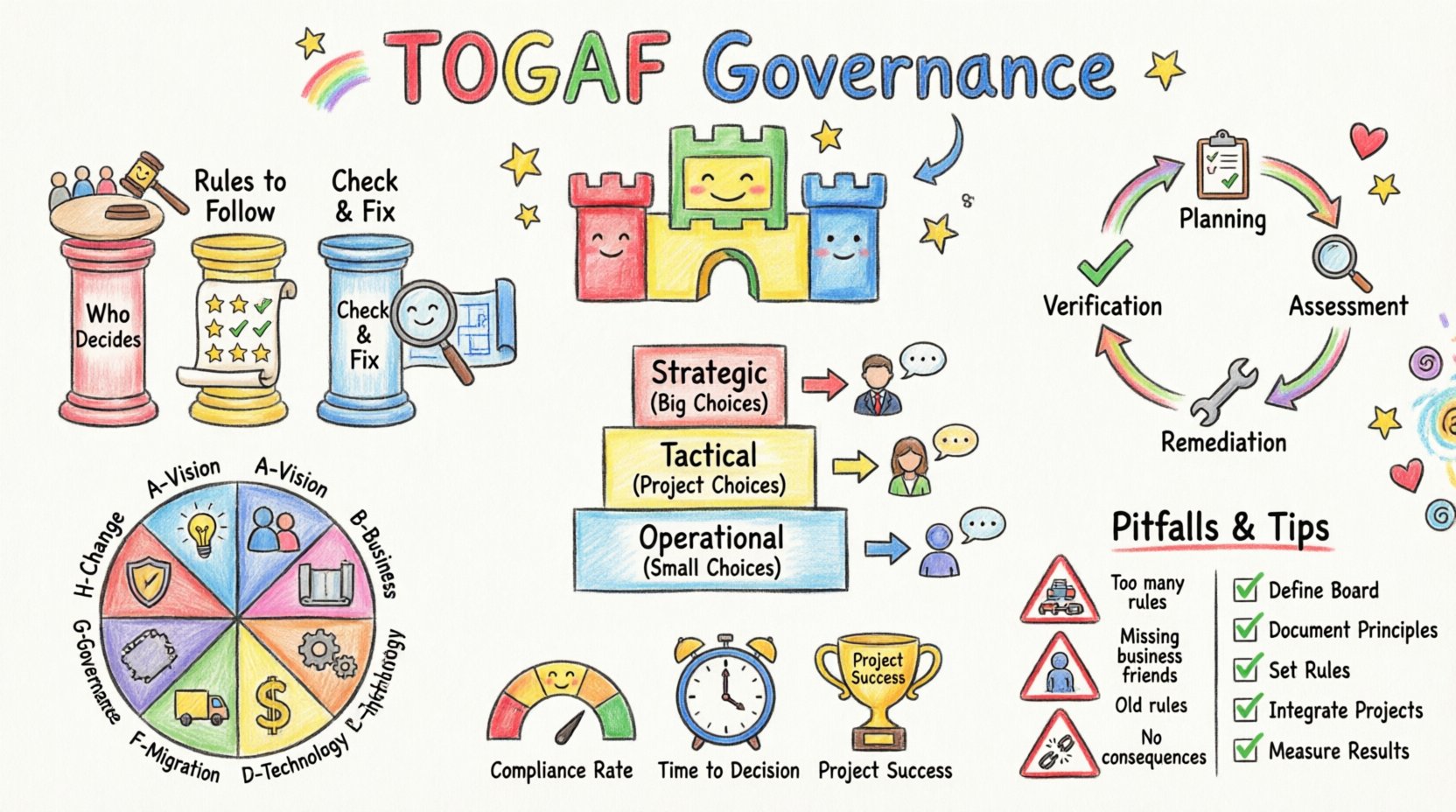
Effective governance relies on three core pillars:
- Architecture Board: The governing body responsible for decision-making.
- Architecture Principles: The fundamental rules that guide decision-making.
- Compliance Management: The mechanism for verifying adherence to standards.
These pillars work together to create a system of checks and balances. They prevent siloed decision-making and ensure that technology investments are consistent with the broader enterprise vision.
The Role of the Architecture Board 🎩
The Architecture Board is the cornerstone of TOGAF governance. It is a body of representatives from the business and technical sides of the organization. Its primary function is to review architecture work and make binding decisions regarding architectural assets. The board does not design the architecture; it validates and approves it.
Composition and Responsibilities
Members of the Architecture Board typically include:
- Chief Information Officer (CIO): Provides executive sponsorship.
- Chief Architect: Leads the technical perspective.
- Business Unit Representatives: Ensure business context is understood.
- Security and Compliance Officers: Validate risk and regulatory alignment.
- Project Managers: Represent delivery timelines and constraints.
The board operates under a charter that defines its authority. This charter should specify:
- What types of decisions require board approval.
- The frequency of meetings.
- The voting mechanism (unanimous, majority, or consensus).
- The escalation path for unresolved disputes.
Decision-Making Authority
Clear authority prevents bottlenecks. The board must know when to intervene and when to delegate. A common model categorizes decisions into three levels:
- Strategic: Long-term direction, major budget allocations, and high-level standards.
- Tactical: Project-specific architectural designs and technology selection.
- Operational: Minor changes, configuration updates, and adherence to existing patterns.
Strategic decisions usually require full board review. Tactical decisions might be delegated to an Architecture Review Board (ARB) subgroup. Operational decisions are often handled by the lead architects themselves, provided they align with established principles.
Implementing Compliance Management 🔍
Compliance management is the process of ensuring that actual implementations match the planned architecture. Without this, deviations accumulate, leading to technical debt and misalignment. TOGAF provides a structured approach to this through the Compliance Management process.
The Compliance Lifecycle
Compliance is not a one-time event. It is a continuous cycle involving:
- Planning: Defining what must be compliant and who is responsible.
- Assessment: Reviewing designs and implementations against standards.
- Remediation: Fixing non-compliant elements.
- Verification: Confirming that fixes are in place.
This cycle should be triggered at specific milestones in the project lifecycle. For example, a compliance check might occur before a project moves from the Planning phase to the Execution phase.
Types of Compliance Assessments
Different contexts require different assessment methods. The following table outlines common assessment types and their focus areas.
| Assessment Type | Focus Area | When to Apply |
|---|---|---|
| Design Review | Architecture diagrams, models, and specifications. | Before development begins. |
| Code Review | Implementation details, security configurations. | During development or prior to deployment. |
| Post-Implementation Audit | Actual performance and usage vs. design. | After solution goes live. |
| Standards Audit | Adherence to enterprise-wide technology standards. | Periodic (e.g., quarterly). |
Compliance Statements
To formalize compliance, organizations use compliance statements. These documents record the outcome of an assessment. A positive statement indicates alignment, while a negative statement identifies gaps. Each negative statement must include:
- The specific standard violated.
- The risk associated with the violation.
- The recommended remediation action.
- The owner responsible for the fix.
These statements feed into a risk register, allowing management to track architectural risk over time.
Architectural Principles and Standards 📜
Principles are the high-level rules that guide the enterprise. They are the foundation upon which governance is built. If principles are vague, governance becomes subjective. If they are clear, governance becomes objective.
Characteristics of Effective Principles
Good principles are:
- Simple: Easy to understand and remember.
- General: Applicable across the organization.
- Enforceable: Capable of being checked and validated.
- Stable: Not changing with every project.
Managing the Principles Repository
A central repository is essential for maintaining principles. This repository should contain:
- The statement of the principle.
- The rationale (why it exists).
- The implications (what it requires).
- The status (active, draft, retired).
When a new project proposes a solution that conflicts with a principle, the conflict must be documented. This is known as a principle waiver. Waivers should be rare and require high-level approval. They should also have an expiration date, forcing a re-evaluation of the decision.
Integrating Governance into the ADM Cycle 🔄
Governance is not separate from the Architecture Development Method (ADM). It runs parallel to it. The ADM cycle provides the context for governance activities. At each phase of the ADM, specific governance checkpoints ensure alignment.
For example, during Phase A (Architecture Vision), governance ensures the scope is defined. During Phase D (Technology Architecture), governance ensures technology choices align with standards. During Phase E (Opportunities and Solutions), governance ensures that implementation projects adhere to the architecture.
| ADM Phase | Governance Activity |
|---|---|
| Phase A: Vision | Approve the scope and mandate. |
| Phase B: Business | Review business capability maps. |
| Phase C: Information Systems | Validate data and application standards. |
| Phase D: Technology | Approve technology stack and infrastructure. |
| Phase E: Opportunities | Assess project alignment with architecture. |
| Phase F: Migration | Monitor implementation progress. |
| Phase G: Implementation Governance | Conduct compliance audits. |
| Phase H: Change Management | Manage architectural evolution. |
By embedding governance into these phases, the Architecture Board ensures that architecture is not just a document, but a living process that evolves with the organization.
Measuring Governance Effectiveness 📊
How do you know if governance is working? You need metrics. Without measurement, governance becomes a black box. The following key performance indicators (KPIs) help measure the health of the governance framework.
- Compliance Rate: The percentage of projects that pass compliance checks without remediation.
- Time to Decision: The average time taken by the Architecture Board to review a submission.
- Principle Adherence: The number of principle waivers issued per quarter.
- Technical Debt Ratio: The volume of architectural debt recorded in the repository.
- Project Success Rate: The correlation between architectural approval and project delivery success.
These metrics should be reported to senior leadership regularly. They provide evidence of whether the architecture function is adding value or creating friction.
Avoiding Common Governance Pitfalls ⚠️
Even with a solid framework, governance can fail if implemented poorly. Several common pitfalls can undermine the effectiveness of architectural controls.
1. Over-Governance
When every small decision requires board approval, progress slows down. This creates a bottleneck where innovation is stifled. Governance should focus on high-risk, high-impact decisions. Low-risk changes should be handled by delegated authority.
2. Lack of Business Alignment
If the board consists only of technical staff, business priorities are ignored. Governance must include business stakeholders to ensure that technical constraints do not prevent business outcomes.
3. Static Principles
Principles that do not change become irrelevant. As the market evolves, principles must be reviewed. A principle that is valid today might be obsolete in two years. Regular reviews are necessary.
4. No Enforcement Mechanism
If a project violates a principle and faces no consequences, the principle is meaningless. There must be a clear link between governance decisions and project funding or approval. Non-compliance should be a risk factor that is recorded and managed.
Sustaining Architectural Control Long Term 🏁
Governance is a long-term investment. It requires consistent attention and resources. To sustain it, organizations must:
- Train Staff: Ensure that architects and project managers understand the governance process.
- Automate Where Possible: Use tools to track compliance and principles automatically.
- Communicate Value: Regularly demonstrate how governance prevents failures and reduces risk.
- Iterate the Process: Treat the governance process itself as an architecture problem. Refine it based on feedback.
By treating governance as a dynamic system rather than a static set of rules, organizations can maintain control without sacrificing agility. The goal is not to stop change, but to guide change in a direction that supports the enterprise.
Key Takeaways for Implementation ✅
Implementing governance with TOGAF requires discipline and clarity. The following checklist summarizes the essential steps for success.
- Define the Board: Establish the charter and membership of the Architecture Board.
- Document Principles: Create a repository of enforceable architectural principles.
- Set Compliance Rules: Define what triggers an assessment and what the outcomes mean.
- Integrate with Projects: Make governance a mandatory step in the project lifecycle.
- Measure Outcomes: Track KPIs to ensure the framework is effective.
When these elements are in place, the organization gains visibility into its technology landscape. Decisions become transparent. Risks are managed proactively. This is the true value of establishing strong architectural controls within the TOGAF framework.