
The Open Group Architecture Framework (TOGAF) has long served as the bedrock for Enterprise Architecture (EA) globally. For over two decades, it has provided a standardized approach to designing, planning, implementing, and governing enterprise information architecture. However, the business landscape is shifting at an unprecedented pace. Digital transformation, cloud adoption, and the rise of artificial intelligence are rewriting the rules of engagement. This guide explores the trajectory of TOGAF, examining how the framework adapts to modern demands while maintaining its core value proposition. 🚀
Understanding the Current State of TOGAF 📊
Before projecting forward, it is necessary to establish a baseline. The most recent major iteration, TOGAF 10, introduced significant structural changes compared to its predecessor, TOGAF 9.2. The shift was not merely cosmetic; it represented a philosophical move towards modularity and flexibility. The Content Metamodel, Delivery Cycle, and Capability Framework were restructured to allow architects to pick and choose components that fit their specific organizational context rather than forcing a rigid, one-size-fits-all approach.
Key attributes of the current framework include:
- Modularity: The framework is now broken into distinct parts that can be adopted independently.
- Iteration: The Architecture Development Method (ADM) is supported by continuous cycles rather than linear phases.
- Integration: Greater emphasis on how architecture aligns with business strategy and operational delivery.
Integration with Agile and DevOps 🔄
One of the most significant discussions surrounding the future of Enterprise Architecture is its relationship with Agile and DevOps methodologies. Historically, EA was often viewed as a gatekeeper, a function that slowed down development through extensive documentation and approval processes. The future demands a shift from governance as control to governance as enablement.
The emerging direction involves embedding architectural oversight directly into the delivery pipeline. Instead of a long phase of analysis before coding begins, architects are expected to work alongside development teams. This requires a change in mindset regarding the Architecture Development Method.
Key shifts include:
- Sprint-Based Architecture: Architecture artifacts are created and updated incrementally, matching the velocity of development sprints.
- Definition of Done: Architectural compliance becomes a criterion for completing a user story, not a separate gate.
- Just-in-Time Documentation: Documentation is generated as needed for specific decisions rather than as a comprehensive upfront plan.
This approach reduces the friction between the architecture team and the engineering teams. It allows the organization to respond to market changes quickly while still maintaining a coherent technical landscape. The focus moves from predicting the future to managing the current state effectively.
The Role of Artificial Intelligence and Automation 🤖
Artificial Intelligence (AI) and Machine Learning (ML) are not just technologies to be architected; they are tools that will fundamentally change how architecture is practiced. The future of TOGAF involves leveraging automation to handle the heavy lifting of data management, consistency checking, and impact analysis.
Traditionally, maintaining architecture repositories was a manual, error-prone task. In the future, AI-driven systems will monitor the IT landscape in real-time. They can alert architects to technical debt, compliance violations, or security vulnerabilities before they become critical issues.
Practical applications in EA include:
- Automated Compliance Checking: Algorithms verify that proposed solutions adhere to established architectural standards automatically.
- Impact Analysis: AI models predict the ripple effects of a change across the ecosystem, reducing risk.
- Generative Design: Systems can suggest architectural patterns based on specific business requirements and constraints.
This does not replace the architect. Instead, it frees the architect to focus on strategic decision-making, innovation, and human-centric design. The value of the architect shifts from drawing diagrams to interpreting complex data and guiding strategy.
Cloud-Native and Microservices Architectures ☁️
The move to cloud-native environments has rendered some traditional architectural patterns obsolete. Microservices, containerization, and serverless computing introduce a level of complexity and dynamism that static diagrams struggle to capture. The future of TOGAF must accommodate these fluid environments.
Cloud-native architecture emphasizes elasticity, resilience, and decentralization. This challenges the traditional view of a monolithic architecture governed by a central authority. Instead, the focus shifts to platform engineering and API management.
Considerations for the framework include:
- Decentralized Governance: Teams own their services but adhere to shared standards for interoperability.
- Data Consistency: Managing data across distributed systems requires new patterns like Event Sourcing and CQRS.
- Security Perimeter: Security moves from the network edge to the identity and data layer.
Architects must design for failure. In a distributed system, components will fail. The architecture must be resilient enough to handle these failures without impacting the user experience. This requires a deep understanding of resilience patterns and observability.
Sustainability and Environmental Goals 🌱
Sustainability is no longer a side topic; it is a core business imperative. Organizations are under pressure to reduce their carbon footprint, and IT is a significant contributor to energy consumption. The future of Enterprise Architecture includes Green IT principles as a standard requirement.
Architects will need to evaluate solutions not just on cost and performance, but on energy efficiency. This involves selecting hardware, optimizing software, and designing data centers with sustainability in mind.
Integrating Sustainability into Architecture:
- Energy-Efficient Coding: Promoting algorithms and code structures that require less processing power.
- Hardware Lifecycle: Planning for the end-of-life of hardware to reduce e-waste.
- Cloud Provider Selection: Choosing cloud regions and providers based on their renewable energy commitments.
This adds a new dimension to the architecture decision tree. It requires architects to collaborate with sustainability officers to ensure that digital transformation contributes to environmental goals rather than hindering them.
TOGAF 10 Implementation and the Content Metamodel 📝
TOGAF 10 represents a significant step towards the future. It introduces a more granular Content Metamodel. This allows organizations to define their own standards and building blocks without being constrained by a rigid template. It supports the concept of “tailoring,” where the framework is adapted to the organization’s specific needs.
The Content Metamodel separates the definition of architecture from the delivery of it. This means that the same model can be used to generate documentation, code scaffolds, or configuration files. This flexibility is crucial for modern DevOps environments where infrastructure is defined as code.
Benefits of the new structure:
- Reusability: Building blocks can be reused across different projects.
- Interoperability: Standards are defined in a way that supports integration with other frameworks and tools.
- Clarity: Separation of concerns makes it easier to manage complex systems.
Challenges in Adoption and Evolution ⚠️
While the trends are clear, implementation is not without challenges. Organizations often struggle to balance the need for structure with the need for speed. Too much governance slows innovation; too little leads to chaos. Finding the right balance is a continuous effort.
Common obstacles include:
- Cultural Resistance: Teams accustomed to autonomy may resist architectural oversight.
- Skill Gaps: Traditional architects may lack the skills required for cloud-native and AI-driven environments.
- Tooling: Lack of integrated tools that support both traditional EA and modern DevOps pipelines.
Overcoming these hurdles requires leadership support and a willingness to evolve processes. It is not enough to update the framework; the culture surrounding the framework must also change.
Future Skills for the Enterprise Architect 🎓
As the framework evolves, so must the practitioners. The role of the Enterprise Architect is becoming more strategic and less about drawing boxes and lines. The future architect needs a diverse skill set.
Essential competencies:
- Business Acumen: Deep understanding of market dynamics and business models.
- Data Literacy: Ability to interpret data trends and leverage data as an asset.
- Technical Fluency: Knowledge of cloud, security, and modern development practices.
- Soft Skills: Communication, negotiation, and change management.
Continuous learning is vital. The landscape changes too fast for static knowledge. Architects must engage with the community, attend conferences, and stay updated on new standards and practices.
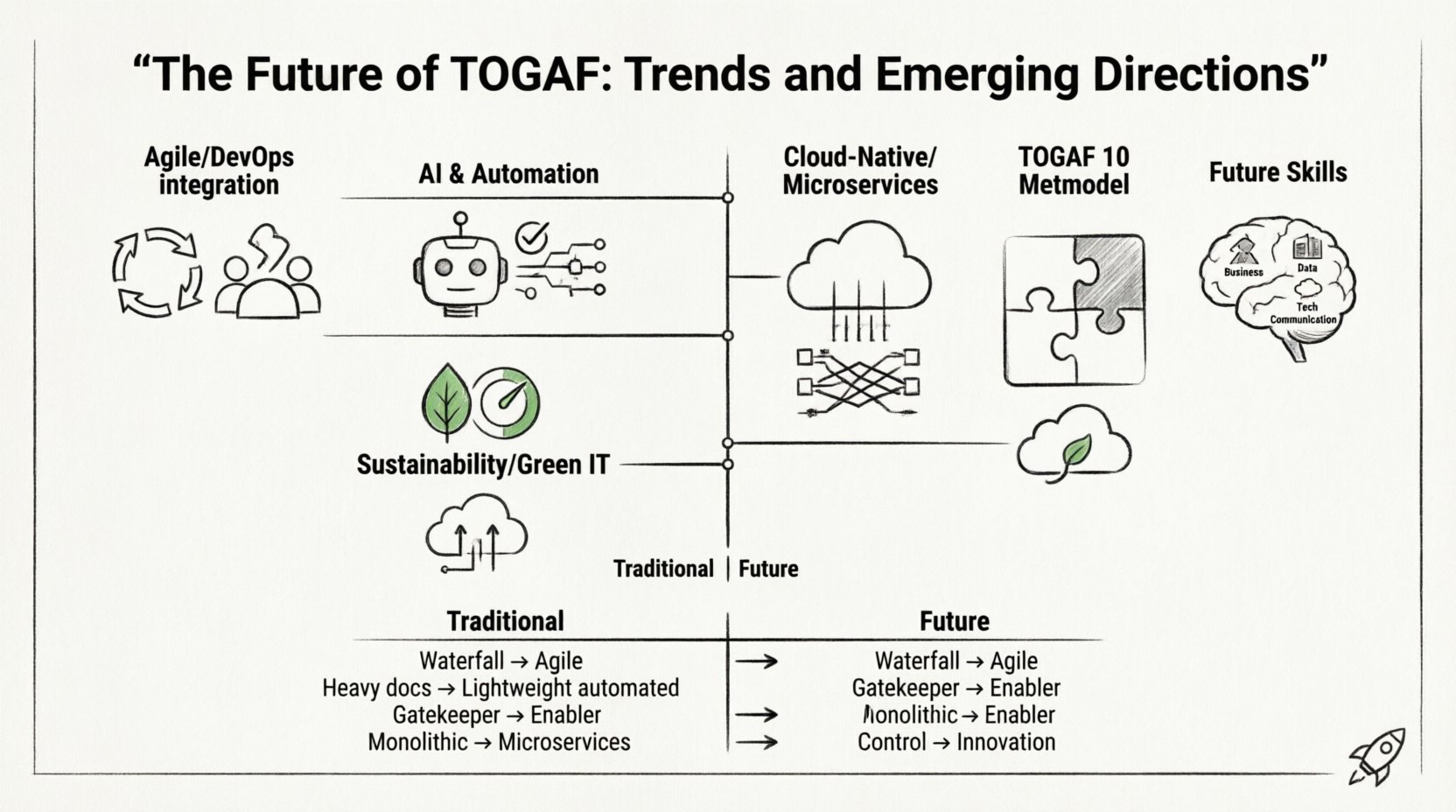
Comparison: Traditional vs. Future EA Practices 📋
To visualize the shift, consider the following comparison of practices.
| Aspect | Traditional Approach | Future Approach |
|---|---|---|
| Delivery Cycle | Waterfall, Long-term planning | Agile, Iterative, Continuous |
| Documentation | Heavy, upfront, static | Lightweight, living, automated |
| Governance | Gatekeeper, Approval-focused | Enabler, Compliance-focused |
| Technology | On-premise, Monolithic | Cloud-native, Microservices |
| Focus | Stability and Control | Innovation and Resilience |
Final Considerations on the Path Forward 🔮
The trajectory of TOGAF points towards greater flexibility, automation, and alignment with business value. It is moving away from a prescriptive methodology towards a guiding framework that adapts to the organization. The core principles remain valid, but the application is evolving.
Organizations that embrace these trends will be better positioned to navigate complexity. They will build systems that are not only robust but also adaptable to future changes. The architect’s role is central to this transition, acting as the bridge between strategy and execution.
By focusing on modularity, automation, and human-centric design, the framework remains relevant. The future is not about replacing TOGAF but enhancing it to meet the demands of a digital-first world. Success depends on the willingness to experiment, learn, and adapt continuously.