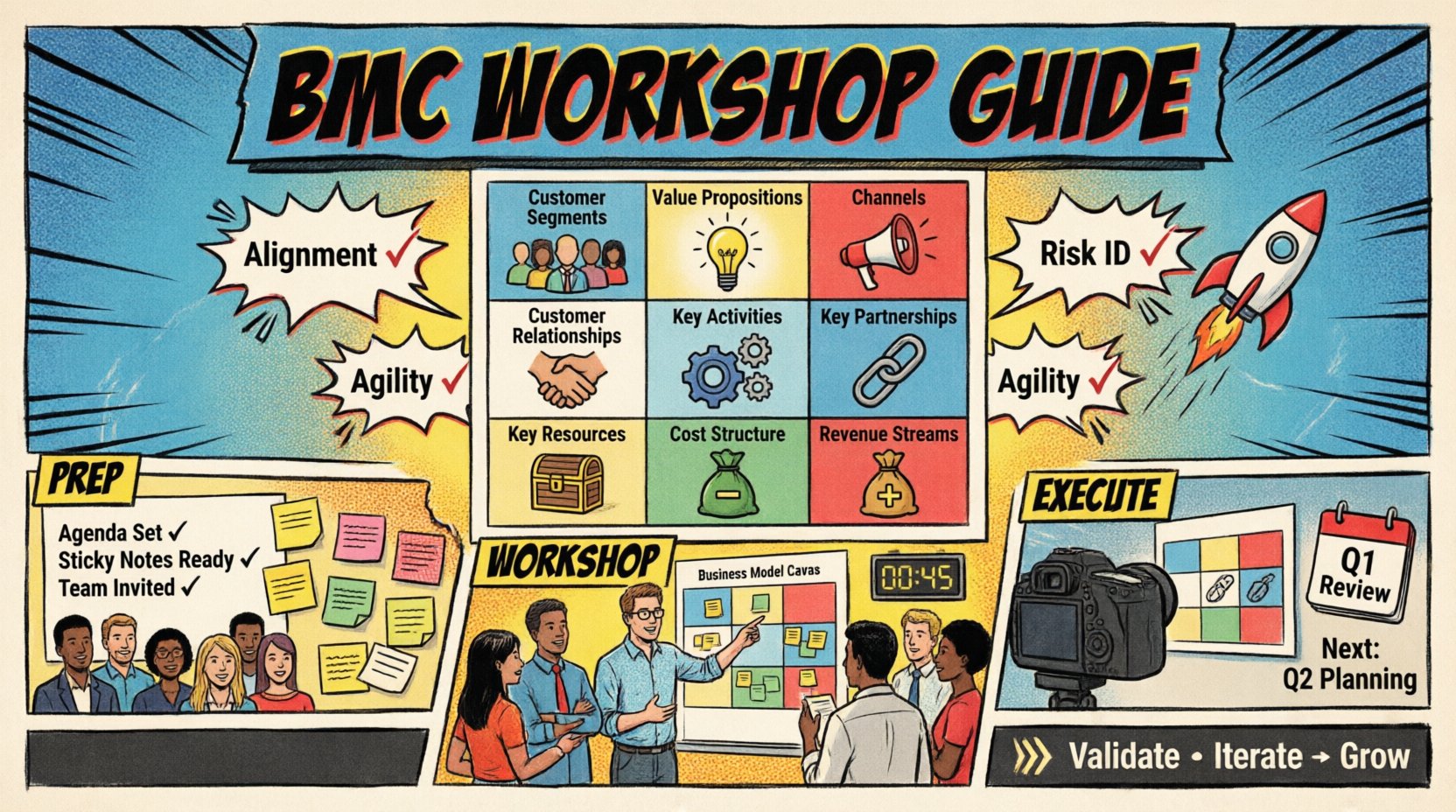
Creating a shared understanding of how a business creates, delivers, and captures value is a critical task for any organization. The Business Model Canvas (BMC) offers a structured framework to visualize this complexity. However, a canvas on paper is only as good as the conversation that fills it. This guide outlines the process of facilitating a Business Model Canvas workshop, ensuring your team leaves with clarity, alignment, and actionable insights.
📋 Why Run a BMC Workshop?
A strategic session centered on the canvas serves multiple purposes. It forces stakeholders to articulate assumptions. It exposes gaps in logic where one block does not support another. It creates a single source of truth for the team. Without a facilitated approach, these sessions can drift into abstract debates or become dominated by the loudest voices. Proper facilitation ensures every perspective is heard and synthesized.
Key benefits include:
- Alignment: Everyone sees the same picture of the business.
- Identification of Risks: Weak links in the model become visible early.
- Communication: A visual language that simplifies complex strategy.
- Agility: The model can be updated as market conditions shift.
🛠 Preparation Phase: Before the Session
Success is often determined before the first meeting begins. Preparation sets the stage for focused work. Rushing into the canvas without context leads to superficial results.
1. Define the Objective
Is the goal to validate an existing model? To pivot a struggling division? To launch a new product line? The objective dictates the scope. If the aim is innovation, focus on Value Propositions and Customer Segments. If the aim is operational efficiency, focus on Key Activities and Cost Structure.
2. Select the Right Participants
You need a cross-section of the organization. Include representatives from:
- Leadership (for strategic direction)
- Product/Service Development (for feasibility)
- Sales and Marketing (for customer reality)
- Finance (for cost and revenue viability)
- Customer Support (for pain point insights)
Avoid inviting too many people. A group of 6 to 10 is usually optimal for collaboration. If the group is larger, split into smaller teams and reconvene.
3. Gather Materials
Physical materials often work better than digital tools for initial brainstorming. You need:
- Large wall space or whiteboards
- Printed BMC templates (A1 or larger)
- Sticky notes in multiple colors
- Markers of various widths
- Timer
- Camera or scanner for documentation
🧩 The 9 Building Blocks Explained
The canvas is divided into four main areas: Infrastructure, Offerings, Customers, and Finances. Understanding the specific questions to ask for each block is crucial for deep discussion.
| Building Block | Category | Focus Question |
|---|---|---|
| Customer Segments | Front Stage | Who are we creating value for? |
| Value Propositions | Front Stage | What problem are we solving? |
| Channels | Front Stage | How do we reach our customers? |
| Customer Relationships | Front Stage | How do we interact and retain them? |
| Key Activities | Back Stage | What must we do to make this work? |
| Key Resources | Back Stage | What assets do we need? |
| Key Partnerships | Back Stage | Who can help us do this better? |
| Cost Structure | Back Stage | What are the major costs involved? |
| Revenue Streams | Back Stage | How do we generate income? |
🗣 Deep Dive: Facilitating Each Block
During the workshop, move through the blocks logically. Starting with the Value Proposition often works best, as everything else supports that core promise.
1. Customer Segments
Ask the team to list every group of people or organizations they intend to reach. Use sticky notes to group similar personas. Discuss which segments are the most profitable and which are the most reachable. Challenge the team to be specific. “Small businesses” is too broad. “Small retail businesses in the Midwest” is actionable.
2. Value Propositions
This is the heart of the canvas. What bundle of products and services creates value for a specific Customer Segment? Is it newness? Performance? Customization? Design? Brand Status? Price? Cost Reduction? Risk Reduction? Accessibility? Convenience? Use this list to brainstorm specific offerings that address the identified customer needs.
3. Channels
How do Customer Segments want to be reached? Channels are customer touchpoints. Consider awareness, evaluation, purchase, delivery, and after-sales. Are you using physical stores, web sales, or mobile apps? Decide on the mix of direct and indirect channels. Discuss the cost and customer experience for each.
4. Customer Relationships
What type of relationship does each Customer Segment expect? Is it personal assistance, dedicated personal assistance, self-service, or automated services? Is the focus on acquisition, retention, or boosting sales? Define the emotional and practical connection you want to maintain with your clients.
5. Key Activities
What are the most important things the company must do to make its business model work? These are actions required to offer a Value Proposition, reach markets, maintain relationships, and earn revenues. Examples include production, problem-solving, and platform/network management.
6. Key Resources
What physical, intellectual, human, or financial assets are required? Without these resources, the business model cannot function. Identify the critical assets that differentiate your business. Is it proprietary data, a specific manufacturing facility, or a specialized team?
7. Key Partnerships
Who are your key suppliers and partners? Why are they essential? What activities do they perform? What resources do they provide? Partnerships are often driven by optimization, reduction of risk, or acquisition of particular resources. Distinguish between strategic alliances and joint ventures.
8. Cost Structure
What are the most important costs inherent in the business model? Which key resources and activities are most expensive? Is the model cost-driven or value-driven? Identify fixed costs (salaries, rent) and variable costs (materials, transaction fees). Ensure the costs align with the value delivered.
9. Revenue Streams
For what value are each customer segment really willing to pay? Do they currently pay for what you offer? What are the current revenue streams? How do they pay? How much do they contribute to total revenue? Consider asset sale, usage fee, subscription fees, lending, renting, licensing, brokerage fees, and advertising.
⏱ Running the Session: Logistics and Timing
Structure is key to keeping energy high and focus sharp. A full workshop typically takes a full day or two half-days.
Recommended Agenda
- 09:00 – 09:30: Introduction and Objectives. Set the ground rules.
- 09:30 – 10:30: Customer Segments and Value Propositions.
- 10:30 – 10:45: Break.
- 10:45 – 12:00: Channels and Relationships.
- 12:00 – 13:00: Lunch.
- 13:00 – 14:30: Key Activities, Resources, and Partnerships.
- 14:30 – 14:45: Break.
- 14:45 – 16:00: Cost Structure and Revenue Streams.
- 16:00 – 17:00: Review, Prioritization, and Next Steps.
Facilitation Rules
Establish these rules at the start to maintain order:
- One conversation: Speak one at a time.
- Defer judgment: No “that won’t work” during brainstorming.
- Stay focused: Stick to the sticky notes, not the laptop.
- Be visual: Draw simple icons to convey ideas quickly.
🤝 Managing Group Dynamics
Facilitation is not just about timekeeping; it is about managing human behavior. Different personalities bring different energy to the room.
Handling Dominant Voices
Some participants talk over others or insist on their view. As the facilitator, intervene gently. Use phrases like, “Let’s hear from someone who hasn’t spoken yet,” or “I want to capture that idea, but let’s move to the next point.” Ensure the conversation remains balanced.
Encouraging Quiet Voices
Introverts often have deep insights but wait to be invited. Directly ask them for their perspective. “Sarah, you mentioned X earlier, how does that fit with this segment?” Make space for reflection time where people write notes silently before sharing.
Managing Conflict
Disagreements are healthy if managed well. If two departments clash over resources or strategy, step back and ask the group what the evidence is. Refer back to the customer. “Which option better serves the customer need we identified?” Keep the focus on the business model, not personal preferences.
🔍 Common Pitfalls to Avoid
Avoid these common mistakes to ensure the workshop yields results.
- Too Much Detail: Do not get bogged down in specific marketing copy or technical specs. Keep it high level. You can fill in details later.
- Ignoring the Back Stage: Teams often focus heavily on the customer side (Front Stage) and neglect the operational reality (Back Stage). Ensure costs and activities are realistic.
- No Validation: Treat the canvas as a hypothesis, not a fact. Plan to test these assumptions with real customers immediately after the workshop.
- Forgotten Priorities: A canvas filled with 50 ideas is useless. Force the team to vote on the top 3 priorities for the next quarter.
🚀 Post-Workshop Execution
The workshop ends when the sticky notes are removed, but the work continues. Without a plan to act, the session is just a meeting.
Documentation
Photograph the canvas from multiple angles. Create a digital version for the team to reference. Distribute the summary document within 24 hours while the memory is fresh.
Validation Plan
Identify the riskiest assumptions on the canvas. Create a list of experiments to run. For example, if the Revenue Stream relies on a new pricing model, run a survey or a beta test. If the Channel relies on a new partner, draft a proposal.
Iterate Regularly
The business model is not static. Schedule a review of the canvas every quarter. Update the blocks based on new data. This keeps the strategy alive and responsive to market changes.
❓ Frequently Asked Questions
How long should the workshop last?
A comprehensive session typically requires 4 to 8 hours. If the team is new to the tool, split it into two half-day sessions to allow for digestion of the concepts.
Can we use digital tools instead of sticky notes?
Yes, digital whiteboards work well for remote teams. However, physical notes often generate more energy and engagement in person. If remote, ensure the platform allows for easy dragging, dropping, and grouping of items.
What if we disagree on a block?
Disagreement is a signal to investigate further. Note the conflict on a separate note. Create a task to resolve it with data. Do not let it stall the progress of the whole group.
Who owns the canvas after the workshop?
The entire leadership team shares ownership. However, assign a specific owner to update the document. Usually, the Strategy Lead or Product Manager takes this responsibility.
Is this only for startups?
No. Large enterprises use this for internal innovation labs, new division launches, and restructuring efforts. The tool scales from small ventures to complex organizations.
📝 Final Considerations
Facilitating a Business Model Canvas workshop is about more than filling boxes. It is about building a shared mental model for the team. When everyone understands how the pieces fit together, decision-making becomes faster and more aligned. The canvas is a living document, not a final report. Use it to navigate uncertainty, challenge assumptions, and drive growth. With the right preparation and facilitation, your team will leave the room ready to execute.