The foundation of a sustainable online business lies not just in traffic or product selection, but in the financial architecture that supports growth. For entrepreneurs and strategists, the Business Model Canvas (BMC) serves as a critical visual chart to describe how an organization creates, delivers, and captures value. Within this framework, the Revenue Streams block stands as a pivotal indicator of viability. It answers the fundamental question: For what value are customers willing to pay? In the context of e-commerce, where competition is fierce and margins can be tight, mapping these streams requires precision and a deep understanding of customer behavior.
Many e-commerce ventures fail because they focus solely on acquiring customers without a clear plan for monetization. They assume that sales volume will naturally cover costs. However, a robust strategy involves deliberate mapping of income sources to ensure stability and scalability. This guide explores how to effectively map revenue streams within the Business Model Canvas for online retail environments. We will examine various models, pricing mechanisms, and the strategic alignment required to build a resilient financial structure.
Understanding the Revenue Streams Block 💰
The Revenue Streams section of the Business Model Canvas represents the cash a company generates from each customer segment. In e-commerce, this is not merely the price of a product. It encompasses a broader ecosystem of transactions and value exchanges. To map this accurately, one must look beyond the initial checkout. It involves analyzing the entire customer journey and identifying every touchpoint where value can be monetized.
When filling out this block, consider the following core components:
- Transaction Revenue: One-time payments for products or services.
- Recurring Revenue: Payments made at regular intervals (subscriptions, maintenance).
- Usage Revenue: Charges based on how much a customer uses a service.
- Licensing Revenue: Fees for using proprietary technology or content.
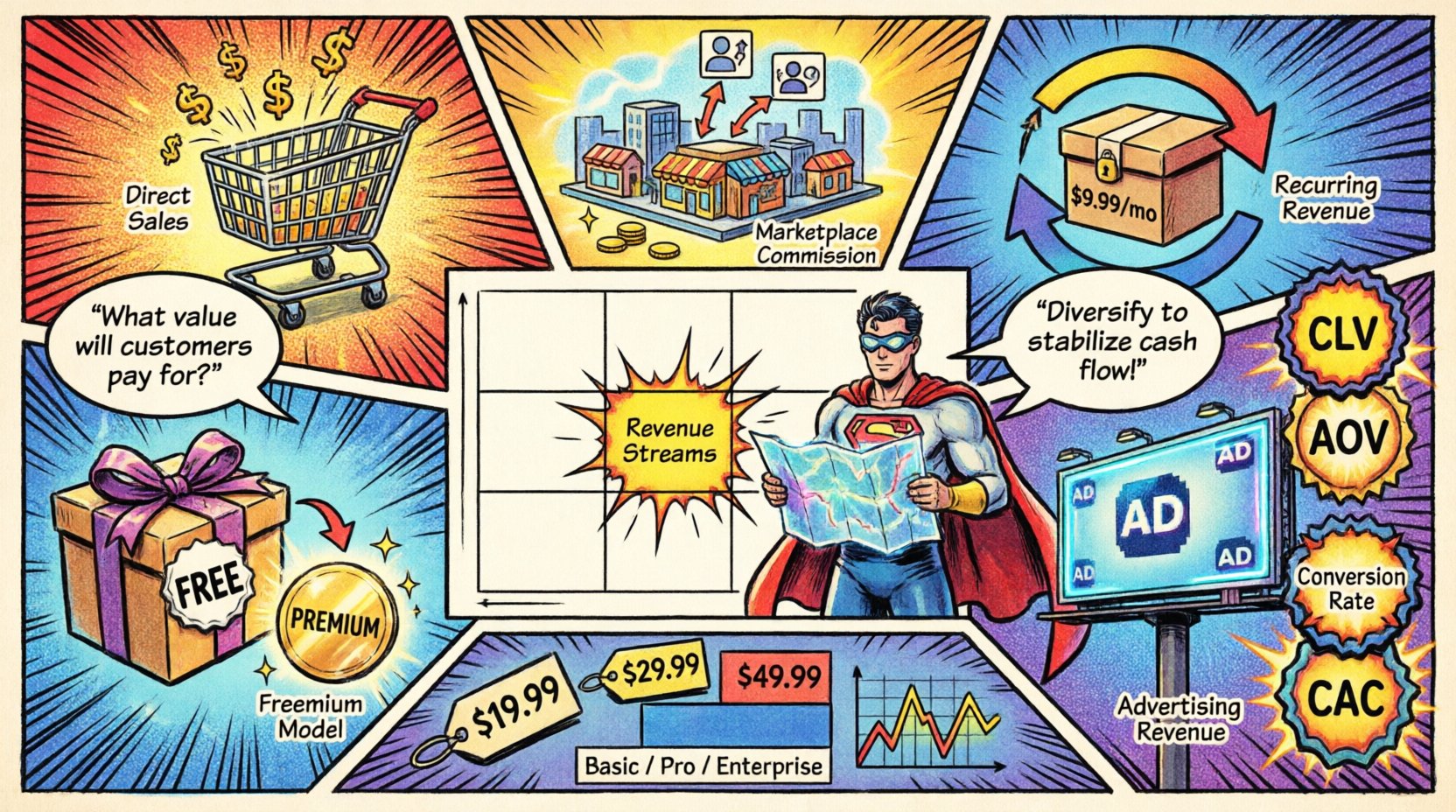
- Advertising Revenue: Income generated from displaying third-party ads on your platform.
Each of these categories requires different operational support and customer expectations. A mismatch between the value proposition and the revenue model can lead to customer churn. For instance, offering a free product with an expectation of high transaction revenue later requires a funnel that nurtures trust effectively. Mapping this early in the planning phase helps identify potential friction points before significant resources are allocated.
Common E-commerce Monetization Models 🛒
E-commerce platforms operate under various financial models. Identifying the right fit depends on the product type, target audience, and competitive landscape. Below is a detailed breakdown of the most prevalent models used in digital retail.
1. Direct Sales Model 📦
This is the traditional approach where the business sells goods directly to the consumer. The revenue stream is derived from the markup on the product cost. While straightforward, this model demands high efficiency in logistics and inventory management to maintain healthy margins. Variations include:
- Inventory Holding: Purchasing stock upfront and selling it. Higher risk, higher control.
- Dropshipping: Selling without holding stock. Lower risk, lower margins, reliance on suppliers.
- White Labeling: Selling generic products under your own brand. Balances cost and branding.
2. Subscription Model 🔄
Recurring revenue provides predictability and improves customer lifetime value (CLV). This model works best for consumables, curated boxes, or access-based services. The key to success here is retention. If the value provided in the first month does not compel the customer to stay for the second, the model will fail.
- Consumables: Coffee, skincare, pet food delivered regularly.
- Access: Membership sites or exclusive content libraries.
- SaaS Integration: Software tools bundled with physical goods.
3. Marketplace Model 🏪
In this setup, the platform connects buyers and sellers. The revenue stream is typically a commission fee on each transaction or a listing fee charged to sellers. This model scales quickly because the inventory burden is shared, but it requires significant trust and liquidity to attract both sides of the market.
4. Freemium Model 🎁
Common in digital goods and apps, this model offers a basic version for free while charging for premium features. In physical e-commerce, this might manifest as free samples that lead to paid full-size purchases, or free shipping thresholds that encourage higher basket sizes. The challenge is converting the free user base into paying customers without devaluing the premium offering.
5. Advertising and Data Monetization 📢
High-traffic e-commerce sites can monetize their audience without charging for the product. Revenue comes from advertisers paying for display space or from selling anonymized customer data insights. This approach requires a massive user base and strict adherence to privacy regulations.
Pricing Mechanisms and Psychology 💵
Once the revenue model is selected, the pricing mechanism determines the actual flow of cash. Pricing is not just a number; it is a signal of value, quality, and brand positioning. In the Business Model Canvas, this links directly to the Value Proposition. If the value is high, the price should reflect that. If the value is convenience, the price may include a premium for speed.
Consider the following pricing strategies when mapping your revenue:
- Cost-Plus Pricing: Adding a standard markup to the cost of goods. Simple but ignores customer willingness to pay.
- Value-Based Pricing: Setting prices based on perceived value to the customer. Requires deep market research.
- Dynamic Pricing: Adjusting prices in real-time based on demand, competitor pricing, or user behavior.
- Tiered Pricing: Offering multiple versions of a product (Basic, Pro, Enterprise) to capture different segments.
- Bundling: Selling multiple items together at a discount to increase average order value.
Psychological pricing tactics, such as anchoring (showing a high price next to a lower one) or charm pricing (ending in .99), also play a role. These should be tested rigorously. What works for one segment may alienate another. The mapping process involves testing these mechanisms against the specific customer segment identified in the canvas.
Mapping Process: Step-by-Step Guide 🗺️
Integrating revenue streams into the Business Model Canvas requires a structured approach. Follow these steps to ensure alignment with other building blocks like Customer Segments and Key Activities.
Step 1: Identify Customer Segments First 👥
Revenue cannot exist without customers. Before defining how you charge, define who you are charging. Different segments have different price sensitivities and value drivers. A luxury segment may prefer exclusive access and high price points, while a budget segment prioritizes cost efficiency.
Step 2: Define the Value Proposition 💎
What problem are you solving? Why should they pay you? The revenue stream must directly correspond to the solution provided. If you sell time-saving software, the revenue should reflect the hours saved. If you sell emotional comfort (e.g., comfort food), the revenue reflects the feeling provided.
Step 3: Select Revenue Types 🧾
Based on the segment and value, choose the appropriate revenue type. Will it be one-time, recurring, or usage-based? You may combine multiple types. For example, an e-commerce site might sell physical goods (transaction) and offer a loyalty membership (recurring).
Step 4: Determine Pricing Strategy 🏷️
Establish the specific pricing mechanism. Will you use discounts, bundles, or subscription tiers? Ensure this aligns with your cost structure. If your costs are high, a low-price strategy will fail unless volume is guaranteed.
Step 5: Map to Key Activities & Resources ⚙️
Revenue streams dictate operational needs. A subscription model requires customer support and retention marketing. A high-volume transaction model requires efficient logistics and inventory management. Ensure your Key Activities and Key Resources can support the chosen revenue model.
Interdependencies with Other Canvas Blocks 🔗
The Revenue Streams block does not operate in isolation. It is deeply interconnected with the other eight blocks of the Business Model Canvas. Understanding these relationships is crucial for a holistic view of the business.
| Canvas Block | Relationship to Revenue Streams | Impact Example |
|---|---|---|
| Customer Segments | Defines who pays and how much they are willing to pay. | Enterprise clients may pay for bulk discounts; individuals pay premium for convenience. |
| Value Proposition | Justifies the price point. Without value, revenue is unsustainable. | High quality justifies high price; speed justifies premium shipping fees. |
| Channels | Direct channels often yield higher margins than marketplaces. | Selling on your own site retains more revenue than selling via a third-party aggregator. |
| Cost Structure | Revenue must exceed costs to generate profit. Pricing covers this. | High customer acquisition costs require higher lifetime revenue per customer. |
| Customer Relationships | Retention strategies drive recurring revenue streams. | Personalized support increases willingness to pay for premium tiers. |
| Key Activities | Activities must generate the service or product being sold. | Marketing activities drive traffic that converts to revenue. |
For example, if you choose a low-cost strategy (Revenue Stream), your Cost Structure must be lean. This might mean automating Key Activities to reduce labor costs. If you choose a high-touch service model, your Customer Relationships block must support extensive onboarding and support, increasing costs but allowing for higher price points.
Optimizing Revenue Through Diversification 📊
Relying on a single source of income is risky. Diversification stabilizes cash flow. In the Business Model Canvas, this means expanding the Revenue Streams block to include multiple income sources that complement each other.
- Upselling and Cross-selling: Offering higher-end versions or complementary products at checkout increases the value of each transaction.
- Affiliate Marketing: Recommending third-party products can generate commission revenue without inventory risk.
- Merchandising: Selling branded merchandise can deepen brand connection and add a secondary revenue line.
- Services: Offering installation, consulting, or repair services alongside products adds high-margin revenue.
When mapping these additions, ensure they do not confuse the core value proposition. A brand known for low prices should not suddenly introduce expensive services that alienate its core audience. The diversification should feel natural to the customer journey.
Metrics for Evaluation 📉
Once the revenue streams are mapped, they must be monitored. Data-driven decisions allow for adjustments to pricing and models over time. Key Performance Indicators (KPIs) specific to the Revenue Streams block include:
- Customer Lifetime Value (CLV): The total revenue a single customer generates over their relationship with the business.
- Average Order Value (AOV): The average amount spent each time a customer places an order.
- Conversion Rate: The percentage of visitors who complete a purchase.
- Churn Rate: The rate at which subscription customers cancel.
- Customer Acquisition Cost (CAC): The cost to acquire a new paying customer.
- Revenue per Visitor (RPV): Total revenue divided by total number of visitors.
Tracking these metrics helps identify which parts of the revenue model are working and which need adjustment. For instance, if CLV is low, the focus might shift from acquisition to retention strategies. If CAC is high, the value proposition may need strengthening to justify the marketing spend.
Common Pitfalls to Avoid 🚫
When mapping revenue streams, several common mistakes can undermine the business model. Awareness of these pitfalls allows for proactive mitigation.
- Ignoring Unit Economics: Focusing on top-line revenue without understanding the cost to serve each customer leads to losses at scale.
- Pricing Wars: Competing solely on price often degrades brand value and profitability. Focus on value differentiation instead.
- Overcomplication: Too many pricing tiers confuse customers. Keep the structure simple and intuitive.
- Neglecting Payment Friction: If the checkout process is difficult, revenue is lost. Streamline the payment flow to capture the mapped revenue.
- Assuming Static Demand: Customer willingness to pay changes over time. Regularly review pricing and revenue models to stay aligned with market conditions.
Future-Proofing Your Revenue Model 🚀
The digital landscape evolves rapidly. What works today may not work tomorrow. When mapping revenue streams, consider future trends such as:
- AI-Driven Personalization: Dynamic pricing and product recommendations based on AI analysis.
- Sustainability: Customers may pay a premium for eco-friendly supply chains.
- Web3 and Tokens: Potential for loyalty tokens or decentralized marketplace models.
- Immersive Commerce: Using VR/AR to enhance the shopping experience and justify higher price points.
Flexibility is key. The Business Model Canvas is a living document. As you gather data and market conditions shift, the Revenue Streams block should be revisited and adjusted. This iterative process ensures long-term viability.
Summary of Strategic Alignment ✅
Mapping revenue streams is an exercise in strategic alignment. It requires balancing what the market will pay with what the business can deliver profitably. By using the Business Model Canvas as a guide, e-commerce businesses can visualize these connections clearly. The goal is to build a system where every activity supports the generation of sustainable income.
Start by defining your segments and value. Choose a pricing model that fits your operational capabilities. Diversify where appropriate to reduce risk. Monitor your metrics closely. And always remain ready to adapt. This disciplined approach to financial architecture lays the groundwork for growth that is both rapid and resilient.
Remember, revenue is the lifeblood of the organization. A well-mapped revenue stream ensures that the business has the fuel needed to invest in innovation, improve customer experience, and withstand market fluctuations. Take the time to analyze this block thoroughly, as it ultimately determines the longevity of your e-commerce venture.