
Creating a successful service business requires more than just a good idea. It requires a clear understanding of what you offer and why a customer would choose you over someone else. The Business Model Canvas (BMC) provides a structured framework to map out these elements. For service-based companies, the Value Proposition block is often the most complex area to define. Unlike physical goods, services are intangible, making it harder to demonstrate worth before purchase.
This guide explores how to construct a robust Value Proposition within the context of the Business Model Canvas. We will break down the nuances of service delivery, alignment with customer segments, and the specific mechanics of gain creators and pain relievers. By the end, you will have a clear roadmap for articulating your value.
🧩 Understanding Value in a Service Context
Defining value in the service sector differs significantly from product-based industries. When selling a hammer, the value is the object itself. When selling consulting, legal advice, or maintenance, the value lies in the outcome, the expertise, or the time saved. To define this on the canvas, you must look beyond the activity.
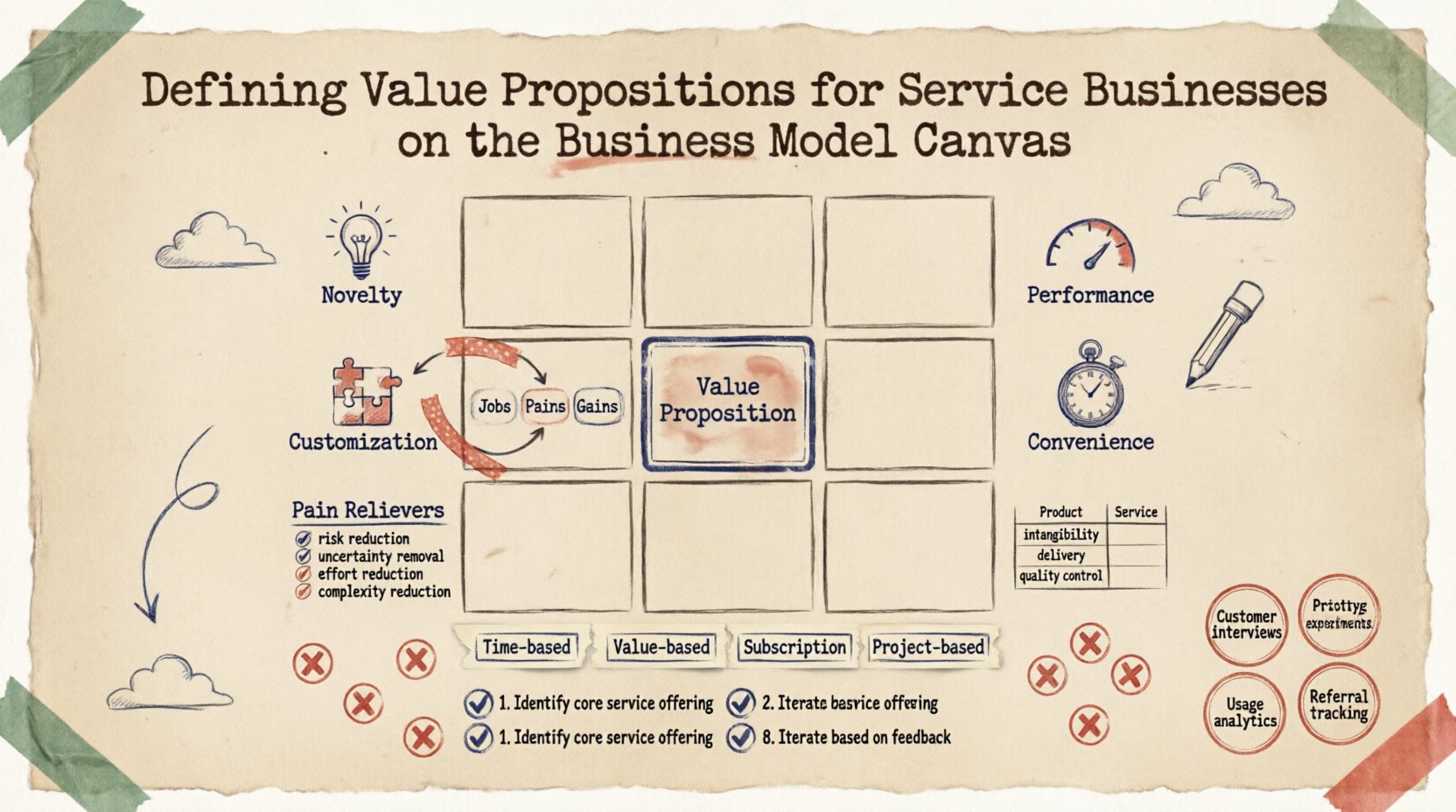
Service value propositions generally fall into four categories:
- Novelty: Offering something new to the market. For example, a new methodology for training staff.
- Performance: Improving the function or efficiency of a process. A logistics company promising 24-hour delivery.
- Customization: Tailoring the service to the specific needs of the client. A marketing agency creating bespoke brand strategies.
- Convenience: Making the service easier to access or use. An on-demand repair service that comes to your home.
When placing this on the canvas, you must ensure these categories align with what the customer actually cares about. Many businesses fail here by focusing on their internal capabilities rather than external needs.
👥 Linking Value Propositions to Customer Segments
The Value Proposition block cannot exist in isolation. It is directly connected to the Customer Segments block. In the Business Model Canvas, every segment has a unique set of jobs, pains, and gains. Your value proposition must address these specific points.
For a service business, the relationship is often more personal than with products. Consider the following connections:
- Customer Jobs: What task is the customer trying to accomplish? If you offer bookkeeping services, the job is “maintaining accurate financial records to ensure compliance.”
- Value Add: Your service simplifies this, ensuring they pass audits without stress.
- Pains: What obstacles or risks do they face? They might fear penalties, lost time, or data errors.
- Value Add: You offer guarantees, security protocols, and speed.
- Gains: What outcomes do they desire? They want growth, stability, or peace of mind.
- Value Add: You provide insights that help them grow their revenue.
If your value proposition does not directly resolve a pain or create a gain for a specific segment, it will not resonate. The canvas helps visualize this alignment. You should be able to draw a line from a specific Customer Segment to your Value Proposition and explain exactly how it solves a problem.
🛠️ The Mechanics of Gain Creators and Pain Relievers
Within the Value Proposition block, two specific tools help structure your offering: Gain Creators and Pain Relievers. Using these terms clarifies the intent of your service.
Gain Creators
Gain creators describe the positive outcomes your service produces. These are the benefits that exceed expectations. In a service context, these might include:
- Speed: Reducing the time it takes to complete a task.
- Design: Improving the aesthetic or user experience of a deliverable.
- Cost Reduction: Helping the client save money on their operations.
- Access: Providing entry to networks or information previously unavailable.
- Status: Enhancing the client’s reputation through association with your brand.
Pain Relievers
Pain relievers address the negative aspects of the customer experience. Services often introduce friction, such as complexity or uncertainty. Your job is to remove that friction.
- Risk Reduction: Offering warranties or performance guarantees.
- Uncertainty Removal: Providing clear timelines and fixed pricing.
- Effort Reduction: Handling the heavy lifting so the client does not have to.
- Complexity Reduction: Simplifying technical jargon into actionable steps.
When drafting your Value Proposition, list your top three pain relievers and top three gain creators. This forces specificity.
🔗 Aligning Key Activities and Resources
A value proposition is only as strong as the operations behind it. The Business Model Canvas connects the Value Proposition to Key Activities and Key Resources. If you promise high-quality, personalized service, your Key Resources must include skilled personnel and your Key Activities must include rigorous training and client management.
Consider the following alignment checks:
- If you promise speed: Do you have the staff and technology to deliver it? Or will you promise speed and fail to deliver?
- If you promise customization: Do you have the flexible systems to adapt to different client needs? Or are you bound by rigid processes?
- If you promise expertise: Do you have the right talent and knowledge base?
It is common for service businesses to overpromise on the canvas without ensuring the backend can support it. This leads to customer dissatisfaction. The canvas forces you to verify that your operational reality matches your marketing promise.
💰 Pricing and Revenue Streams
The Value Proposition also dictates your pricing strategy. In the Business Model Canvas, this connects to the Revenue Streams block. How you charge reflects the value you deliver.
Common pricing models for services include:
- Time-based: Charging for hours worked. This works well for legal or consulting work where scope is fluid.
- Value-based: Charging based on the outcome or value created. This works well for performance marketing or sales consulting.
- Subscription: Recurring fees for ongoing access or maintenance. Common in SaaS support or retainer models.
- Project-based: A fixed fee for a defined scope. Good for one-off deliverables.
Your pricing must align with the perceived value. If your value proposition emphasizes “premium, exclusive access,” a low price point may signal low quality. If your proposition is “affordable, accessible help,” high pricing will deter the segment.
📊 Product vs. Service Value Proposition Comparison
To clarify the differences, consider this comparison between a product and a service value proposition within the canvas structure.
| Feature | Product Business | Service Business |
|---|---|---|
| Intangibility | Low. The item is physical and inspectable. | High. The value is experienced over time. |
| Delivery | One-time transfer of ownership. | Ongoing interaction or performance. |
| Quality Control | Standardized manufacturing processes. | Dependent on staff performance and consistency. |
| Customer Interaction | Low during consumption. | High during delivery and consumption. |
| Value Anchor | Features and durability. | Outcomes and relationships. |
This table highlights why service value propositions require more emphasis on the relationship and the outcome. You cannot ship the value and be done with it.
🚧 Common Pitfalls in Service Value Propositions
Many service businesses struggle to articulate their value. Below are common errors to avoid when filling out this section of the canvas.
- Being Too Generic: Phrases like “high quality service” or “best in class” are meaningless without context. Define what quality means for your specific niche.
- Focus on Inputs: Don’t say “we use 50 employees.” Say “we provide 24/7 coverage.” Focus on what the customer gets, not what you do.
- Ignoring the Invisible: Services have invisible components like trust, culture, and brand reputation. These must be part of the value proposition.
- One Size Fits All: A single value proposition rarely works for all segments. A service for startups differs from a service for enterprise clients.
- Overcomplicating: If you cannot explain your value in one sentence, it is too complex. Clarity drives conversion.
🔄 Validation and Iteration
Defining the Value Proposition is not a one-time event. It is a hypothesis that must be tested. The Business Model Canvas is a living document. As you gather feedback from customers, you may find that your assumed value proposition does not match reality.
Methods to validate your value proposition include:
- Customer Interviews: Ask potential clients what problems they are trying to solve. Listen for the words they use.
- Prototype Service: Offer a pilot version of the service to a small group and measure their satisfaction.
- A/B Testing: Test different value statements in your marketing to see which attracts more interest.
- Churn Analysis: If clients leave, analyze whether the value they expected was not delivered.
Iterating based on data ensures your value proposition remains relevant. Markets shift, and customer needs evolve. The canvas allows you to pivot quickly without rebuilding the entire business model.
🌟 Summary of Key Steps
To successfully define your Value Proposition on the Business Model Canvas for a service business, follow this checklist:
- Identify the specific Customer Segment you are serving.
- Define the Job they are trying to get done.
- List the specific Pains they experience.
- List the specific Gains they desire.
- Draft your Gain Creators and Pain Relievers.
- Ensure Key Resources and Activities support the promise.
- Set a Pricing Model that reflects the value.
- Validate assumptions with real customer data.
By following this structured approach, you move from vague ideas to a concrete strategy. The canvas acts as a blueprint, ensuring every part of the business supports the core promise made to the customer.
🔍 Final Considerations
The strength of your service business lies in the clarity of your offer. A well-defined Value Proposition reduces friction in the sales process. It helps the customer understand why they should choose you. It also guides your team on what to prioritize internally.
Remember that services are about trust. The canvas helps build that trust by ensuring consistency between what you say and what you deliver. Keep the focus on the customer’s perspective. When you solve their problems effectively, the business model sustains itself.
Regularly review this block. Update it as you grow. A static value proposition leads to stagnation. An evolving one leads to growth. Use the canvas to track this evolution over time.