
Enterprise architecture requires a precise language to describe how an organization functions. Without clear definitions, the gap between strategy and execution widens. One of the most critical components of this language is the concept of business capability. In the context of the ArchiMate specification, defining these capabilities is not merely about listing activities. It involves mapping them against structural elements that provide stability and context. This guide explores how to structure these definitions effectively.
Understanding the distinction between what an organization does (capability) and how it does it (process) is fundamental. By utilizing the structural elements of ArchiMate, architects can create models that remain relevant despite changes in technology or organizational structure. This document details the methodology for defining capabilities, the role of structural containers, and the relationships that bind these elements together.
Understanding the ArchiMate Structure 📐
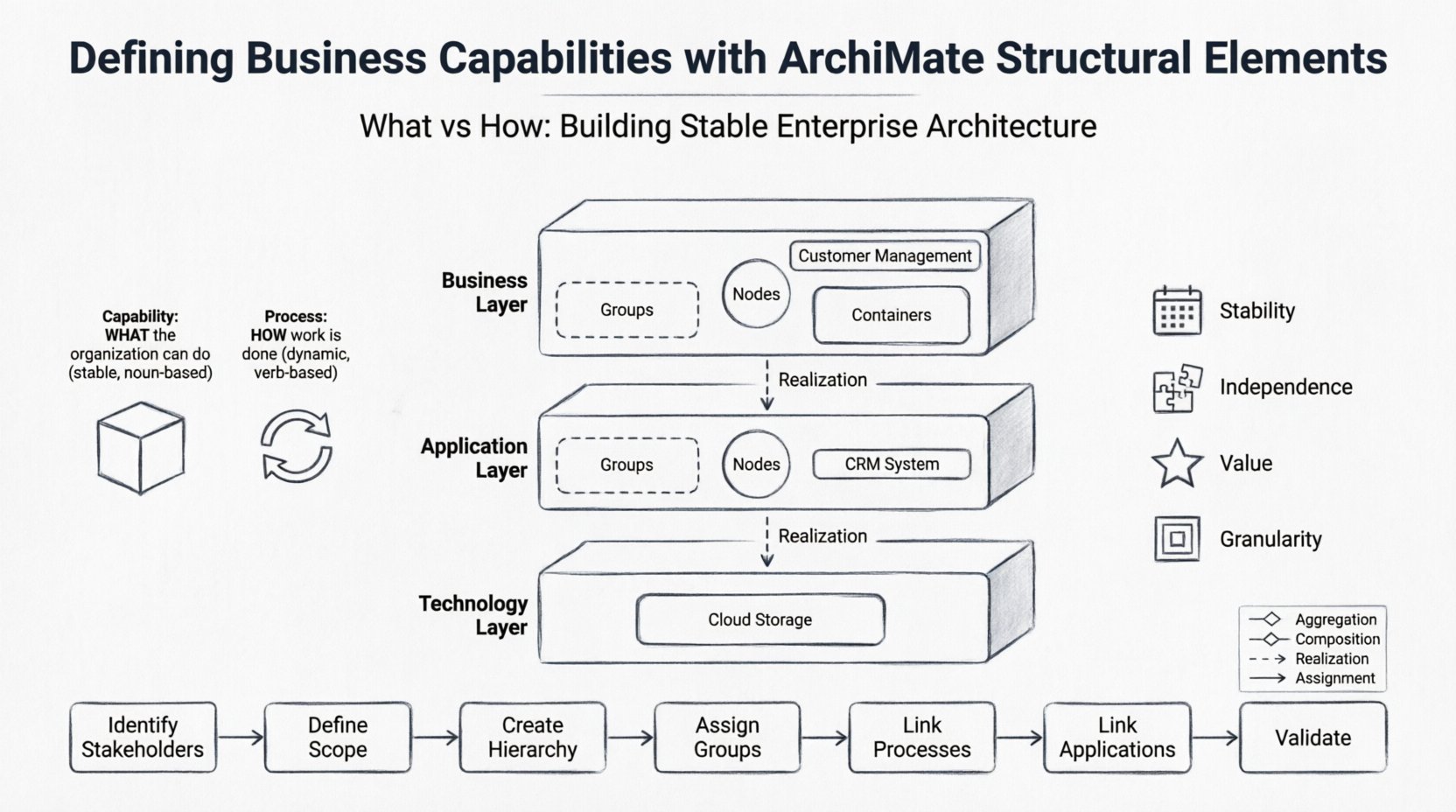
The ArchiMate framework provides a layered approach to modeling enterprise architecture. It separates concerns into distinct layers, such as Business, Application, and Technology. However, within each layer, specific structural elements serve as the building blocks. These elements define the static aspects of the architecture.
- Nodes: Represent processing points or storage points where information is processed or stored.
- Groups: Serve as logical containers for structuring elements.
- Containers: Represent physical or logical devices or software systems.
When defining business capabilities, the focus primarily lies within the Business Layer. However, the structural elements in this layer determine how capabilities are grouped and presented. A capability is an abstraction of an ability to perform a specific function. It is stable and changes infrequently compared to processes.
What Defines a Business Capability? 💡
A business capability is the ability to achieve a business goal. It represents a what, not a how. For example, “Customer Management” is a capability. “Processing a refund” is a process that falls under that capability. Distinguishing these is vital for maintaining a clear architecture model.
To define a capability accurately, consider the following attributes:
- Stability: Capabilities should remain valid for several years. If a capability changes every quarter, it is likely a process or a function, not a capability.
- Independence: A capability should be independent of the specific implementation. It exists regardless of the software used.
- Value: It must deliver value to the organization or its customers.
- Granularity: Capabilities must be broken down into a manageable hierarchy. Too high, and they are vague. Too low, and they become processes.
When modeling these, you are essentially creating a map of the organization’s ability to execute strategy. This map serves as the foundation for impact analysis. If a capability is removed or changed, you can trace the impact on the processes, applications, and technology that support it.
Structural Elements and Organization 🌍
While capabilities are the core content, structural elements provide the container for them. In ArchiMate, structural elements allow architects to group capabilities logically. This is essential for managing complexity in large enterprise models.
The Role of Groups and Aggregations
Groups are used to cluster capabilities. They do not define behavior but rather provide a structural view. For instance, you might group all capabilities related to “Finance” into a single group node. This allows stakeholders to focus on specific domains without being overwhelmed by the entire enterprise model.
- Aggregation: This relationship indicates that a whole is made up of parts. A business capability group can aggregate specific capabilities.
- Composition: A stronger form of aggregation where the parts cannot exist without the whole. In capability mapping, this is less common but can be used for tightly coupled capability clusters.
Using structural elements correctly ensures that the model remains navigable. If you have fifty capabilities, they should be organized into logical buckets. These buckets are often represented by groups or nodes within the Business Layer.
Structural Elements vs. Behavioral Elements
It is crucial to distinguish between structural elements and behavioral elements. Structural elements represent the actors and containers. Behavioral elements represent the actions and events.
| Element Type | Category | Example in Business Layer |
|---|---|---|
| Structural | Static | Business Capability, Business Actor |
| Behavioral | Dynamic | Business Process, Business Function, Business Event |
| Relational | Connective | Assignment, Realization |
When defining capabilities, you are populating the structural column. You are defining the static ability. You link this to behavioral elements like processes to show how the ability is exercised.
Distinguishing Capability from Process ⚙️
One of the most common errors in enterprise architecture is confusing capabilities with processes. A process is a sequence of activities. A capability is the ability to perform those activities. For example, “Order Fulfillment” is a capability. “Picking, Packing, and Shipping” are processes.
- Process Focus: How the work is done. It is optimized for efficiency and flow.
- Capability Focus: What the organization can do. It is optimized for stability and strategic alignment.
When modeling, you should define the capability first. Then, you can model the processes that realize that capability. This approach ensures that if a process changes, the capability remains intact. For example, if you switch from manual picking to automated picking, the capability “Order Fulfillment” remains valid.
Mapping the Relationship
The relationship between a capability and a process is typically a realization or assignment. A process realizes a capability. This means the process provides the means to achieve the ability. In the model, you draw a line from the process to the capability.
This distinction is critical for change management. If the strategy shifts, you might need to change the processes. However, if the strategy shifts to focus on a new area, you might need to create a new capability. Understanding the structural element helps you decide which element to change.
Mapping Capabilities Across Layers 🔄
Archimate is a layered framework. A business capability does not exist in isolation. It relies on capabilities in other layers. Specifically, it relies on application capabilities and technology capabilities. This cross-layer mapping is where the true value of the model emerges.
The Business Layer
This is the primary layer for defining business capabilities. These are the high-level abilities of the organization. Examples include “Financial Reporting” or “Human Resource Management”.
The Application Layer
Application capabilities are the ability of a software system to perform a specific function. A business capability is often realized by one or more application capabilities. For instance, the business capability “Customer Management” might be realized by the application capability “CRM System”.
The Technology Layer
Technology capabilities refer to the hardware or infrastructure capabilities. They support the application layer. A technology capability might be “Cloud Storage” or “Network Connectivity”.
By linking these layers, you can perform impact analysis. If a technology capability is deprecated, you can trace which application capabilities are affected, and subsequently, which business capabilities are at risk.
Guidelines for Naming and Granularity 📝
Consistency in naming conventions is vital for readability. When defining capabilities, follow these guidelines:
- Noun-Based: Use nouns or gerunds (e.g., “Management”, “Analysis”, “Planning”). Avoid verbs as the primary identifier (e.g., “Manage” vs “Management”).
- Standardized Vocabulary: Create a glossary for your organization. Ensure that “Customer Service” is always called “Customer Service” and not “Client Support”.
- Consistent Depth: Maintain a consistent level of detail across the model. If you have a top-level capability “Finance”, its children should be at the same granularity, such as “Financial Planning” and “Financial Reporting”.
- Avoid Overlap: Ensure capabilities do not duplicate each other. If “Sales” and “Revenue Generation” overlap, consolidate them.
Granularity is a balancing act. If your capabilities are too broad, the model is useless for detailed planning. If they are too narrow, the model becomes cluttered. The goal is to find the level where the capability is stable enough to be a structural element but specific enough to drive investment decisions.
Integrating with Value Streams 📈
Value streams describe the sequence of activities that create value for a stakeholder. They are a powerful way to contextualize capabilities. While capabilities represent what you can do, value streams represent how value is delivered.
Mapping capabilities to value streams helps answer critical questions:
- Which capabilities support this specific value stream?
- Are there capabilities that do not support any current value stream (potential waste)?
- Which value stream is most dependent on a specific capability?
In ArchiMate, a capability is often assigned to a value stream. This assignment indicates that the capability is necessary for the value stream to function. For example, the “Order Processing” value stream relies on the “Order Management” capability.
This integration allows for strategic alignment. You can identify which capabilities are critical for the primary value streams and prioritize investment in them. Conversely, you can identify capabilities that are not aligned with current value streams and consider their removal or consolidation.
Best Practices for Modeling 💡
To ensure your ArchiMate model is effective, adhere to these best practices when defining business capabilities.
- Start with Strategy: Derive capabilities from strategic goals. If a capability does not support a strategic goal, question its existence.
- Use Structural Elements for Grouping: Do not use the entire canvas as one list. Use groups and nodes to segment the model by domain.
- Document the Rationale: Add comments to capabilities explaining why they exist. This is helpful for future maintainers of the model.
- Review Regularly: Capabilities should be reviewed annually. The organization changes, and the model must reflect that.
- Keep it Visual: Use the visual nature of ArchiMate to show relationships. Do not rely solely on text descriptions.
Common Pitfalls to Avoid ⚠️
Even experienced architects make mistakes when modeling capabilities. Being aware of common pitfalls can save significant time.
1. Confusing Function with Capability
A function is often an organizational unit’s job description. A capability is an ability that might span multiple units. For example, “IT Support” is often a function. “IT Service Management” is the capability. The capability is more stable than the function.
2. Ignoring Structural Containers
Placing all capabilities on a single canvas makes the model unreadable. Use Groups to organize them. This structural element is essential for managing complexity.
3. Over-Modeling Relationships
Do not create relationships for every possible connection. Focus on the critical links. Too many lines (assignments, realizations, flows) create a spaghetti diagram that is difficult to interpret.
4. Static Definitions
Do not treat the model as a one-time project. Treat it as a living artifact. If a capability is no longer relevant, archive it. Do not leave dead elements in the model.
Implementation Workflow 🛠️
Implementing a capability model involves a systematic approach. Follow these steps to define capabilities using structural elements effectively.
- Identify Stakeholders: Engage with business leaders to understand the high-level abilities of the organization.
- Define the Scope: Determine the boundaries of the model. Which departments are included? Which are excluded?
- Create the Hierarchy: Establish the top-level capabilities. Break them down into sub-capabilities.
- Assign Structural Elements: Use groups to organize the hierarchy logically.
- Link to Processes: Map the capabilities to existing business processes.
- Link to Applications: Identify which applications support which capabilities.
- Validate: Review the model with stakeholders to ensure accuracy.
The Value of Structural Context 🏗️
Using structural elements to define business capabilities provides context. It moves the model from a simple list to a structured representation of the enterprise. This structure allows for better communication between IT and business stakeholders.
When capabilities are grouped within structural nodes, it becomes easier to identify dependencies. If a group node is removed or modified, the impact on the capabilities within it is clear. This structural awareness is crucial for risk management.
Furthermore, structural elements allow for abstraction. You can hide details within a group node and only show them when necessary. This keeps the high-level view clean while maintaining the ability to drill down into specifics.
Summary of Key Takeaways 📋
- Capability vs. Process: Capability is the ability (static); Process is the activity (dynamic).
- Structural Elements: Use Groups and Nodes to organize capabilities logically.
- Layering: Link Business Capabilities to Application and Technology layers for full context.
- Stability: Capabilities change less frequently than processes or applications.
- Value Streams: Use value streams to contextualize how capabilities deliver value.
- Consistency: Maintain consistent naming and granularity across the model.
By adhering to these principles, architects can build robust models that support long-term strategic planning. The definition of business capabilities is not just an exercise in documentation. It is a foundational step in aligning technology with business goals. Using the structural elements of ArchiMate correctly ensures that this alignment is maintained over time, providing a clear view of the enterprise architecture landscape.