
Enterprise architecture serves as the blueprint for organizational transformation. It maps the current state and the desired future state to ensure strategic alignment. A critical phase in this process is the gap analysis. This activity identifies the differences between the baseline architecture and the target architecture. ArchiMate provides a standardized language to represent these differences clearly.
Conducting a gap analysis requires more than just listing missing features. It involves understanding the relationships between business processes, applications, and technology infrastructure. The ArchiMate specification allows architects to model these dependencies effectively. This guide explores the techniques for performing gap analysis within the ArchiMate framework.
📚 Understanding the ArchiMate Layers for Analysis
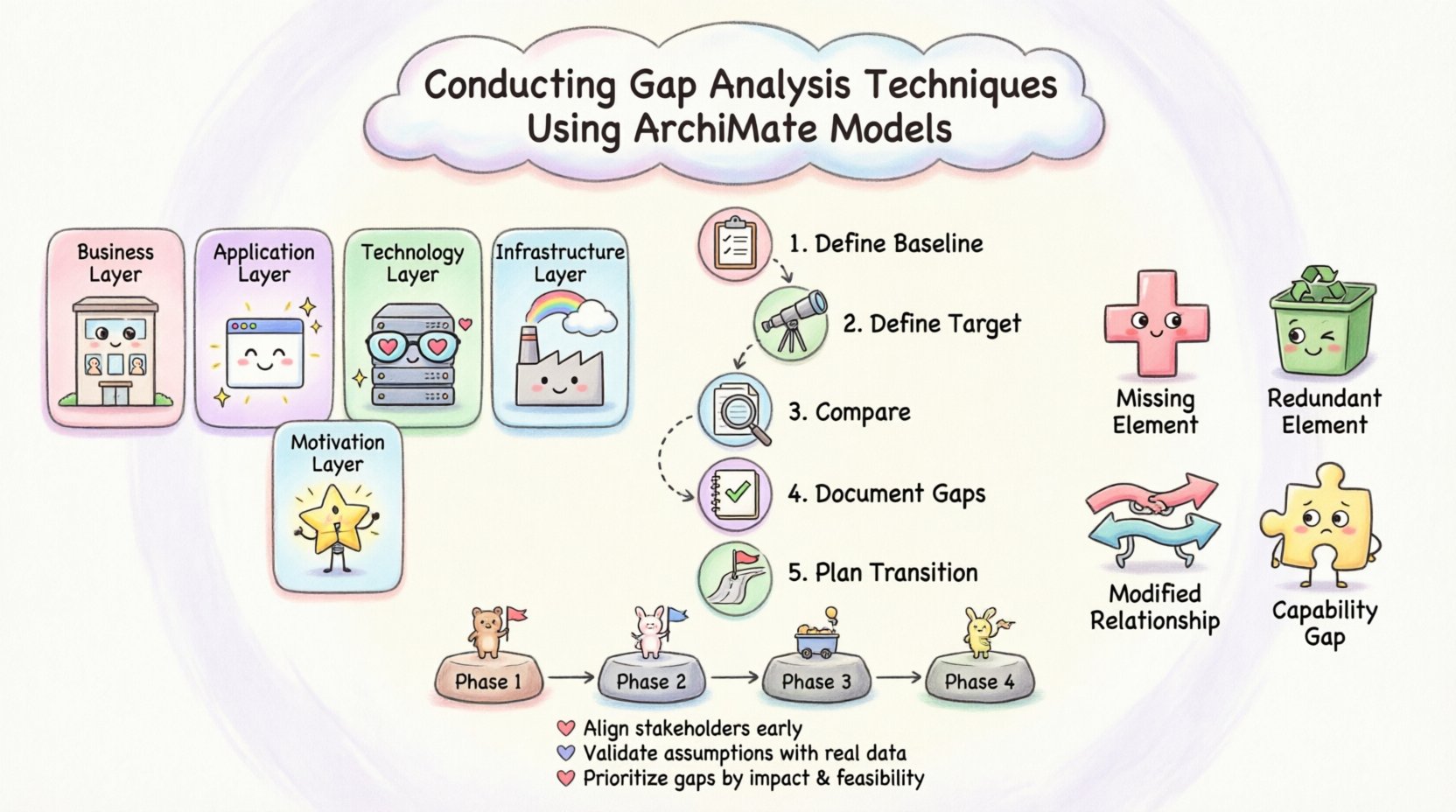
To perform an accurate gap analysis, one must understand the structural layers of the ArchiMate model. The specification divides the architecture into four primary layers. Each layer represents a different aspect of the enterprise.
- Business Layer: Represents the organizational structure, processes, and roles.
- Application Layer: Focuses on the software systems and services.
- Technology Layer: Deals with hardware, networks, and physical infrastructure.
- Infrastructure Layer: Covers the underlying facilities and environment.
In addition to these layers, the Motivation Layer captures the strategic drivers, goals, and principles. This layer is crucial for understanding why a gap exists. The gap is not just a missing capability; it is often a misalignment with strategic objectives.
🔍 The Gap Analysis Process
Performing a gap analysis follows a logical sequence. It moves from definition to comparison, then to documentation and planning. Skipping steps can lead to incomplete models or missed dependencies.
1. Define the Baseline Architecture
The baseline represents the current state of the enterprise. It includes all existing elements, relationships, and capabilities. Accuracy here is vital. If the baseline is incomplete, the gap analysis will be flawed.
- Document existing business processes.
- Map current applications to business services.
- Identify the technology supporting these applications.
- Ensure all relevant stakeholders validate the model.
2. Define the Target Architecture
The target architecture describes the desired future state. It is derived from strategic goals and business requirements. It should be aligned with the baseline structure to ensure consistency.
- Specify new business processes or modified ones.
- Define new application services or retirements.
- Outline the technology infrastructure required.
- Align with the motivation layer to ensure feasibility.
3. Compare Baseline and Target
This is the core of the analysis. The architect compares the two models to identify differences. The comparison should be structured and systematic.
| Comparison Type | Description | Example |
|---|---|---|
| Missing Elements | Elements present in target but not in baseline | A new Customer Portal application |
| Redundant Elements | Elements in baseline not needed in target | Legacy Reporting Tool |
| Modified Relationships | Changes in how elements interact | New data flow between App and System |
| Capability Gaps | Functional areas lacking support | No support for Mobile Access |
4. Document the Gaps
Once identified, gaps must be documented clearly. In ArchiMate, this is often done using specific modeling constructs. The documentation should be actionable for stakeholders.
- Use Gap Analysis Views to visualize the differences.
- Link gaps to specific strategic goals in the Motivation layer.
- Categorize gaps by severity and impact.
- Assign ownership for addressing each gap.
5. Plan the Transition
Closing the gap requires a transition plan. This plan outlines the steps needed to move from baseline to target. The ArchiMate Transition Architecture concept is useful here.
- Define intermediate states.
- Sequence the migration steps.
- Identify dependencies between steps.
- Estimate resources and timeframes.
🛠️ Modeling Techniques for Gap Identification
Effective gap analysis relies on specific modeling techniques. These techniques help visualize the differences without creating excessive complexity.
Using Associations for Comparison
Associations represent generic relationships between elements. When comparing layers, architects often use associations to link baseline elements to target elements. This creates a direct line of sight for the gap.
- Mapping: Connect a baseline business process to a target business process.
- Traceability: Link an application function to the business service it supports.
- Access: Show how a user interacts with a system in both states.
Leveraging Realization Relationships
Realization relationships show how one element implements or realizes another. For example, an application service realizes a business service. When gaps exist, this relationship might be missing in the baseline.
- If a business service exists in the target but has no realization in the baseline, this indicates a capability gap.
- If a technology node is required in the target but absent in the baseline, this is an infrastructure gap.
- Document the missing realization as a specific gap item.
Applying Flow Relationships
Flow relationships describe the movement of data or artifacts. Changes in flow indicate process changes. Comparing flows between layers helps identify data integrity issues.
- Check if data required by a target process exists in the baseline.
- Identify if data sources have changed between states.
- Highlight missing data flows as critical gaps.
📉 Handling Motivation Layer Gaps
Strategic alignment is often the biggest challenge. The Motivation Layer captures the drivers behind the architecture. Gaps here are often overlooked but are critical for success.
Identifying Goal Gaps
Goals define what the organization wants to achieve. A gap exists if a goal in the target state has no corresponding support in the baseline.
- List all strategic goals.
- Check if baseline capabilities support these goals.
- Mark unsupported goals as strategic gaps.
Principles and Constraints
Principles guide decision-making. New principles in the target state might require changes in the baseline. Constraints limit what is possible. Gaps arise when baseline constraints prevent target goals.
- Review baseline constraints against target principles.
- Identify conflicts that must be resolved.
- Document constraints that need to be lifted.
🔄 Transition Architecture and Phasing
Closing gaps rarely happens overnight. Transition architecture breaks the move into manageable phases. This approach reduces risk and allows for feedback.
Phased Implementation
Divide the transition into distinct steps. Each step should close a specific set of gaps.
- Phase 1: Stabilize the baseline.
- Phase 2: Implement critical target capabilities.
- Phase 3: Optimize and integrate remaining elements.
- Phase 4: Achieve full target state.
Managing Dependencies
Dependencies dictate the order of operations. A gap in one layer might block progress in another.
- Map dependencies between layers (e.g., Technology to Application).
- Ensure infrastructure is ready before application deployment.
- Verify business processes are defined before tool configuration.
🚧 Common Challenges in ArchiMate Gap Analysis
Several challenges can hinder the accuracy and effectiveness of gap analysis. Awareness of these issues helps in planning mitigation strategies.
Complexity Overload
Attempting to model every single element can lead to overwhelming models. It becomes difficult to see the gaps.
- Focus on key capabilities first.
- Use views to filter information.
- Abstract details where possible.
Inconsistent Granularity
The baseline might be detailed while the target is high-level, or vice versa. This makes comparison difficult.
- Standardize the level of detail across both models.
- Ensure business processes are defined at the same hierarchy level.
- Align application functions to business services consistently.
Stakeholder Alignment
Different departments may have conflicting views of the baseline or target.
- Conduct workshops to validate the models.
- Resolve conflicts before finalizing the gap list.
- Document assumptions clearly.
✅ Best Practices for Effective Modeling
Following established practices ensures the gap analysis is robust and reliable.
Consistency in Naming
Use consistent naming conventions for elements. This makes comparison easier.
- Define a naming standard for the project.
- Use the same names for common services in both layers.
- Update the glossary regularly.
Version Control
Architectural models change over time. Versioning helps track the evolution of the gap analysis.
- Label baseline and target versions clearly.
- Record the date of the analysis.
- Archive previous versions for audit trails.
Iterative Refinement
Gap analysis is not a one-time activity. It should be refined as more information becomes available.
- Review gaps at key project milestones.
- Update models based on new requirements.
- Validate closure of gaps before moving to the next phase.
📝 Conclusion on Architectural Alignment
Gap analysis using ArchiMate models provides a structured approach to understanding the distance between current and future states. It moves beyond simple lists to show the structural implications of the change. By utilizing the layers and relationships defined in the specification, architects can create a clear roadmap for transformation.
The process requires discipline and attention to detail. It involves mapping business processes, application services, and technology nodes. It also requires understanding the strategic drivers behind the change. When executed correctly, this analysis ensures that investments are aligned with business needs.
Success depends on accurate modeling and clear communication. Stakeholders must understand the gaps and the plan to address them. Transition architecture bridges the gap, ensuring a smooth move to the target state. Continuous monitoring ensures that the architecture remains aligned with the evolving enterprise.
By adhering to these techniques and best practices, organizations can manage complexity and achieve their strategic goals. The ArchiMate specification remains a powerful tool for this purpose. It offers the necessary granularity and structure to handle large-scale transformations effectively.