Developing a sustainable business requires more than just a good idea. It demands a structured understanding of how value is created, delivered, and captured. The Business Model Canvas (BMC) serves as a strategic management tool that visualizes this logic. Unlike traditional business plans, which can be lengthy and static, the BMC condenses the essence of a business into a single page. This approach allows for agility and rapid iteration.
This comprehensive guide walks you through the process of filling out your canvas. We will examine the nine building blocks, explore how they interact, and provide practical steps to ensure your model is robust. By the end of this article, you will have a clear, actionable blueprint for your venture.
🧐 Understanding the Business Model Canvas
Before diving into the specifics, it is important to understand the origin and purpose of this framework. Developed by Alexander Osterwalder and Yves Pigneur, the BMC is designed for entrepreneurs, managers, and strategists. It focuses on the four main pillars of a business: customers, offering, infrastructure, and financial viability.
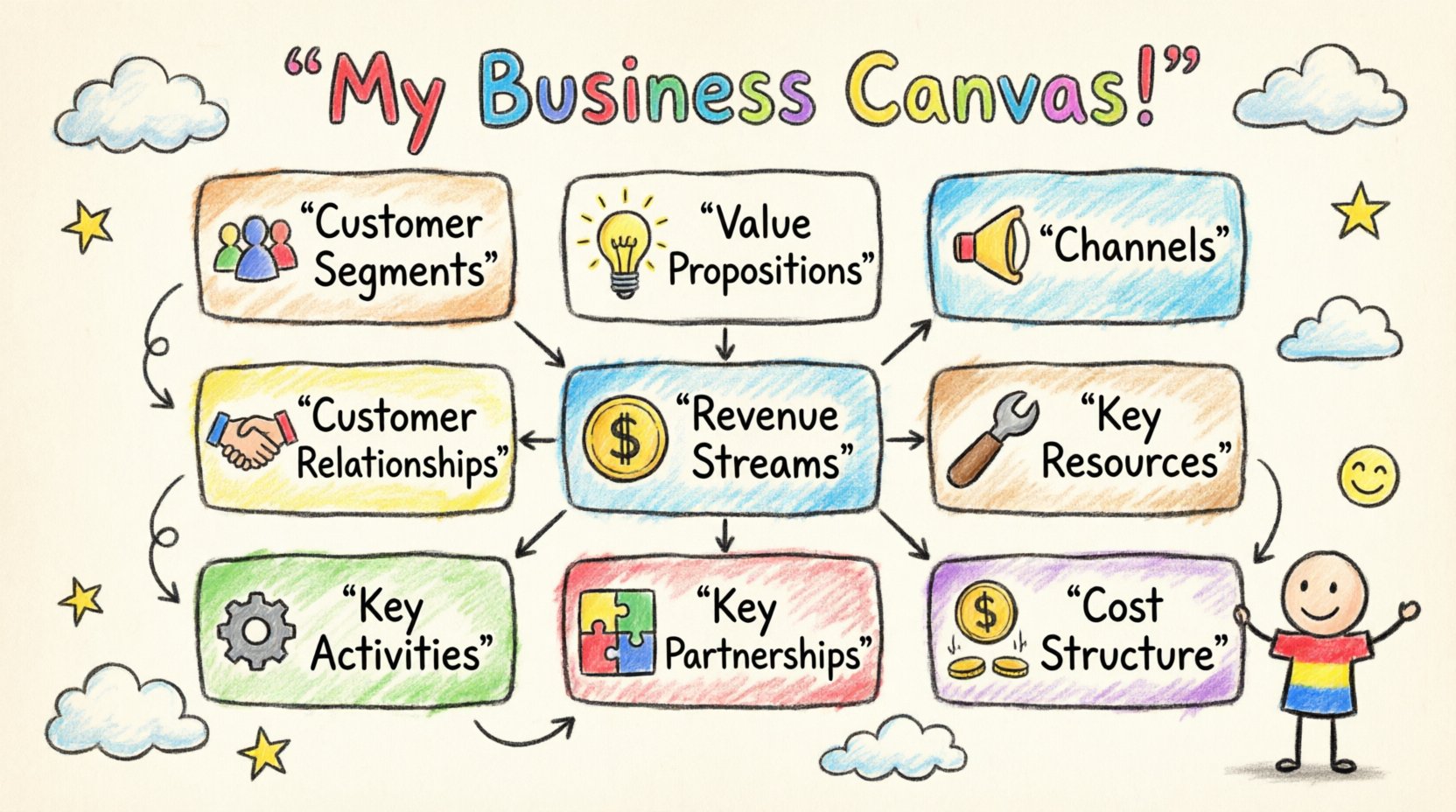
The canvas is divided into nine sections. These sections are not isolated; they are interconnected. For instance, your Key Resources must support your Key Activities, which in turn enable your Value Propositions. Understanding these relationships is crucial for a coherent strategy.
Using the BMC helps you avoid common pitfalls such as focusing too much on the product and neglecting the customer. It forces you to articulate your assumptions explicitly. This clarity is vital for securing funding or aligning internal teams.
🏗️ The 9 Building Blocks Explained
To fill the canvas effectively, you must understand each component. Below, we break down the nine blocks with detailed questions and considerations for each.
1. 👥 Customer Segments
Every business exists to serve a specific set of people or organizations. Defining who your customers are is the foundation of your model. You cannot be everything to everyone.
- Mass Market: No specific segmentation. You aim for the general public (e.g., consumer electronics).
- Niche Market: A specific group with specialized needs (e.g., professional photography equipment).
- Segmented: Distinct groups with different needs but overlapping characteristics.
- Multi-sided Platforms: Two or more interdependent customer groups (e.g., credit card users and merchants).
Key Question: For whom are we creating value? Who are our most important customers?
2. 💡 Value Propositions
This block describes the bundle of products and services that create value for a specific customer segment. It is the reason customers turn to you instead of a competitor.
Value propositions can be quantitative (price, speed) or qualitative (design, customer experience). They often solve a specific problem or satisfy a need.
- Performance: Does the product work better than alternatives?
- Customization: Is the offering tailored to the user?
- Pain Relievers: Does it reduce the effort or cost of a problem?
- Gain Creators: Does it produce positive outcomes or benefits?
Key Question: What value do we deliver to the customer? Which of our customer’s problems are we helping to solve?
3. 📢 Channels
Channels are how a company communicates with and reaches its customer segments to deliver a value proposition. They are touchpoints where the customer experiences the business.
- Owned Channels: Your website, physical stores, or sales force.
- Partner Channels: Distributors, retailers, or affiliates.
Effectiveness is measured by reach, frequency, and cost. Channels also serve as the interface for the customer relationship.
Key Question: Through which channels do our customer segments want to be reached? How are we reaching them now?
4. 🤝 Customer Relationships
This block describes the types of relationships a company establishes with specific customer segments. Relationships can be automated or personal, or a mix of both.
- Personal Assistance: Direct human interaction (e.g., dedicated account manager).
- Automated Services: Self-service without direct interaction.
- Self-Service: The customer does everything themselves.
- Communities: Creating a platform where users interact with each other.
- Co-creation: Working with the customer to create the value.
Key Question: What relationships does each customer segment expect us to establish? How costly are they to maintain?
5. 💰 Revenue Streams
This block represents the cash a company generates from each customer segment. It is the financial heart of the model.
Revenue can come from various sources:
- Asset Sale: Selling ownership of a product.
- Usage Fee: Charging based on how much a service is used.
- Subscription Fees: Recurring revenue for continued access.
- Lending/Renting: Temporary access to assets.
- Advertising: Charging for space to display ads.
Key Question: For what value are our customers really willing to pay? How do they currently pay? How would they prefer to pay?
6. 🛠️ Key Resources
Key resources are the most important assets required to make a business model work. They can be physical, intellectual, human, or financial.
- Physical: Buildings, vehicles, machines.
- Intellectual: Patents, copyrights, data, customer databases.
- Human: Staff, management, specialists.
- Financial: Cash, credit lines, stock options.
Key Question: What key resources do our value propositions require? Who are our key partners? What key resources do our partners provide?
7. ⚙️ Key Activities
Key activities are the most important things a company must do to make its business model work. These activities vary by industry type (production, problem-solving, platform/network).
- Production: Designing, making, and delivering a product.
- Problem Solving: Developing new solutions to individual customer problems.
- Platform/Network: Maintaining the platform and supporting the users.
Key Question: What key activities do our value propositions require? Who are our key partners? What key activities do our partners perform?
8. 🤝 Key Partnerships
Key partnerships are the network of suppliers and partners that make the business model work. Companies form partnerships to optimize efficiency, reduce risk, or acquire resources.
- Strategic Alliances: Between non-competitors.
- Co-opetition: Strategic partnerships between competitors.
- Joint Ventures: To develop new businesses.
- Buyer-Supplier Relationships: To ensure reliable supplies.
Key Question: Who are our key suppliers? Which key resources are we acquiring from partners? Which key activities do partners perform?
9. 💸 Cost Structure
The cost structure describes all costs incurred to operate a business model. It can be cost-driven (lowest possible cost) or value-driven (premium value).
- Fixed Costs: Costs that do not change with production volume (rent, salaries).
- Variable Costs: Costs that vary with output (materials, shipping).
- Economies of Scale: Costs decrease as volume increases.
- Economies of Scope: Costs decrease as variety increases.
Key Question: What are the most important costs inherent in our business model? Which key resources/activities are most expensive?
📊 Mapping the Relationships
To visualize how these blocks connect, consider the following summary table. This structure helps ensure logical consistency across your canvas.
| Building Block | Primary Focus | Key Metric Example |
|---|---|---|
| Customer Segments | Who we serve | Market Size, Retention Rate |
| Value Propositions | Why they choose us | Customer Satisfaction Score |
| Channels | How we reach them | Cost per Acquisition |
| Customer Relationships | How we interact | Churn Rate, Lifetime Value |
| Revenue Streams | How we earn | Gross Margin, Revenue Growth |
| Key Resources | What we need | Asset Utilization |
| Key Activities | What we do | Operational Efficiency |
| Key Partnerships | Who helps us | Partner Satisfaction |
| Cost Structure | What we spend | Cost of Goods Sold |
🚀 Step-by-Step Execution Process
Filling out the canvas is a dynamic process. It is not a one-time event but a cycle of planning and testing. Follow these steps to execute the process effectively.
Step 1: Preparation and Setup
Gather your core team. You need diverse perspectives to avoid blind spots. Prepare large sheets of paper, sticky notes, and markers. Physical tools often work better than digital ones for brainstorming because they allow for easy movement of ideas.
- Define the Scope: Is this for a new startup or an existing division?
- Set the Time: Allocate at least 2 to 4 hours for a focused session.
- Assign Roles: Have someone facilitate, someone write, and others contribute.
Step 2: Start with the Right Side
Begin with the Customer Segments and Value Propositions. This is the “front end” of the business. If you do not have a clear value for a specific customer, the rest of the model will not matter.
- Write down potential customer segments on sticky notes.
- Brainstorm value propositions for each segment.
- Ensure there is a clear link between the problem and the solution.
Step 3: Fill the Infrastructure
Once the value is defined, determine how you will deliver it. Fill in the Channels, Customer Relationships, and Revenue Streams.
- Map out the customer journey from awareness to purchase.
- Identify the most efficient channels for your specific market.
- Decide on the pricing strategy that matches the value delivered.
Step 4: Define the Backend
Now, look at the Key Resources, Key Activities, and Key Partnerships. These are the internal mechanics required to support the front end.
- List the essential assets you currently possess.
- Identify gaps that require partnerships or outsourcing.
- Ensure your activities directly support your value proposition.
Step 5: Calculate the Economics
Finally, fill in the Cost Structure. This should be the last step to avoid biasing the creative process. Estimate the costs based on the activities and resources you have listed.
- Distinguish between fixed and variable costs.
- Compare total costs against projected revenue streams.
- Identify areas where costs can be optimized without hurting quality.
🔄 Validating and Iterating
A canvas on paper is only a hypothesis. The real test is in the market. You must validate your assumptions with real customers.
- Customer Interviews: Ask potential users about their pain points. Does your value proposition resonate?
- Minimum Viable Product (MVP): Build a basic version of the service to test the channels and revenue model.
- Feedback Loops: Collect data on usage and satisfaction.
Business models are dynamic. As the market changes, your canvas must evolve. Schedule regular review sessions to update the model. If a customer segment stops responding, move the focus. If a new partnership reduces costs, update the structure.
⚠️ Common Pitfalls to Avoid
Even with a clear guide, mistakes happen. Be aware of these common errors to maintain the integrity of your planning.
- Too Many Segments: Trying to serve everyone dilutes your value. Focus on the most profitable or viable segment first.
- Ignoring Costs: Focusing only on revenue can lead to unsustainable operations. Be realistic about your cost structure.
- Static Thinking: Treating the canvas as a final document rather than a living tool. Update it frequently.
- Disconnects: Ensure your Key Resources actually support your Key Activities. If there is a gap, the model will fail.
- Over-reliance on Partners: If you depend too heavily on one supplier or partner, you create a single point of failure.
📈 Conclusion and Next Steps
The Business Model Canvas is a powerful tool for strategic thinking. It simplifies complex business logic into manageable components. By following the steps outlined here, you can create a coherent and testable business plan.
Remember that the goal is not perfection on the first try. The goal is clarity. Use the canvas to communicate your vision to stakeholders and to guide your decision-making. As you gather market data, refine the blocks. This iterative process leads to a resilient business model capable of adapting to change.
Start with a blank sheet today. Map out your current reality or your future vision. The clarity you gain will be the foundation of your success.