In the fast-paced world of modern business, growth often brings complexity. Company X was a prime example of this dynamic. Starting as a niche player in the logistics sector, they experienced rapid expansion over five years. What began as a manageable operation quickly evolved into a sprawling enterprise with multiple divisions, international offices, and a vast array of digital services. However, this growth came at a cost. The organization found itself grappling with siloed data, redundant processes, and a technology stack that no longer supported their strategic goals. 📉
Leadership recognized that traditional project management was insufficient for the scale they had achieved. They needed a structured approach to architecture. They turned to The Open Group Architecture Framework (TOGAF). This case study explores how Company X implemented TOGAF to navigate their transformation, manage technical debt, and align their business capabilities with their technology investments. 🛠️
🧩 The Challenge: Growing Pains and Fragmentation
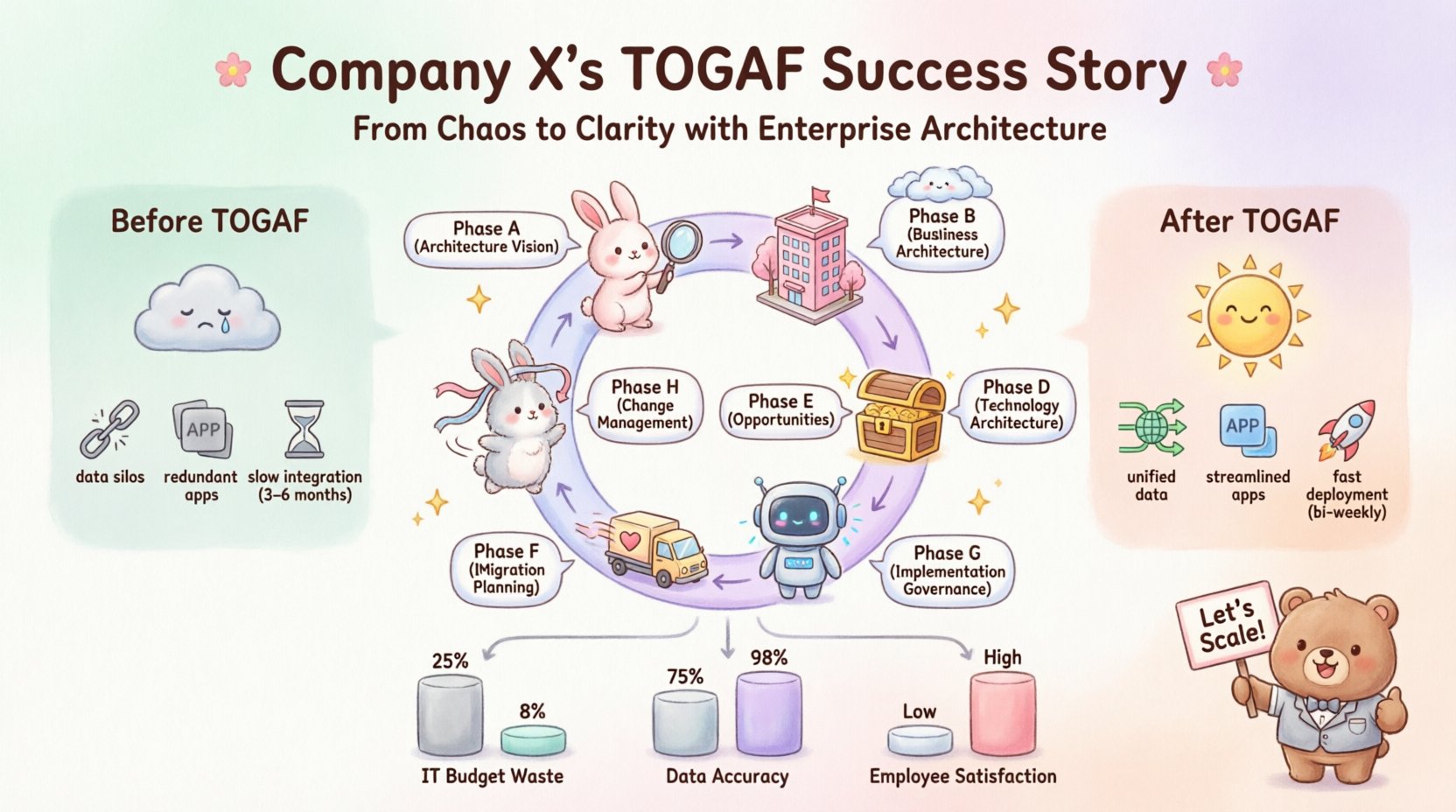
Before the adoption of a formal framework, Company X operated with a decentralized model. Each division built its own solutions based on immediate needs. While this allowed for speed initially, it created significant issues as the organization matured.
- Data Silos: Customer information was stored in multiple locations, making a unified view impossible.
- Redundancy: Different teams built similar applications, wasting resources and budget.
- Integration Issues: New tools often clashed with existing infrastructure, leading to downtime and performance bottlenecks.
- Strategic Misalignment: IT initiatives did not always support the core business objectives of the company.
Executives realized that without a cohesive strategy, future scaling would be unsustainable. They needed a methodology that could bridge the gap between business strategy and technical execution. This is where the Architecture Development Method (ADM) cycle within TOGAF became essential. 🔄
📋 Phase A: Architecture Vision
The journey began with the initial phase of the ADM cycle. The goal here was not to build anything immediately, but to define the scope and constraints of the initiative. A steering committee was formed, comprising senior stakeholders from both business and technical sides. 👥
Key activities during this phase included:
- Stakeholder Identification: Mapping out who had influence over the architecture and who would be affected by changes.
- Defining the Scope: Determining which business units would be part of the initial rollout and which would follow in later iterations.
- Establishing Principles: Creating a set of rules to guide decision-making, such as “buy before build” and “data must be standardized across all regions”.
By defining these principles early, Company X avoided the common pitfall of scope creep. The team documented the current state of the architecture and outlined the desired future state. This vision provided a clear North Star for all subsequent work. 🧭
🏭 Phase B: Business Architecture
Before touching technology, the team needed to understand the business itself. Phase B focused on modeling the business processes, organization structures, and information flows. This ensured that any technical changes would directly support operational needs. 🏢
The team mapped out the end-to-end supply chain processes. They identified critical pain points where automation could yield the highest return on investment. For instance, they discovered that manual data entry between the sales and fulfillment departments was a major source of errors.
Key outcomes of this phase included:
- Process Standardization: Identifying variations in how different departments handled orders and creating a unified standard.
- Capability Mapping: Listing the specific capabilities the organization needed to possess to compete effectively in the market.
- Gap Analysis: Comparing current capabilities against future requirements to determine where investment was needed.
This phase proved crucial. It shifted the conversation from “what software do we need?” to “what business capabilities do we need to deliver?”. This alignment ensured that technology spending was driven by value, not just novelty. 💡
🗄️ Phase C: Information Systems Architectures
With the business landscape understood, the focus shifted to data and applications. Phase C is often where the most tangible technical work begins. The objective was to design the data architecture and application architecture that would support the business processes defined in Phase B. 📊
The team faced the challenge of legacy systems. Company X had been running on-premises servers for over a decade. Moving to a cloud-native environment was a priority, but it required careful planning to ensure data integrity.
- Data Architecture: A master data management strategy was developed. This defined how customer, product, and supplier data would be governed and shared across the enterprise.
- Application Architecture: The team audited all existing applications. Many were retired, while others were refactored to support microservices patterns.
- Integration Strategy: A service-oriented architecture (SOA) approach was adopted to allow systems to communicate seamlessly without tight coupling.
By standardizing data models, Company X eliminated the silos mentioned in the introduction. Reports that previously took days to compile could now be generated in real-time. This shift empowered decision-makers with accurate, timely information. ⚡
🖥️ Phase D: Technology Architecture
Phase D addressed the underlying infrastructure. This involved selecting the hardware, software platforms, and network standards required to support the applications and data layers. 🔌
The team evaluated various infrastructure options. They considered cost, scalability, and security requirements. The decision was made to adopt a hybrid cloud model. This allowed Company X to keep sensitive financial data on-premises for compliance reasons while leveraging the elasticity of the public cloud for customer-facing applications.
Key considerations during this phase included:
- Security Posture: Implementing zero-trust network principles to protect against modern threats.
- Scalability: Ensuring the infrastructure could handle traffic spikes during peak seasons without manual intervention.
- Compliance: Adhering to international regulations regarding data residency and privacy.
This architectural foundation provided the stability needed for the organization to expand into new markets. The technology stack became an enabler of growth rather than a constraint. 🌐
🚀 Phase E: Opportunities and Solutions
Now that the target architectures were defined, the team needed a roadmap. Phase E focused on identifying projects that would bridge the gap between the current state and the target state. This is where the transformation plan was solidified. 📅
Projects were categorized based on urgency and value. High-value, quick-win projects were prioritized to demonstrate early success and build momentum. Longer-term initiatives were sequenced to ensure dependencies were met.
- Project Portfolio: A curated list of initiatives was created, each linked to specific business capabilities.
- Resource Allocation: Budget and personnel were assigned based on the strategic importance of each project.
- Risk Assessment: Potential risks were identified for each initiative, and mitigation strategies were developed.
This structured approach to project management prevented the chaos that often accompanies large-scale transformations. Every project had a clear justification and a defined endpoint. ✅
🔄 Phase F: Migration Planning
Phase F was about the detailed planning of the transition. It involved creating specific migration plans for different workstreams. The team needed to ensure minimal disruption to daily operations during the switch. 🛠️
Migration was not a “big bang” event. It was executed in waves. Core systems were migrated first, followed by less critical applications. This phased approach allowed the team to learn and adjust as they went.
Key elements of the migration plan included:
- Rollback Strategies: Ensuring that if a migration failed, the system could revert to the previous stable state quickly.
- Training Programs: Preparing staff for new tools and processes to ensure adoption was smooth.
- Communication Plans: Keeping all stakeholders informed about progress and potential impacts.
This careful planning reduced downtime to near zero during the transition. The organization maintained service levels throughout the entire migration process. 🤝
🔒 Phase G: Implementation Governance
Once the projects were underway, governance became critical. Phase G ensured that the implementation adhered to the architecture principles defined earlier. Without governance, teams might drift back to old habits, undermining the entire effort. 🛡️
A Architecture Review Board (ARB) was established. This group reviewed project proposals and designs to ensure compliance with the enterprise architecture. They had the authority to stop projects that deviated from the plan.
- Compliance Checks: Regular audits were conducted to verify adherence to standards.
- Change Management: A formal process was put in place for handling changes to the architecture.
- Issue Tracking: Any deviations or non-compliance issues were logged and resolved systematically.
This governance model ensured quality and consistency. It prevented the reintroduction of technical debt and maintained the integrity of the architecture over time. 📉
🌱 Phase H: Architecture Change Management
Architecture is not a one-time event; it is a continuous cycle. Phase H focuses on managing changes to the architecture as the business evolves. This ensures the framework remains relevant and effective. 🔄
Company X established a feedback loop. Lessons learned from projects were fed back into the architecture repository. This allowed the organization to refine its principles and standards based on real-world experience.
- Continuous Improvement: Regular reviews of the architecture to identify areas for optimization.
- Knowledge Management: Ensuring that architectural decisions were documented and accessible to all teams.
- Evolution Planning: Anticipating future trends and preparing the architecture to adapt.
This phase turned TOGAF from a static document into a living methodology. The organization remained agile and responsive to market changes. 📈
📊 Results and Impact
After two years of implementation, Company X saw measurable improvements across the board. The structured approach provided by TOGAF allowed them to manage complexity while scaling operations. 🏆
The table below summarizes the key performance indicators before and after the transformation:
| Metric | Before TOGAF | After TOGAF |
|---|---|---|
| System Integration Time | 3-6 months | 2-3 weeks |
| IT Budget Waste | 25% | 8% |
| Employee Satisfaction (IT) | Low (High frustration) | High (Clear processes) |
| Data Accuracy | 75% | 98% |
| New Feature Deployment | Quarterly | Bi-weekly |
Beyond the numbers, the cultural shift was profound. Teams felt empowered to innovate within the guardrails set by the architecture. Collaboration improved because everyone spoke the same language. 🗣️
🔑 Key Takeaways for Success
Based on the experience of Company X, several critical factors contributed to the successful adoption of the framework:
- Executive Sponsorship: Leadership support was vital to drive the cultural change required for architecture adoption.
- Phased Approach: Tackling the ADM cycle in stages prevented overwhelming the organization.
- Stakeholder Engagement: Involving business leaders ensured the architecture remained business-centric.
- Iterative Refinement: The architecture was treated as a living document, updated as needs changed.
- Focus on Principles: Establishing clear principles guided decision-making when specific details were unclear.
🤝 Final Thoughts
Scaling a business is rarely just about adding more resources. It is about organizing those resources effectively. Company X demonstrated that a structured framework can provide the necessary discipline to manage growth without losing agility. By adopting the Architecture Development Method, they transformed their technology from a cost center into a strategic asset. 🌟
The journey was not without challenges. It required patience, persistence, and a willingness to change long-standing habits. However, the payoff was a resilient, scalable organization ready for the future. For any enterprise facing similar complexity, following a proven framework like TOGAF offers a path forward that balances innovation with stability. 🛤️
Ultimately, the goal is not to create perfect documentation, but to enable better decision-making. When architecture serves the business, growth becomes sustainable. Company X proved that with the right approach, scaling is achievable without chaos. 🚀