Enterprise Architecture (EA) frameworks are designed to bring structure to complex business environments. The Open Group Architecture Framework (TOGAF) stands as one of the most recognized methodologies globally. It provides a standardized approach for designing, planning, implementing, and governing enterprise information architecture. However, the gap between theoretical adoption and practical success is often wide. Many organizations invest significant resources into certification and documentation, only to find the framework struggling to deliver tangible business value.
This guide examines the frequent pitfalls encountered during TOGAF implementation. By understanding these challenges, architecture teams can navigate the complexities of the Architecture Development Method (ADM) more effectively. We will explore governance, culture, documentation, and the practical application of the ADM cycle without relying on specific software tools.
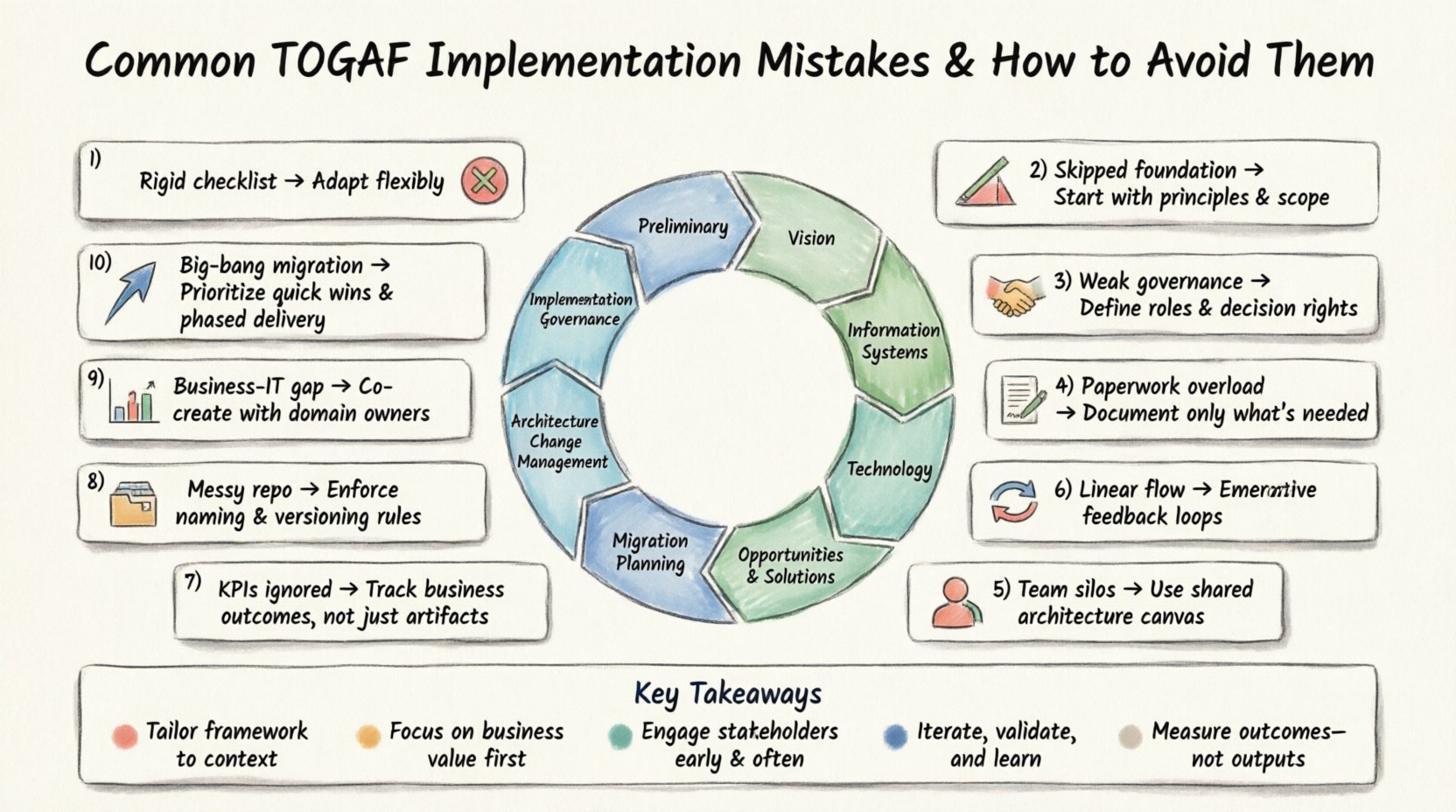
1. Misinterpreting the Framework as a Rigid Checklist ❌
A primary reason for failure is treating TOGAF as a prescriptive list of deliverables rather than a flexible methodology. Organizations often attempt to force every phase of the Architecture Development Method (ADM) into their projects, regardless of relevance. This leads to administrative overhead without strategic benefit.
- The Problem: Teams feel compelled to produce every document defined in the TOGAF Standard, such as the Architecture Vision, Statement of Architecture Work, and various architecture views, even for small-scale IT changes.
- The Consequence: Resources are diverted from actual solution design to creating documentation. Stakeholders lose interest because they do not see immediate value in the output.
- The Solution: Tailor the framework. Use the TOGAF ADM as a guide, not a rulebook. Identify which phases add value to the specific business problem at hand. Adapt the scope to fit the project size and complexity.
2. Neglecting the Preliminary Phase 🏗️
The Preliminary Phase is often rushed or skipped entirely. This phase is where the organization defines its specific Architecture Capability. It involves setting up the architecture governance, defining the principles, and establishing the architecture repository.
- The Problem: Jumping straight into the Vision Phase (Phase A) without establishing the foundation. This results in a lack of context for subsequent architecture work.
- The Consequence: Architectures are built without agreed-upon principles or governance rules. Different teams create conflicting standards, leading to siloed solutions and technical debt.
- The Solution: Dedicate time to establish the architecture principles and the architecture contract. Ensure that the governance model is approved by leadership before starting specific architecture projects.
3. Governance and Organizational Alignment Issues 🤝
Successful architecture requires strong governance. Without it, architecture decisions are ignored, or business units operate independently of the strategic plan. Governance is not just about approval; it is about alignment.
Consider the following comparison regarding governance structures:
| Weak Governance Structure | Strong Governance Structure |
|---|---|
| Architecture team has no authority. | Architecture board holds decision-making power. |
| Compliance is checked post-project. | Compliance is a gate in the project lifecycle. |
| Stakeholders are informed after decisions. | Stakeholders are engaged during design. |
| Principles are optional guidelines. | Principles are mandatory constraints. |
Key Governance Challenges
- Lack of Executive Sponsorship: If senior leadership does not champion the architecture function, the team lacks the political capital to enforce standards.
- Isolated Architecture Teams: When the EA team operates in a vacuum, disconnected from business units, their outputs become irrelevant to daily operations.
- Unclear Roles: Ambiguity regarding who is responsible for compliance leads to gaps where no one takes ownership of architectural debt.
4. Over-Documentation and Analysis Paralysis 📝
TOGAF encourages comprehensive documentation through artifacts like the Architecture Repository and Architecture Definition Documents. However, there is a fine line between necessary documentation and excessive bureaucracy.
- The Problem: Spending weeks creating detailed diagrams and specifications that no one reads or updates.
- The Consequence: The architecture documentation becomes outdated before it is published. This erodes trust in the architecture function. Developers may bypass the documentation entirely and build what they see fit.
- The Solution: Adopt a “living documentation” approach. Use tools and repositories that allow for easy updates. Prioritize high-level views for stakeholders and detailed views for implementation teams. Ensure that every document has an owner responsible for its maintenance.
5. Ignoring the Iterative Nature of the ADM 🔄
The Architecture Development Method is designed to be iterative. It is not a linear waterfall process. Projects often move back and forth between phases as new information emerges or requirements change.
- The Problem: Treating the ADM as a strict sequence where Phase A must finish completely before Phase B begins. In reality, requirements evolve, and architecture must adapt.
- The Consequence: Inflexibility. When the business environment shifts, the architecture cannot pivot quickly enough, leading to solutions that miss the market.
- The Solution: Embrace iteration. Allow movement between phases as needed. Use incremental releases of architecture components. Implement feedback loops where stakeholders review the architecture at regular intervals, not just at the end of a phase.
6. Underestimating the Human Element 👥
Architecture is fundamentally about people, technology, and business processes. Focusing solely on the technical models ignores the cultural resistance that often accompanies change.
Common Cultural Pitfalls
- Resistance to Change: Teams accustomed to legacy ways of working may view new architectural standards as obstacles. Communication must focus on benefits, not just compliance.
- Skill Gaps: Implementing TOGAF requires specific skills in modeling, stakeholder management, and strategic thinking. If the team lacks training, the framework will be misapplied.
- Lack of Communication: Complex architecture concepts must be translated into business language. If stakeholders do not understand the value, they will not support the initiative.
7. Failure to Measure Success 📊
Without metrics, it is impossible to determine if the architecture investment is paying off. Many organizations fail to define Key Performance Indicators (KPIs) for their architecture function.
- Missing Metrics: Relying solely on the number of documents produced. This is a vanity metric.
- Relevant Metrics: Focus on outcomes. Examples include:
- Reduction in project delivery time due to reusable components.
- Decrease in technical debt incidents.
- Alignment score between business initiatives and IT capabilities.
- Reduction in integration costs between systems.
8. The Architecture Repository Neglect 📂
A central repository is a core concept in TOGAF. It stores all architecture artifacts, standards, and models. If this repository is poorly managed, it becomes a graveyard of unused data.
- The Problem: Storing documents in shared drives without version control or metadata. Searching for information becomes a guessing game.
- The Consequence: Duplicate work. Different teams solve the same problems because they cannot find existing solutions. Inconsistency arises because standards are not centrally accessible.
- The Solution: Implement a structured repository. Ensure it is searchable. Define clear taxonomy and classification rules. Establish a process for archiving obsolete artifacts to keep the repository clean.
9. Disconnect Between Business and IT 📉
The goal of Enterprise Architecture is to bridge the gap between business strategy and IT execution. When this bridge is weak, IT delivers systems that do not support business goals.
- Strategic Misalignment: Architecture teams often focus on technology stacks rather than business capabilities. This leads to technical excellence without business relevance.
- Language Barriers: Architects speak in technical jargon, while business leaders speak in revenue and risk. Bridging this gap is essential for effective communication.
- Remedy: Map technology directly to business capabilities. Use Business Capability Modeling to ensure every IT investment ties back to a business outcome. Involve business stakeholders in the design process.
10. Skipping the Migration Planning Phase 🚀
Phase G (Migration Planning) and Phase H (Implementation Governance) are critical for transitioning from the current state to the target state. Skipping or rushing these phases leads to implementation chaos.
- The Problem: Defining the target state but failing to plan the steps to get there. This is known as the “Valley of Death” in architecture.
- The Consequence: Projects stall because there is no roadmap. Prioritization is unclear, and resources are wasted on low-value initiatives.
- The Solution: Develop a detailed Migration Plan. Prioritize work packages based on business value and feasibility. Create a transition architecture to guide the interim states. Ensure that governance monitors the implementation against the plan.
Building a Sustainable Architecture Practice 🛠️
Avoiding these mistakes requires a shift in mindset. It is not about enforcing rules but about enabling the business. The framework should serve the organization, not the other way around.
Start small. Pilot the approach in one department or project. Refine the processes based on feedback. Build a community of practice where architects share knowledge and lessons learned. This creates a culture of continuous improvement rather than rigid compliance.
Key Takeaways for Success
- Tailor the Framework: Adapt TOGAF to fit your organization’s size and needs.
- Focus on Value: Ensure every output contributes to business goals.
- Engage Stakeholders: Communication is more important than documentation.
- Iterate and Learn: Treat the ADM as a cycle, not a straight line.
- Measure Outcomes: Define clear metrics for success.
By addressing these common pitfalls, organizations can move beyond theoretical adoption and achieve genuine architectural maturity. The journey requires patience and commitment, but the result is a resilient, agile, and aligned enterprise capable of navigating future challenges.