Building a startup is rarely a solo endeavor. It is a high-stakes partnership where vision, execution, and capital must converge. Yet, statistics show that a significant portion of early-stage ventures fail not because the product lacks demand, but because the founding team falls out of sync. Misalignment in strategy, risk tolerance, or operational tempo can fracture a company before it finds its footing. To navigate this complexity, founders need a shared language. The Business Model Canvas serves this purpose effectively. It transforms abstract ideas into a structured visual framework that allows partners to see the entire picture, identify gaps, and agree on the path forward. 🧩
This guide explores how to utilize the Business Model Canvas as a tool for co-founder alignment. We will examine the specific blocks of the canvas, how they influence team dynamics, and the practical steps to ensure every partner is reading from the same page. The goal is not just to fill in boxes, but to build a foundation of trust and clarity.
Why Alignment Matters More Than You Think 📉
Many founders assume that if they agree on the product, they are aligned. However, product strategy is only one slice of the business pie. Alignment extends to how the company makes money, who it serves, and what risks it is willing to take. When co-founders operate with different assumptions, friction inevitably arises. One partner might prioritize rapid scaling while the other focuses on profitability. Without a tangible reference point, these debates become personality clashes rather than strategic discussions.
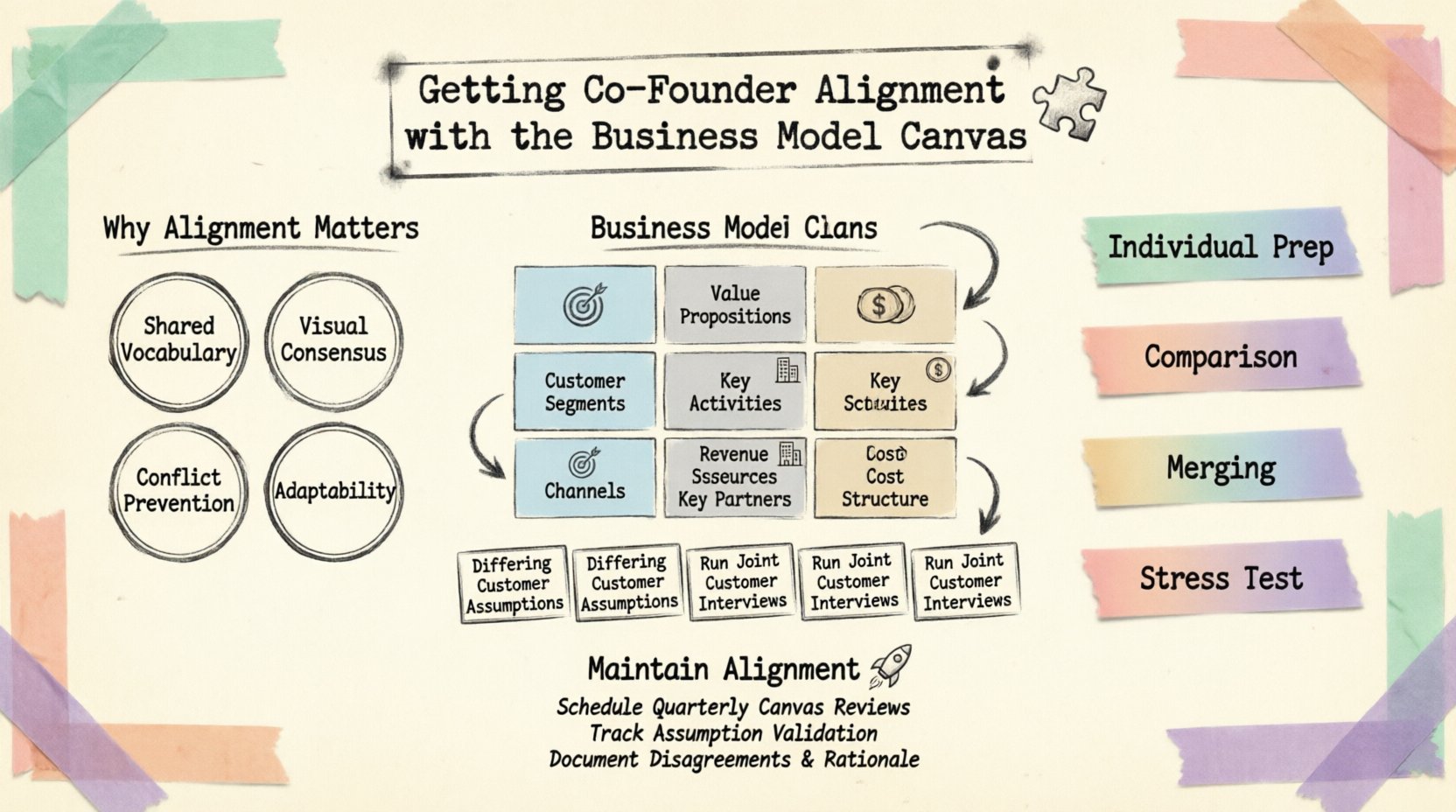
- Shared Vocabulary: The Canvas provides standard terms for discussing the business, reducing ambiguity.
- Visual Consensus: A physical or digital representation forces partners to confront every aspect of the model simultaneously.
- Conflict Prevention: Identifying disagreements early saves immense emotional energy later.
- Adaptability: A living document allows the team to pivot together when market conditions change.
Without this alignment, decision-making slows down. Every minor choice requires negotiation. With it, the team moves with speed and confidence. The canvas acts as the single source of truth for the venture’s logic.
Understanding the Building Blocks for Partners 🧱
The Business Model Canvas consists of nine building blocks. For co-founders, each block represents a negotiation point. Understanding the implications of each block is crucial for deep alignment. We break these down into three core sections: the front of the canvas (value and customers), the backbone (infrastructure), and the financials (viability).
1. The Front of the Canvas: Value and Customers 🎯
This section defines who you are serving and why they care. It is often the source of the most intense debate regarding market focus.
- Customer Segments: Who exactly is the buyer? Is it enterprise clients, individual consumers, or a niche market? Founders often disagree on the “ideal customer profile.” One may want to chase the biggest wallet, while the other prefers the easiest market to penetrate.
- Value Propositions: What problem are we solving? Is it convenience, cost reduction, or performance? If one founder sees the product as a luxury and the other as a utility, the marketing strategy will fracture.
- Channels: How do we reach them? Direct sales, online marketplaces, or partnerships? This dictates the operational workload and the type of team needed.
2. The Backbone: Infrastructure and Activities 🏗️
This section covers the internal mechanics required to deliver the value. It is where operational reality meets strategic ambition.
- Key Activities: What must the company do every day? Engineering, sales, or customer support? Disagreements here often stem from resource allocation.
- Key Resources: What assets do we need? Intellectual property, physical inventory, or human capital? This affects hiring strategies and capital requirements.
- Key Partners: Who helps us deliver? Suppliers, distributors, or technology providers? This defines the external dependencies and risk exposure.
3. The Financials: Viability and Costs 💰
The final section determines if the model is sustainable. This is often where personal financial goals intersect with business reality.
- Revenue Streams: How do we make money? Subscription, licensing, or transaction fees? This shapes the pricing model and cash flow projections.
- Cost Structure: What are the major costs? Fixed costs like salaries or variable costs like server usage? This influences the burn rate and runway.
The Alignment Workshop: A Step-by-Step Process 🛠️
Filling out the canvas together is a deliberate exercise. It is not a one-time event but a structured workshop that requires preparation and discipline. The following steps outline a robust process for achieving alignment.
Step 1: Individual Preparation 📝
Before meeting, each founder should fill out their own version of the canvas. This allows them to articulate their personal assumptions without the influence of the other person. It reveals hidden biases and differing mental models immediately.
Step 2: The Side-by-Side Comparison 🔍
Place the two canvases next to each other. Do not try to merge them yet. Instead, highlight the differences. Ask why each decision was made. Is it based on data, intuition, or past experience? This step is about understanding, not convincing.
Step 3: The Merging Session 🧩
Now, create a single canvas together. Where you disagree, discuss the implications. If one founder wants to target a different customer segment, what does that mean for the value proposition? The goal is to find a middle ground that both can commit to.
Step 4: Stress Testing 🧪
Once merged, challenge the model. What happens if the primary revenue stream dries up? What if a key partner leaves? This helps identify vulnerabilities in the shared strategy.
Deep Dive: Common Friction Points and Resolutions 🛑
Certain areas of the canvas are notorious for causing friction. Below is a breakdown of common conflicts and how to resolve them using the framework.
| Friction Point | Business Model Block | Resolution Strategy |
|---|---|---|
| Growth vs. Profit | Revenue Streams | Define a timeline for profitability. Agree on a specific revenue threshold before shifting focus from growth to margin. |
| Feature Scope | Value Proposition | Limit the MVP to the core value. Agree that “nice-to-haves” are reserved for post-product-market fit. |
| Hiring Speed | Key Resources | Set headcount limits based on cash runway. Prioritize roles that directly impact the value delivery. |
| Market Focus | Customer Segments | Identify the primary segment for the first year. Revisit secondary segments only after validating the primary. |
| Equity & Roles | Key Activities | Align ownership with responsibility. If one founder takes the lead on sales, their role in the activities block reflects that. |
Using this table as a reference during meetings can depersonalize conflicts. It moves the conversation from “I want” to “The model requires.”
Mapping Roles to the Canvas 🗺️
Alignment is not just about the model; it is about who owns which part of it. Co-founders often have complementary skills. One might excel at technology, while the other leads sales. The Canvas helps formalize these responsibilities.
- The Technologist: Usually owns Key Resources, Key Activities (Development), and Technology Partners.
- The Commercial Lead: Usually owns Customer Segments, Channels, and Revenue Streams.
- The Operator: Usually owns Cost Structure and Infrastructure.
By assigning ownership of specific blocks, founders gain autonomy in their areas while maintaining visibility into the whole. This reduces micromanagement and builds trust. When the commercial lead decides on a pricing change, they understand the impact on the Cost Structure because they have reviewed the financial block.
Maintaining Alignment Over Time ⏳
A canvas created at launch is rarely accurate after six months. Markets shift, and startups evolve. Alignment is a dynamic state, not a static destination. To maintain it, the team must treat the Canvas as a living document.
Regular Review Cycles 📅
Schedule quarterly reviews dedicated solely to updating the Business Model Canvas. Do not mix this with operational stand-ups. This session is for strategic realignment. Ask:
- Has our customer segment changed?
- Are our revenue assumptions still valid?
- Did we discover a new key partner that changes our infrastructure?
Documenting Decisions 📖
When changes are made to the Canvas, document the “why.” This prevents future arguments about past decisions. If the team pivots from B2B to B2C, record the data that drove that conclusion. This creates an institutional memory that survives team turnover.
Handling New Co-Founders 🆕
What happens when a new partner joins? The onboarding process must include a deep dive into the existing Canvas. The new founder should be asked to critique the current model. This signals that the business is open to feedback while respecting the foundational work already done.
The Psychological Aspect of Alignment 🧠
Technical alignment on the canvas does not guarantee emotional alignment. Founders are human, and stress can erode trust. The Canvas helps by externalizing the problem. Instead of fighting each other, the team fights the model.
- Vulnerability: Admitting a block is wrong is easier when it is just a box on a page, not a personal failure.
- Shared Ownership: When the Canvas is a collective output, no single person can claim ownership of the strategy, reducing ego clashes.
Practical Tips for Implementation 🛡️
To get the most out of this process, keep these practical tips in mind.
- Use Physical Space: Whiteboards or sticky notes allow for easier movement of ideas than static documents. Moving a sticky note physically can symbolize a strategic shift.
- Limit Time: Set a timer for alignment sessions. Decision fatigue can lead to poor compromises. Keep sessions focused and energetic.
- Invite Feedback: Occasionally bring in advisors to review the Canvas. An outside perspective can spot alignment gaps the founders miss.
- Keep it Simple: Do not overcomplicate the blocks. If a block requires too much text, it is not clear. Simplify the language to ensure shared understanding.
When Alignment Fails 🚨
Sometimes, despite best efforts, alignment proves impossible. If the fundamental assumptions in the Value Proposition or Customer Segments cannot be reconciled, the partnership may be unsustainable. The Canvas makes this visible early. It is better to identify a fundamental mismatch during the planning phase than after significant capital has been spent.
If disagreements persist on the core blocks, consider a “pre-mortem.” Imagine the company has failed two years from now. Why did it fail? Was it the strategy, the team, or the market? This exercise often clarifies whether the team is compatible.
Moving Forward with Confidence 🚀
Co-founder alignment is the bedrock of a resilient startup. It transforms a group of individuals into a unified command structure. The Business Model Canvas provides the necessary structure to facilitate this alignment. It forces clarity, exposes assumptions, and creates a shared roadmap.
By treating the Canvas as a living document and a tool for communication, founders can navigate the complexities of building a business together. The process requires honesty, time, and a willingness to challenge one’s own assumptions. However, the result is a stronger team better equipped to handle the uncertainties of the market.
Start the workshop today. Put the boxes on the wall. Discuss the differences. Agree on the path. The future of the venture depends on the clarity you establish now.