Profitability is the lifeblood of any sustainable enterprise. Without a clear mechanism to generate income, even the most innovative products or services will eventually cease to exist. The Business Model Canvas (BMC) offers a structured approach to visualizing how an organization creates, delivers, and captures value. Within this framework, the Revenue Streams block is often the most critical determinant of long-term viability.
This guide explores the mechanics of designing robust income sources. We will move beyond basic pricing and examine how revenue interacts with value propositions, customer segments, and cost structures. The goal is to construct a financial foundation that supports growth while maintaining operational efficiency.
🧩 The Role of Revenue Streams in the Business Model Canvas
The Revenue Streams section of the Business Model Canvas represents the cash a company generates from each customer segment. It is not merely a reflection of price multiplied by volume; it is a strategic decision regarding how value is monetized. Every revenue stream must be traceable back to a specific customer need addressed by the value proposition.
When mapping this block, you must consider:
- Revenue Types: Is the income recurring, one-time, or usage-based?
- Pricing Mechanisms: How do you determine the price? Is it fixed, dynamic, or auction-based?
- Payment Methods: How do customers transfer value to the organization?
A well-defined revenue stream ensures that the value delivered is actually captured. Many businesses fail because they create value but lack a viable mechanism to extract monetary compensation. This disconnect often occurs when the pricing model does not align with the perceived value of the customer.
💰 Understanding Different Revenue Models
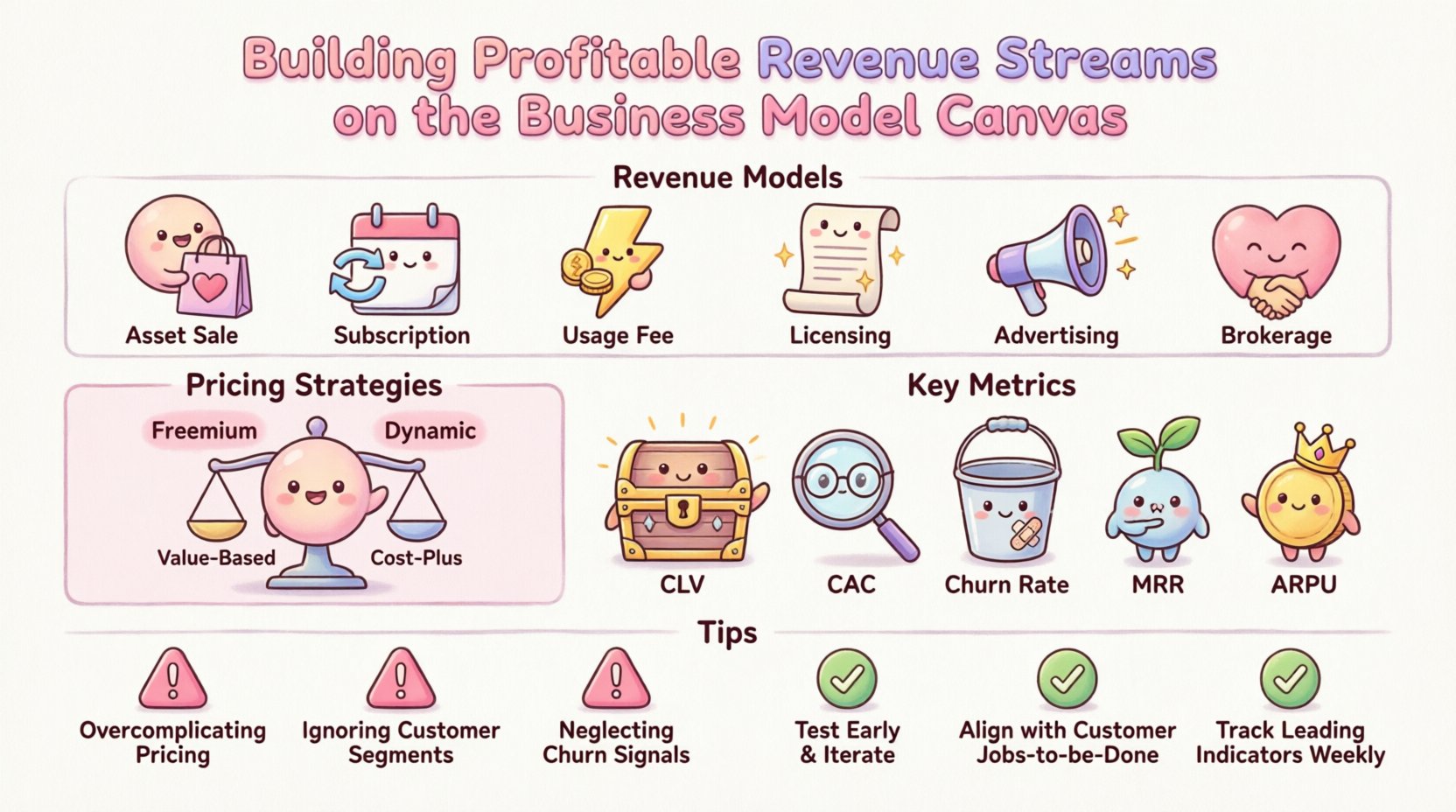
Different industries and business types require different approaches to monetization. Selecting the right model depends on the nature of the product, the customer relationship, and the competitive landscape. Below is a breakdown of common revenue mechanisms used in modern business.
1. Asset Sale
This is the most traditional model. Customers pay a one-time fee for ownership of a physical good or a digital asset. The revenue is recognized upon delivery or transfer of title.
- Example: Retail clothing, hardware manufacturing, software licenses.
- Characteristics: High upfront cost for customer, recurring maintenance potential.
2. Subscription Fees
Access to a service or product is granted for a recurring fee over a defined period. This model is highly valued for its predictability and cash flow stability.
- Example: Media streaming platforms, SaaS applications, membership clubs.
- Characteristics: Recurring revenue, high customer retention focus.
3. Usage Fees
Customers pay based on how much they use the product or service. This aligns costs with value consumption.
- Example: Cloud computing, utility services, API calls.
- Characteristics: Scalable revenue, variable income depending on customer activity.
4. Licensing
Permission is granted to use proprietary intellectual property, technology, or brand assets. This often involves a royalty fee.
- Example: Franchise operations, patent licensing, music rights.
- Characteristics: Passive income potential, low marginal cost.
5. Advertising
Revenue is generated by selling access to the customer base to third parties. The end-user often receives the service for free or at a reduced cost.
- Example: Social media platforms, free news sites, search engines.
- Characteristics: Dependent on traffic volume, privacy considerations.
6. Brokerage Fees
Income is derived from facilitating transactions between two parties. The platform itself does not own the assets being traded.
- Example: Real estate agencies, stock exchanges, e-commerce marketplaces.
- Characteristics: Transaction-based, scales with volume of trade.
📊 Comparison of Revenue Models
| Model Type | Cash Flow Stability | Customer Acquisition Focus | Scalability |
|---|---|---|---|
| Asset Sale | Low (One-off) | High Volume | Medium |
| Subscription | High (Recurring) | Retention | High |
| Usage Fee | Medium (Variable) | Engagement | Very High |
| Advertising | Medium (Market Dependent) | Traffic | Very High |
| Brokerage | Medium (Transaction Dependent) | Network Effects | High |
⚖️ Pricing Strategies and Value Alignment
Setting the price is a complex negotiation between cost, value, and competition. The price you set sends a signal about the quality and positioning of your offering. It must reflect the value perceived by the customer segment you are targeting.
Value-Based Pricing
This approach sets prices primarily based on the perceived or estimated value of a product or service to the customer rather than on the cost of the product or historical prices. It requires deep insight into customer pain points and the economic impact of your solution.
- Benefit: Captures maximum value when the product solves a critical problem.
- Requirement: Strong understanding of customer economics.
Cost-Plus Pricing
The price is determined by adding a standard markup to the cost of producing the product. While simple to calculate, this method may leave money on the table if the value delivered is significantly higher than the cost.
- Benefit: Ensures all costs are covered.
- Requirement: Accurate cost accounting.
Freemium Model
A portion of the service is offered for free, while advanced features require payment. This lowers the barrier to entry and allows users to experience value before committing financially.
- Benefit: Rapid user acquisition and data generation.
- Requirement: High conversion rate from free to paid tiers.
Dynamic Pricing
Prices fluctuate based on real-time demand, time of day, or customer profile. This is common in travel, hospitality, and ride-sharing sectors.
- Benefit: Maximizes revenue during peak demand.
- Requirement: Automated systems and customer acceptance.
🔗 Integration with Cost Structure
Revenue cannot be evaluated in isolation. It must be viewed in conjunction with the Cost Structure block of the Business Model Canvas. Profitability is the difference between what you earn and what you spend to generate that revenue.
If your revenue model relies on high customer acquisition costs (CAC), your Cost Structure must reflect this. A subscription model may have high initial costs but lower long-term costs per customer due to retention. Conversely, an asset sale model might have lower upfront acquisition costs but requires constant marketing to replace churned customers.
Key considerations for alignment:
- Fixed vs. Variable Costs: Does your revenue model support fixed costs (e.g., salaries, rent)? High fixed costs require stable revenue streams like subscriptions.
- Margins: What is the gross margin on each transaction? Low-margin models require high volume.
- Break-Even Point: How many units or subscribers are needed to cover total costs?
📈 Validation and Iteration
A revenue model is a hypothesis until proven otherwise. Testing and validation are essential steps before scaling. You must verify that customers are willing to pay the proposed price for the proposed value.
Steps for Validation
- Define the Offer: Clearly articulate what is being sold and at what price.
- Select a Test Segment: Choose a small group of potential customers.
- Pilot the Transaction: Run a limited launch or beta test.
- Measure Conversion: Track how many prospects become paying customers.
- Analyze Feedback: Understand why some paid and others did not.
If the conversion rate is low, adjust the pricing, the value proposition, or the target segment. Do not assume that a product that works for one group will work for another. Segmentation plays a vital role in revenue optimization.
🚫 Common Pitfalls in Revenue Design
Even experienced strategists can make mistakes when mapping revenue streams. Recognizing these pitfalls can prevent significant financial losses.
- Overcomplicating the Model: Using too many revenue streams can confuse customers and dilute focus. Stick to the core monetization method.
- Ignoring Churn: In subscription models, high churn can negate the value of new acquisitions. Retention must be prioritized.
- Underestimating Costs: Focusing solely on revenue without accounting for the cost of delivery leads to losses.
- Pricing Too Low: Underpricing can signal low quality and erode margins. Price based on value, not just cost.
- Failing to Adapt: Markets change. A revenue model that worked five years ago may not be viable today due to new competition or technology.
🛠️ Metrics for Success
To ensure the revenue streams remain healthy, specific metrics must be tracked. These indicators provide visibility into the performance of the business model.
Customer Lifetime Value (CLV)
CLV predicts the net profit attributed to the entire future relationship with a customer. A high CLV justifies higher acquisition costs.
Customer Acquisition Cost (CAC)
The total cost of sales and marketing efforts needed to acquire a new customer. Ideally, CLV should be significantly higher than CAC.
Churn Rate
The percentage of customers who stop using your product over a given period. High churn indicates dissatisfaction or better alternatives in the market.
Monthly Recurring Revenue (MRR)
For subscription businesses, this is the predictable revenue generated each month. It is a key indicator of growth and stability.
Average Revenue Per User (ARPU)
Measures the revenue generated per customer. Increasing ARPU is a common way to boost revenue without acquiring new users.
🔄 Future-Proofing Revenue Streams
Business environments are volatile. Strategies that work today may face obsolescence tomorrow. Building flexibility into your revenue model is crucial.
- Diversification: Do not rely on a single customer segment or product line. Diversify income sources to mitigate risk.
- Technology Integration: Leverage automation and data analytics to optimize pricing and delivery efficiency.
- Customer Feedback Loops: Continuously gather feedback to adjust pricing and features based on changing needs.
- Ethical Considerations: Ensure revenue practices do not exploit customers. Trust is a long-term asset.
🏁 Final Considerations
Designing profitable revenue streams requires a blend of creativity, analytical rigor, and strategic foresight. It is not enough to simply sell a product; you must understand the economic engine driving your organization. By aligning revenue mechanisms with customer value and managing costs effectively, you create a foundation for sustainable growth.
Regularly revisit the Business Model Canvas. As your business evolves, so should your approach to monetization. Continuous refinement ensures that the organization remains resilient in the face of market shifts. The path to profitability is a journey of constant measurement and adjustment, not a destination reached once and for all.
Focus on the value delivered. If the value is high, the revenue will follow. Keep the model simple, the metrics clear, and the customer at the center of all financial decisions.