
In modern enterprise architecture, the disconnect between business strategy and technical execution remains a persistent challenge. Organizations often struggle to articulate how a high-level business goal translates into specific software functions or infrastructure components. The ArchiMate modeling language provides a structured approach to visualize these connections, specifically through the concept of Realization Relationships. These relationships form the backbone of traceability, ensuring that every line of code and every server has a defined purpose within the broader business context.
This guide explores the mechanics, application, and strategic value of using Realization Relationships to bridge the gap between the Business Layer and the IT Layers. By understanding these connections, architects can create models that are not just diagrams, but actionable blueprints for alignment.
📐 The Architecture Landscape: Layers and Views
Before diving into relationships, it is essential to understand the structural foundation of the framework. ArchiMate divides the enterprise architecture into distinct layers to manage complexity and focus on specific concerns.
- Motivation Layer: Deals with the drivers behind the architecture. This includes goals, principles, and requirements.
- Business Layer: Represents the business organization and processes. Key elements include business processes, business functions, and business services.
- Application Layer: Focuses on the software applications that support business activities. This includes application functions, application services, and application components.
- Technology Layer: Covers the hardware and software infrastructure. Elements include nodes, devices, and system software.
- Physical Layer: Represents the physical infrastructure where technology is deployed.
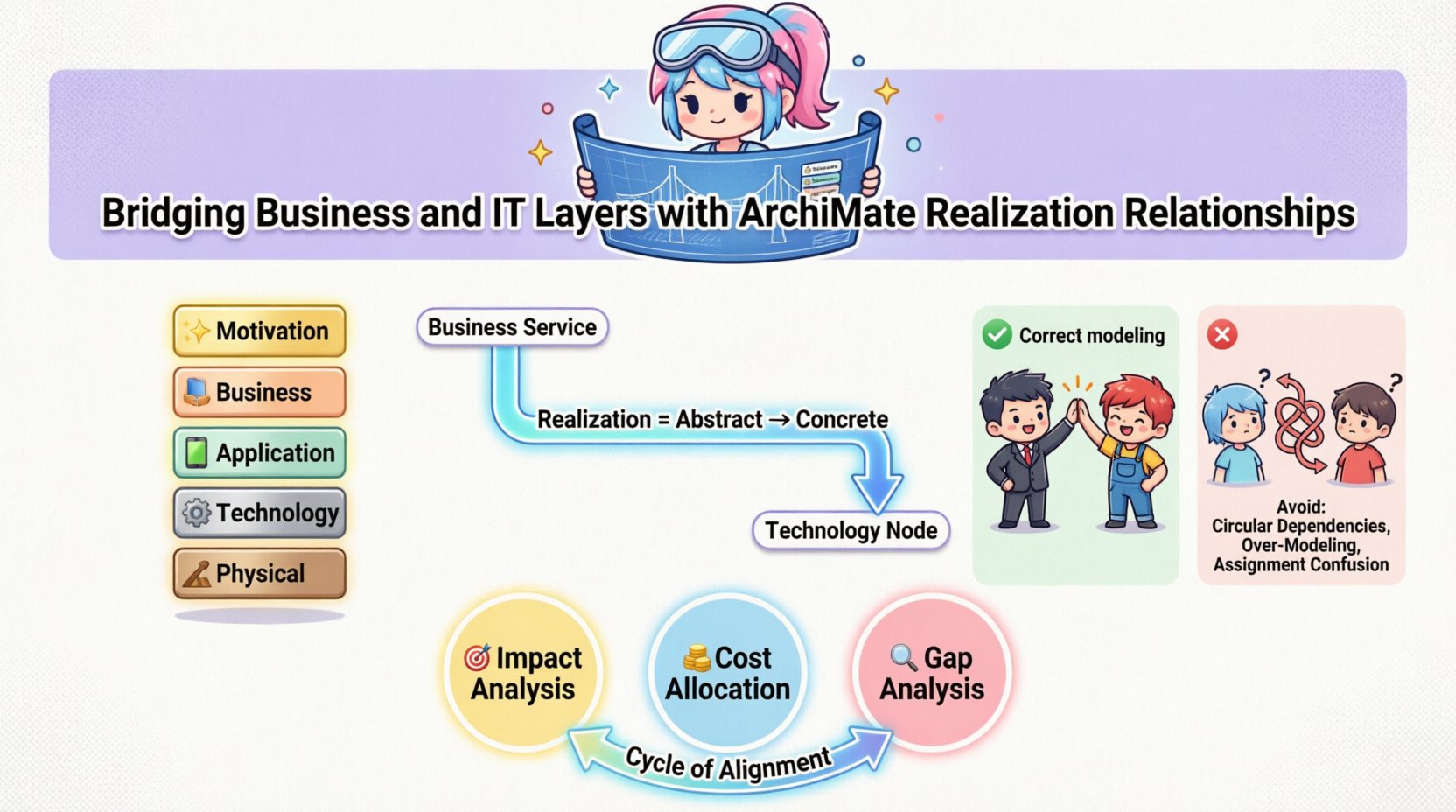
Realization relationships primarily operate across these layers to show how a higher-level concept is implemented by a lower-level concept. For instance, a Business Service is realized by an Application Function, which is deployed on a Technology Node.
🔗 Defining Realization Relationships
A Realization Relationship indicates that the target element is an implementation of the source element. It answers the question: “How is this concept made concrete?”
Unlike an Assignment relationship, which indicates that an element performs a function for another, Realization implies a structural dependency. If the source element is removed, the target element loses its justification for existing in that specific context.
Key Characteristics
- Directionality: The relationship points from the abstract concept (source) to the concrete implementation (target). The arrowhead points towards the target.
- Dependency: The target depends on the source for its definition. You cannot realize a service that does not exist.
- Traceability: It creates a chain of custody from strategy to implementation.
In the context of bridging Business and IT, Realization is the primary mechanism used to demonstrate alignment. It moves the model from a static inventory of assets to a dynamic representation of value delivery.
🏛️ Structural Realization in Detail
Structural elements represent the static architecture of the enterprise. Realization in this context describes how one structural component is built from or implements another.
Business to Application
The most critical bridge for business-IT alignment occurs here. A Business Service, such as “Order Fulfillment,” is realized by an Application Service or Application Function. This tells stakeholders exactly which software capability supports the business outcome.
- Source: Business Service (e.g., Customer Onboarding)
- Target: Application Function (e.g., Validate Identity)
- Meaning: The software function is the technical realization of the business service.
Application to Technology
Once the application layer is defined, Realization connects it to the underlying infrastructure. An Application Component is realized by a Node or Device.
- Source: Application Component (e.g., Payment Module)
- Target: Technology Node (e.g., Web Server)
- Meaning: The software is deployed onto this specific hardware resource.
Table: Structural Realization Examples
| Source Element | Relationship | Target Element | Context |
|---|---|---|---|
| Business Process | Realizes | Application Function | Process Automation |
| Business Service | Realizes | Application Service | Service Orientation |
| Application Component | Realizes | Technology Node | Deployment |
| Business Role | Realizes | User | System Access |
⚙️ Behavioral Realization Dynamics
While structural elements define what exists, behavioral elements define what happens. Realization in behavior is slightly more nuanced, often involving events, functions, and processes.
Event Realization
An event is a specification of something that happens at a specific point in time. An event can be realized by a more detailed event. This is common in state machines where a high-level trigger is broken down into specific system triggers.
- Source: Business Event (e.g., Order Placed)
- Target: Application Event (e.g., Database Insert Trigger)
- Meaning: The business occurrence is technically triggered by the system event.
Function and Process Realization
Processes are sequences of functions. A high-level Business Process is realized by a sequence of Application Functions. This allows architects to map workflow logic directly to system capabilities.
For example, the process “Approve Loan” is realized by the application function “Calculate Risk Score” followed by “Update Status”. This granular mapping helps in impact analysis. If the “Calculate Risk Score” function changes, the architect knows immediately which business process is affected.
📉 Common Modeling Pitfalls
While Realization Relationships are powerful, they are frequently misused in modeling efforts. Avoiding these errors ensures the integrity of the architecture model.
1. Confusing Realization with Assignment
Assignment indicates that an element performs an action on behalf of another. Realization indicates that one element is the implementation of another. Confusing the two leads to models that show who does what rather than how things are built.
- Incorrect: A Business Role is assigned to an Application Function.
- Correct: A Business Role is assigned to a Business Process, which is realized by an Application Function.
2. Circular Realization
A structure cannot realize itself. Creating a cycle where A realizes B and B realizes A violates the hierarchical logic of the framework. This often happens when layers are not clearly defined.
3. Over-Modeling
Not every business service requires a dedicated application function relationship. Modeling every minor detail can clutter the diagram and obscure the main architectural drivers. Focus on the critical paths that drive value.
4. Ignoring the Motivation Layer
A model that stops at the Technology Layer misses the strategic context. The Motivation Layer provides the goals and drivers. A Business Service should ideally trace back to a Business Goal. Skipping this breaks the chain of value.
🚀 Strategic Impact of Accurate Modeling
When Realization Relationships are modeled correctly, they provide tangible benefits for the organization beyond simple documentation.
Impact Analysis
When a change occurs in the IT landscape, such as migrating a database or updating a software library, the Realization relationships allow architects to identify which business services are at risk. This minimizes downtime and reduces business disruption.
- Scenario: A legacy server is decommissioned.
- Traceability: Follow the Realization links from the Node to the Application Component, then to the Application Function, and finally to the Business Service.
- Outcome: Identify exactly which business capabilities are impacted.
Cost Allocation
Understanding the realization chain helps in IT financial management. By linking infrastructure costs to application functions, and application functions to business services, organizations can allocate IT spend more accurately to business units.
Gap Analysis
Realization relationships highlight gaps in capability. If a Business Service exists but has no realization in the Application Layer, it indicates a manual process or a missing system. Conversely, if an Application Function exists but has no realization from a Business Service, it may be technical debt or an unused feature.
✅ Best Practices for Implementation
To maximize the value of these relationships, follow these guidelines during the modeling process.
- Maintain Consistency: Ensure naming conventions are consistent across layers. The Application Function should clearly reflect the Business Process it supports.
- Focus on Value: Prioritize relationships that demonstrate value delivery. Do not model every internal dependency if it does not affect the business outcome.
- Use Groups: Use ArchiMate groups to organize the model. Group related Realization relationships together to improve readability.
- Validate Regularly: Architecture is dynamic. Regular reviews ensure that the realization links remain valid as the business evolves.
- Leverage Tools: Use modeling tools that support the ArchiMate standard to enforce relationship rules and prevent invalid connections.
🔄 The Cycle of Alignment
Creating the bridge between Business and IT is not a one-time task. It requires a continuous cycle of review and adjustment. As business goals shift, the realization chain must be updated. New business services may require new application functions. Existing infrastructure may need to be replaced to support new realization targets.
This cycle ensures that the IT landscape remains responsive to business needs. It transforms the architecture function from a gatekeeping exercise into a strategic enabler.
📝 Summary of Key Concepts
To recap, the core takeaways for utilizing Realization Relationships effectively include:
- Definition: Realization shows how an abstract concept is implemented concretely.
- Direction: Arrows point from the abstract (Business) to the concrete (IT).
- Layers: Primarily connects Motivation, Business, Application, and Technology layers.
- Utility: Enables impact analysis, cost allocation, and gap identification.
- Pitfalls: Avoid circular dependencies and confusion with Assignment relationships.
By rigorously applying these principles, organizations can achieve a level of transparency that fosters trust between business leaders and technical teams. The Realization Relationship is more than a line on a diagram; it is the logical link that ensures technology serves business intent.