Enterprise architecture serves as the blueprint for organizational change. When integrating ArchiMate with TOGAF, the motivation layer provides critical context for requirements. This guide explores how to align motivation concepts with TOGAF requirements management to ensure strategic alignment. We will examine specific elements, traceability, and practical application steps without relying on specific vendor tools.
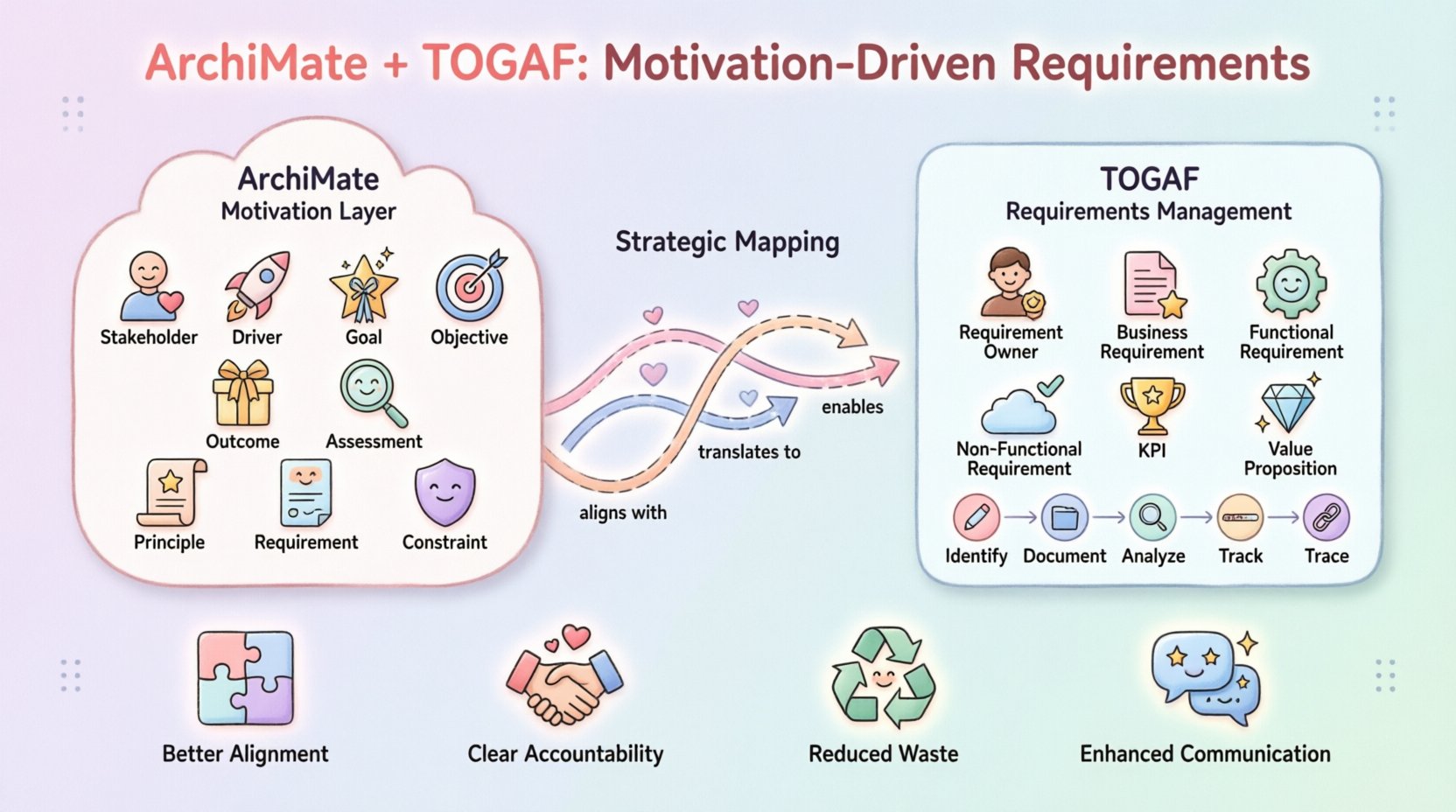
📚 Understanding the ArchiMate Motivation Layer
The motivation layer sits at the top of the ArchiMate architecture framework. It provides the context for why an architecture is being developed. Without motivation, technical artifacts lack purpose. This layer connects stakeholders to the actual business goals.
- Stakeholder: An individual or group with an interest in the architecture.
- Driver: A force that motivates change or action.
- Goal: Something the organization wants to achieve.
- Objective: A measurable target derived from a goal.
- Outcome: The result of implementing an architecture.
- Assessment: An evaluation of the current state against a goal.
- Principle: A rule or guideline.
- Requirement: A statement of need or condition.
- Constraint: A restriction on the solution.
These elements form the foundation for understanding the “why” behind the “what.” In TOGAF, requirements management often focuses on functional and non-functional needs. ArchiMate motivation adds the strategic layer that justifies those needs.
🔄 TOGAF Requirements Management Overview
TOGAF defines requirements management as the process of identifying, documenting, and managing requirements throughout the architecture development lifecycle. This ensures that the final solution meets the needs of the stakeholders.
Key Activities in TOGAF Requirements Management
- Identification: Gathering initial needs from stakeholders.
- Documentation: Recording requirements in a structured catalog.
- Analysis: Assessing feasibility and impact.
- Management: Tracking changes and approvals.
- Traceability: Linking requirements to architecture components.
Traditionally, TOGAF requirements are treated as functional specifications. However, integrating motivation concepts shifts the focus to strategic intent. This prevents the development of features that do not support business objectives.
🔗 Mapping ArchiMate Concepts to TOGAF Requirements
Mapping these frameworks requires understanding the relationship between strategic intent and technical specification. The motivation layer acts as the bridge between high-level strategy and detailed requirements.
1. Stakeholder to Requirement Owner
In TOGAF, every requirement should have an owner. ArchiMate Stakeholders define who holds the interest. By linking a Stakeholder to a Requirement, you ensure accountability. This prevents requirements from becoming orphaned artifacts.
- Identify the Stakeholder in the motivation layer.
- Create a Requirement artifact in the TOGAF catalog.
- Assign the Stakeholder ID to the Requirement Owner field.
2. Driver to Business Requirement
A Driver represents a force pushing for change. In TOGAF, this often translates to a Business Requirement. For example, a regulatory change is a Driver. The requirement to update the system to comply is the Business Requirement.
- Define the Driver (e.g., new compliance law).
- Trace the Driver to the specific Business Requirement.
- Ensure the Requirement addresses the root cause of the Driver.
3. Goal to Functional Requirement
Goals represent desired outcomes. Functional Requirements describe system behavior. A Goal like “Increase Customer Satisfaction” maps to Functional Requirements regarding response time or interface usability.
- Establish the organizational Goal.
- Break down the Goal into measurable objectives.
- Derive Functional Requirements that enable the Objective.
4. Outcome to Non-Functional Requirement
Outcomes describe the value delivered. Non-Functional Requirements (NFRs) define quality attributes like security or performance. These NFRs often determine whether the Outcome is achieved.
- Define the expected Outcome (e.g., reduced cost).
- Identify NFRs that must be met to realize the Outcome.
- Validate NFRs against the Outcome criteria.
📊 Comparison Matrix: ArchiMate vs. TOGAF
The following table outlines the direct correlations between ArchiMate Motivation elements and TOGAF requirements types. This matrix aids in creating a consistent mapping strategy.
| ArchiMate Element | TOGAF Concept | Purpose in Mapping |
|---|---|---|
| Stakeholder | Requirement Owner | Assigns accountability and interest. |
| Driver | Trigger / Context | Explains the reason for the requirement. |
| Goal | Strategic Requirement | Aligns requirements with business strategy. |
| Objective | Measurable KPI | Provides criteria for success. |
| Outcome | Value Proposition | Defines the business value delivered. |
| Principle | Constraint / Guideline | Enforces rules during design. |
| Requirement | Functional Requirement | Specifies system behavior. |
| Constraint | Technical Constraint | Limits design choices. |
🛠️ Practical Application Steps
Implementing this integration requires a structured approach. Follow these steps to ensure consistency across your architecture repository.
Step 1: Define the Motivation Context
Before listing requirements, establish the motivation context. Identify the key Stakeholders and Drivers. This ensures that requirements are not created in a vacuum.
- List all active Stakeholders.
- Document the Drivers influencing the project.
- Define the primary Goals for the architecture.
Step 2: Catalog Requirements with Motivation Tags
When creating the Requirements Catalog in TOGAF, include tags linking to ArchiMate motivation elements. This creates a traceable lineage.
- Create a new Requirement entry.
- Select the associated Goal from the motivation layer.
- Tag the Requirement with the relevant Driver.
- Record the Stakeholder responsible for approval.
Step 3: Validate Traceability
Traceability ensures that every requirement serves a purpose. Use the motivation layer to verify that no requirement exists without a corresponding Goal or Driver.
- Review the Requirements Catalog.
- Check if every Requirement links to a Goal.
- Ensure Drivers are accounted for in the justification field.
- Remove requirements that lack motivation context.
Step 4: Monitor Changes
Architecture evolves. Drivers change, and Goals shift. The motivation layer must be updated alongside requirements to maintain alignment.
- Set up a review cycle for motivation elements.
- Update Goals when business strategy shifts.
- Adjust Requirements to reflect new Drivers.
- Document the impact of changes on the architecture.
✅ Benefits of Integration
Combining ArchiMate motivation with TOGAF requirements management offers several advantages. It moves the conversation from “what” to “why.”
- Improved Alignment: Ensures technical work supports business strategy.
- Better Decision Making: Provides context for prioritizing requirements.
- Clear Accountability: Links stakeholders directly to requirements.
- Reduced Waste: Eliminates features that do not contribute to Goals.
- Enhanced Communication: Uses a common language across business and IT.
⚠️ Common Challenges and Mitigation
Integrating these frameworks is not without difficulties. Recognizing potential pitfalls helps in planning for success.
1. Over-Complexity
Creating too many links can make the model difficult to maintain. Limit links to the most critical relationships.
- Focus on high-level Goals first.
- Aggregate lower-level requirements under broader objectives.
- Review the model regularly to prune unnecessary connections.
2. Inconsistent Naming
Using different terms for the same concept causes confusion. Establish a glossary early.
- Define standard terms for Goals and Requirements.
- Train the architecture team on these definitions.
- Use controlled vocabularies in the requirements catalog.
3. Lack of Stakeholder Engagement
Stakeholders may not participate in defining motivation elements. This leads to inaccurate Goals.
- Schedule workshops to define Goals and Drivers.
- Ensure Stakeholders review and validate the motivation layer.
- Assign specific roles for maintaining motivation elements.
📈 Long-Term Value
Maintaining this integration yields value over time. As the organization grows, the motivation layer serves as a historical record of why decisions were made.
- Onboarding: New architects understand the strategic context immediately.
- Auditing: Auditors can trace requirements back to business drivers.
- Evolution: Future changes can be assessed against original Goals.
- Compliance: Demonstrates due diligence in requirement justification.
🔍 Deep Dive: The Assessment Element
The Assessment element in ArchiMate is often overlooked in TOGAF contexts. It represents an evaluation of the current state. In requirements management, this acts as a baseline.
- Current State Assessment: Evaluates existing capabilities against Goals.
- Gap Analysis: Identifies what is missing to achieve the Goal.
- Requirement Derivation: Gaps become the source of new Requirements.
By formalizing Assessments, you create a clear link between the problem space and the solution space. This prevents the common issue of building solutions for problems that do not exist.
🔍 Deep Dive: Principles and Constraints
Principles and Constraints act as guardrails. In TOGAF, these often appear in the standards catalog. ArchiMate places them in the motivation layer to emphasize their strategic importance.
- Principles: High-level rules that guide decision-making.
- Constraints: Specific limitations on the solution.
- Traceability: Link Principles to Requirements to enforce compliance.
For example, a Principle might state “Data must be secure.” A Requirement might state “The system must use AES-256 encryption.” The Constraint ensures the Requirement cannot be bypassed. This hierarchy ensures that strategic rules are enforced in technical specifications.
🔍 Deep Dive: Outcome and Value
Outcomes represent the tangible value delivered. TOGAF often focuses on deliverables. ArchiMate Motivation focuses on value.
- Deliverable: A piece of work produced.
- Outcome: The benefit gained from the deliverable.
- Value Realization: Requires tracking the Outcome post-implementation.
When managing requirements, ask what Outcome each requirement supports. If a requirement does not support an Outcome, it may be unnecessary work. This focus ensures resources are directed toward value creation.
📝 Summary of Best Practices
To successfully apply these concepts, adhere to the following best practices.
- Start with Strategy: Define Goals before listing Requirements.
- Keep it Simple: Avoid complex mapping trees that are hard to maintain.
- Review Regularly: Motivation elements change; requirements must follow.
- Engage Stakeholders: Ensure they own the motivation layer.
- Document Relationships: Make the links between elements explicit.
- Use Standard Vocabulary: Avoid ambiguity in naming conventions.
- Automate Where Possible: Use tools to manage traceability without manual effort.
🚀 Moving Forward
Integrating ArchiMate Motivation with TOGAF Requirements Management strengthens the architecture practice. It ensures that technical decisions are grounded in business strategy. By following the steps outlined here, architects can build more robust, aligned, and valuable enterprise architectures.
The journey requires discipline. It demands that architects ask “why” before asking “how.” This shift in mindset leads to architectures that deliver real value. Use the motivation layer as your compass. Let it guide the requirements catalog. This approach ensures that every line of code serves a purpose defined at the highest level.
Remember that architecture is not just about documentation. It is about communication. The motivation layer facilitates this communication between business leaders and technical teams. It translates strategic intent into actionable requirements. This translation is the core of successful enterprise transformation.
Continue to refine your models. Update your motivation elements as the business evolves. Keep the link between Goals and Requirements strong. This discipline will pay dividends in the long run. It creates an architecture that is resilient, relevant, and responsive to change.