Non-profit organizations operate in a unique ecosystem where success is measured not only by financial sustainability but by social impact. Traditional for-profit frameworks often fall short when trying to capture the complexity of mission-driven work. The Business Model Canvas (BMC) offers a robust, visual framework that adapts seamlessly to the non-profit sector. This guide explores how to structure, analyze, and refine your organizational model using this proven tool.
Strategic clarity is the backbone of effective non-profit management. By mapping out your value creation process, you can ensure resources are directed toward high-impact activities. This document provides a comprehensive breakdown of the nine building blocks, tailored specifically for mission-driven entities.
🔄 Why Adapt the Business Model Canvas for Non-Profits?
The original Business Model Canvas was designed for commercial enterprises. However, the core logic of value creation, delivery, and capture remains relevant. Non-profits face distinct challenges, including reliance on grants, volunteer engagement, and diverse stakeholder needs. Adapting the framework allows leaders to visualize the relationship between resources and social outcomes.
Key benefits of this adaptation include:
- Alignment: Ensures board members, staff, and volunteers understand the strategic direction.
- Transparency: Clarifies how funds translate into tangible social change.
- Sustainability: Identifies diverse revenue streams beyond traditional donations.
- Agility: Enables rapid pivots when external funding landscapes shift.
🧩 The 9 Building Blocks: A Non-Profit Translation
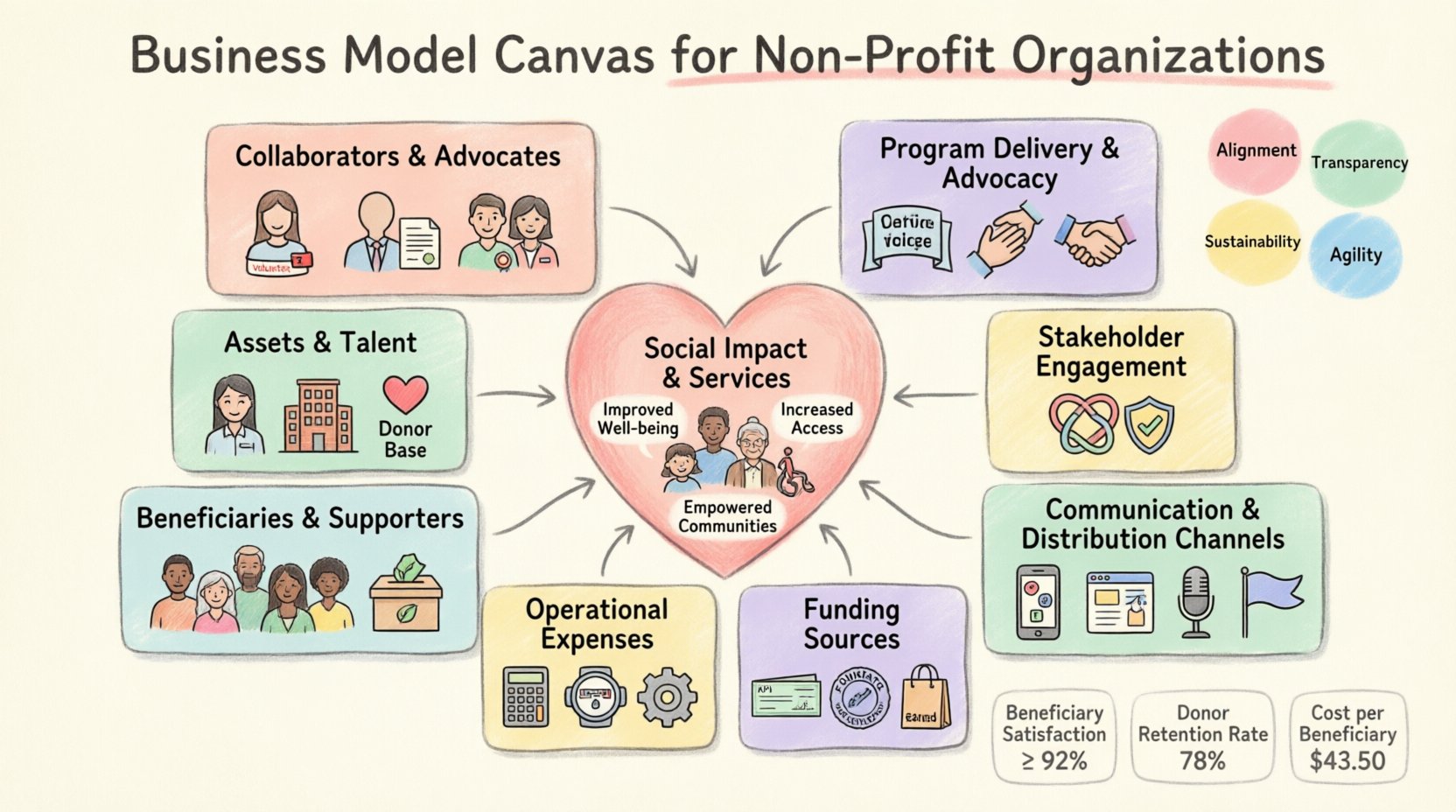
Understanding the specific nuances of each block is critical. Below is a detailed comparison of how standard business terms translate to the non-profit context.
| Standard Business Block | Non-Profit Adaptation | Primary Focus |
|---|---|---|
| Key Partners | Collaborators & Advocates | Government bodies, volunteers, community leaders |
| Key Activities | Program Delivery & Advocacy | Service execution, fundraising, lobbying |
| Key Resources | Assets & Talent | Staff, facilities, intellectual property, donor base |
| Value Propositions | Social Impact & Services | Beneficiary outcomes, systemic change, support |
| Customer Relationships | Stakeholder Engagement | Donor retention, beneficiary trust, community support |
| Customer Segments | Beneficiaries & Supporters | Target populations, donors, grant makers |
| Channels | Communication & Distribution | Website, events, social media, direct mail |
| Cost Structure | Operational Expenses | Program costs, admin, overhead, marketing |
| Revenue Streams | Funding Sources | Grants, donations, earned income, memberships |
🛠️ Deep Dive into the Canvas Blocks
To effectively apply this framework, each section requires specific attention to the non-profit reality.
1. Value Propositions: The Core Mission
For a non-profit, the value proposition is the social benefit delivered to the target audience. It is not merely a product but a change in condition or behavior. This block must answer: What problem are we solving?
- Beneficiary Value: What specific need is being met? (e.g., food security, education access).
- Supporter Value: Why should donors give? (e.g., tax deduction, emotional fulfillment, aligning with values).
- Uniqueness: What differentiates your approach from other organizations in the same sector?
2. Customer Segments: Beneficiaries and Donors
Non-profits often have multiple distinct segments. Unlike a single customer base, you serve those who receive the service and those who pay for it.
- Primary Beneficiaries: The individuals or communities directly impacted by your programs.
- Secondary Beneficiaries: Families, local economies, or society at large.
- Funders: Individual donors, corporate partners, government agencies, foundations.
- Volunteers: The workforce that often sustains the operations.
3. Channels: How You Reach Them
Effective communication is vital for both fundraising and service delivery. Channels must be accessible to your beneficiaries and visible to your supporters.
- Direct Interaction: Case managers, hotlines, community centers.
- Digital Presence: Website, social media campaigns, email newsletters.
- Events: Galas, community fairs, workshops.
- Partnerships: Using partner networks to distribute resources or information.
4. Customer Relationships: Building Trust
Trust is the currency of the non-profit sector. Relationships must be cultivated with care.
- Donor Stewardship: Regular reporting, recognition, and personal acknowledgment.
- Beneficiary Care: Dignity, privacy, and ongoing support mechanisms.
- Community Building: Creating spaces for beneficiaries to connect and support one another.
5. Revenue Streams: Funding Sustainability
Reliance on a single source of funding is a major risk. A healthy model diversifies income.
- Grant Funding: Project-specific or general operating support from foundations.
- Individual Giving: One-time donations, monthly recurring gifts, major gifts.
- Corporate Sponsorship: Partnerships with businesses seeking CSR alignment.
- Earned Income: Selling products or services related to the mission (social enterprise).
- Government Contracts: Service delivery agreements with public bodies.
6. Key Resources: What You Need
Identify the assets that allow the model to function.
- Human Capital: Skilled staff, dedicated board members, trained volunteers.
- Financial Capital: Cash reserves, lines of credit, liquid assets.
- Physical Assets: Office space, vehicles, technology infrastructure.
- Intellectual Capital: Proprietary methodologies, research data, brand reputation.
7. Key Activities: The Work That Matters
Focus on activities that directly drive value. Avoid mission drift by scrutinizing every task.
- Program Implementation: The core service delivery.
- Fundraising: Writing grants, hosting events, donor outreach.
- Advocacy: Lobbying for policy change, public awareness campaigns.
- Monitoring & Evaluation: Tracking impact and reporting to stakeholders.
8. Key Partners: The Ecosystem
No organization works in isolation. Strategic alliances amplify reach and efficiency.
- Service Providers: Organizations that fill gaps in your service delivery chain.
- Media Partners: Outlets that help amplify your message.
- Government Agencies: Entities that provide funding or regulatory approval.
- Peer Organizations: Groups working on similar issues for collaborative advocacy.
9. Cost Structure: Operational Reality
Costs in non-profits are often categorized as program vs. administrative. The canvas helps visualize the full financial picture.
- Fixed Costs: Rent, core salaries, insurance.
- Variable Costs: Event expenses, program materials, travel.
- Program Costs: Direct spending on beneficiaries.
- Overhead: Necessary administrative support to run the organization.
📋 Implementation Framework
Creating the canvas is not a one-time event. It is a strategic exercise that requires collaboration.
Step 1: Preparation
- Gather key stakeholders, including board members and program leads.
- Prepare a large physical space or a digital collaborative environment.
- Define the current strategic goals and time horizon (e.g., 3 years).
Step 2: Drafting the Current State
- Map out how the organization operates today. Be honest about inefficiencies.
- Identify which blocks are strong and which are weak.
- Discuss the disconnects between revenue and cost structures.
Step 3: Designing the Future State
- Imagine the ideal model based on mission goals.
- Propose new revenue streams or partnership models.
- Challenge existing assumptions about who the customers are.
Step 4: Validation and Refinement
- Test the assumptions with external partners or donors.
- Adjust the model based on feedback.
- Set specific milestones for implementation.
⚠️ Common Pitfalls to Avoid
Even with a clear framework, organizations often stumble during the planning process.
- Mission Drift: Pursuing revenue streams that do not align with core values.
- Over-Complexity: Creating a model that is too detailed to be actionable.
- Ignoring Beneficiaries: Focusing too much on donor needs at the expense of the mission.
- Static Planning: Treating the canvas as a document rather than a living strategy.
- Cost Blindness: Underestimating the overhead required to sustain operations.
📊 Measuring Success and Impact
The canvas helps define success, but metrics are needed to track progress. Align your key performance indicators (KPIs) with the blocks you have defined.
| Canvas Block | Example Metric |
|---|---|
| Value Proposition | Beneficiary satisfaction score, outcome achievement rate |
| Revenue Streams | Donor retention rate, grant win rate, earned income ratio |
| Key Activities | Program hours delivered, volunteer hours logged |
| Cost Structure | Cost per beneficiary, administrative expense ratio |
| Customer Relationships | Net Promoter Score (NPS) from donors, repeat engagement rate |
🤝 Balancing Financial and Social Value
One of the most challenging aspects of the non-profit Business Model Canvas is balancing the dual bottom line. Financial health is a means to an end, not the end itself. However, without financial health, the mission cannot survive.
Leaders must navigate this balance by asking:
- Does this revenue stream dilute our mission?
- Are we pricing our services appropriately for the community served?
- Can we afford the operational costs required to deliver the promised value?
Some organizations choose to operate as social enterprises, reinvesting profits into the mission. Others maintain strict non-profit status and rely on philanthropy. The canvas helps visualize the implications of each choice.
🚀 Scaling Impact Through Strategic Alignment
When the nine blocks are aligned, scaling becomes more manageable. Gaps in the model often appear when an organization grows too quickly.
Consider these scenarios:
- Program Expansion: If you add a new service, do you have the Key Partners and Resources to support it?
- Funding Growth: If you secure a large grant, does your Cost Structure allow you to manage the funds effectively?
- Volunteer Recruitment: If you rely on volunteers, do you have the Key Activities to train and retain them?
🔍 Final Thoughts on Strategic Planning
Applying the Business Model Canvas to non-profit organizations transforms abstract mission statements into concrete operational plans. It forces leaders to confront hard questions about sustainability and impact. By visualizing the entire ecosystem, organizations can make informed decisions that protect their resources while maximizing their social contribution.
This tool is not a magic solution. It requires discipline, honest self-assessment, and ongoing maintenance. However, for any organization dedicated to creating lasting change, understanding the mechanics of its own existence is the first step toward success.
Start by mapping your current reality. Identify the friction points. Then, collaboratively design a path forward. The canvas is simply the map; the journey depends on the dedication of the team steering the vehicle.