
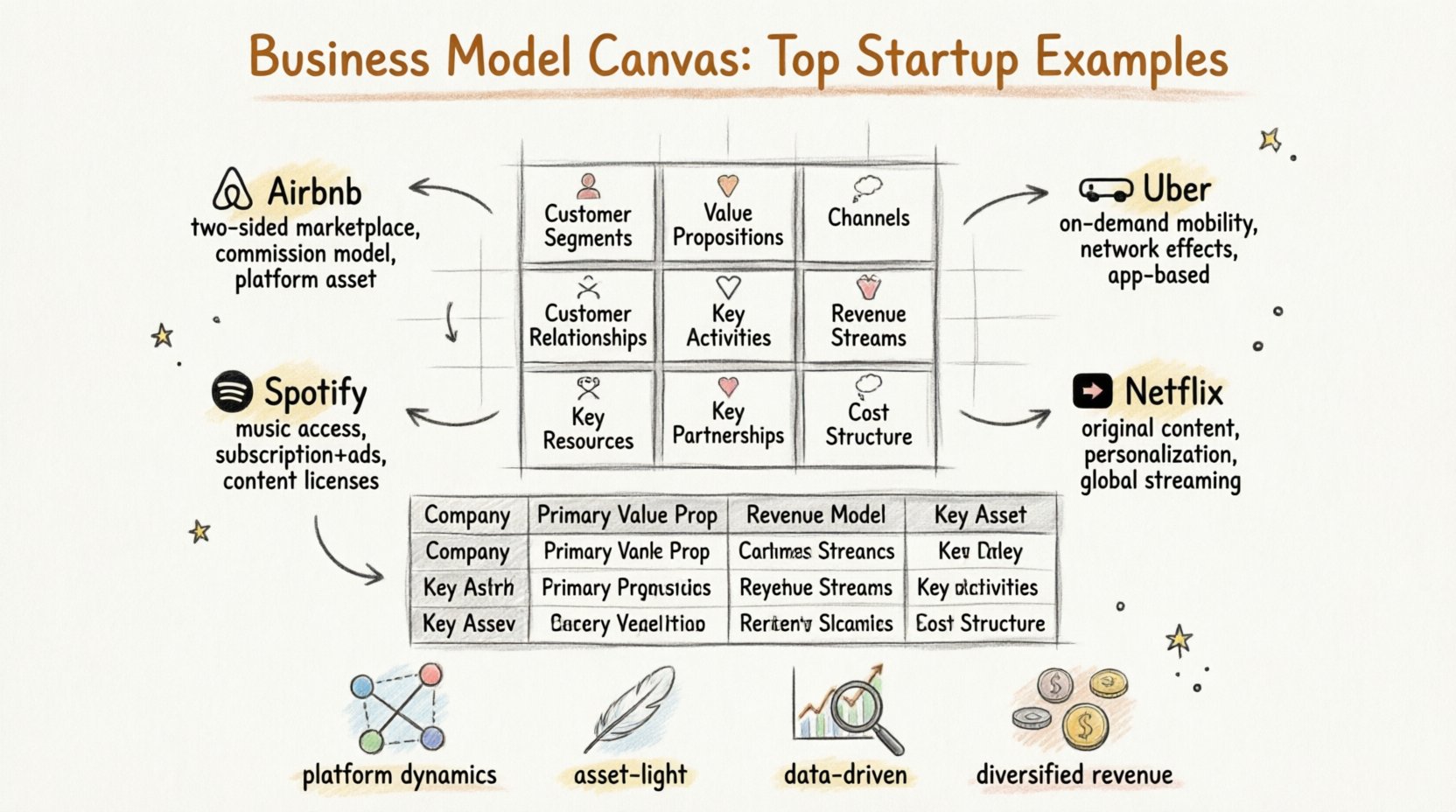
Building a successful venture requires more than a great idea. It demands a structured approach to understanding how value is created, delivered, and captured. The Business Model Canvas (BMC) serves as a strategic management template for developing new or documenting existing business models. This framework breaks down the architecture of a business into nine fundamental building blocks.
In this guide, we will explore detailed analyses of the Business Model Canvas from industry leaders like Airbnb, Uber, Spotify, and Netflix. By examining how these companies structured their operations, you can gain insights into the mechanics of scalable growth. We will avoid generic advice and focus on specific strategic choices that drove their early success.
🏗️ The Nine Building Blocks of the Business Model Canvas
Before diving into specific examples, it is essential to understand the components of the framework. Each block represents a core aspect of the business logic. These blocks are interconnected, meaning a change in one area often necessitates adjustments in others.
- Customer Segments: Who are the most important people or organizations the business serves? This defines the market.
- Value Propositions: What value do you deliver to the customer? Which problem are you solving?
- Channels: How does the company reach its customers? This includes communication, distribution, and sales.
- Customer Relationships: What type of relationship does each segment expect? Is it personal, automated, or community-driven?
- Revenue Streams: How does the business earn money? What are the pricing mechanisms?
- Key Resources: What physical, intellectual, human, or financial assets are required to make the model work?
- Key Activities: What strategic actions must the company perform to deliver its value proposition?
- Key Partnerships: Who are the suppliers and partners? What resources do they provide?
- Cost Structure: What are the most important costs inherent in the business model?
Understanding these elements individually is only the first step. The true power lies in the alignment between them. Let us examine how top startups have utilized these blocks to build empires.
🏠 Case Study 1: Airbnb
Airbnb disrupted the hospitality industry by creating a two-sided marketplace. Their Business Model Canvas highlights a shift from asset ownership to asset utilization.
Customer Segments
Airbnb serves two distinct customer segments simultaneously:
- Hosts: Individuals with spare rooms or properties who want to earn income.
- Guests: Travelers seeking unique, often more affordable, accommodation options compared to traditional hotels.
Value Propositions
The value proposition differs for each segment:
- For Hosts: Monetize unused space, gain flexibility, and earn extra income.
- For Guests: Access to a wide variety of lodging, local experiences, and often lower costs than hotels.
Key Resources and Activities
Airbnb does not own any real estate. Their key resources are primarily intellectual and digital:
- The Platform: The website and mobile application that connect hosts and guests.
- Data Algorithms: Systems for search, matching, and pricing.
- Trust Systems: Review mechanisms and verification processes.
Key activities focus on platform development, marketing to acquire both sides of the market, and ensuring safety and trust through support teams.
Revenue Streams
Airbnb operates on a commission-based model:
- They charge a service fee to guests for booking.
- They charge a fee to hosts for each reservation.
This creates a scalable revenue model where income grows directly with the volume of transactions without significant marginal costs.
Key Partnerships
Strategic partnerships are vital for Airbnb:
- Payment Processors: To handle secure transactions globally.
- Local Tourism Boards: To integrate local experiences and promote sustainable tourism.
- Property Management Companies: To help hosts manage their listings professionally.
🚕 Case Study 2: Uber
Uber revolutionized urban transportation through a platform-based logistics model. Their approach relies heavily on network effects and dynamic supply management.
Customer Segments
- Riders: Individuals needing transportation.
- Drivers: Individuals with vehicles who want to work on flexible schedules.
Value Propositions
- For Riders: Reliable, on-demand transportation with transparent pricing and ease of use.
- For Drivers: Flexible earning opportunities and control over working hours.
Key Activities
Uber focuses on technology and operations:
- Software Development: Continuous updates to the app for stability and new features.
- Regulatory Compliance: Navigating complex local transportation laws.
- Driver Onboarding: Verification and support systems for the workforce.
Cost Structure
The cost structure is heavily weighted towards technology and marketing:
- Customer Acquisition: Significant spending on promotions and discounts to grow the rider base.
- R&D: Investment in autonomous vehicle technology and logistics algorithms.
- Operations: Salaries for support staff and administrative overhead.
Channels
Uber relies almost exclusively on digital channels:
- Mobile Application: The primary interface for both drivers and riders.
- Social Media: For brand awareness and community engagement.
🎧 Case Study 3: Spotify
Spotify transformed the music industry by shifting from ownership to access. Their model balances subscription revenue with advertising.
Customer Segments
- Free Users: Listen to music with advertisements.
- Subscribers: Pay a monthly fee for ad-free listening and offline capabilities.
- Artists and Labels: Content providers who need distribution.
Value Propositions
- For Listeners: Instant access to a vast library of music, personalized playlists, and discovery features.
- For Artists: Global distribution and data insights about their audience.
Key Partnerships
Spotify cannot exist without content:
- Record Labels: Universal, Sony, and Warner Music Group provide the music catalog.
- Hardware Manufacturers: Partnerships with phone and car manufacturers to integrate the app deeply.
Revenue Streams
A dual-stream approach ensures diversification:
- Subscription Fees: Monthly recurring revenue from premium users.
- Advertising: Audio and display ads served to free-tier users.
📺 Case Study 4: Netflix
Netflix evolved from a DVD rental service to a global streaming giant. Their canvas focuses on content production and algorithmic recommendation.
Customer Segments
The primary segment is global subscribers seeking entertainment. They segment further by geographic region and content preference.
Value Propositions
- Binge-Watching: Full seasons released at once.
- Original Content: Exclusive shows not available elsewhere.
- Personalization: Algorithms that suggest content based on viewing history.
Key Activities
Content is king for Netflix:
- Content Production: Investing billions in original films and series.
- Data Analysis: Using viewing data to inform production decisions.
- Platform Maintenance: Ensuring high availability and streaming quality.
Key Resources
- Content Library: Both licensed and original intellectual property.
- Technology Infrastructure: Servers and content delivery networks.
- Brand: Recognition associated with quality entertainment.
📊 Comparative Analysis Table
The following table summarizes the core strategic differences between these startups based on their Business Model Canvas.
| Company | Primary Value Prop | Revenue Model | Key Asset | Customer Relationship |
|---|---|---|---|---|
| Airbnb | Unique stays, community trust | Transaction Fees | Platform & Community | Automated & Self-service |
| Uber | On-demand mobility | Commission per Ride | Network & Logistics | Automated |
| Spotify | Music access & discovery | Subscription & Ads | Content License & Data | Personalized |
| Netflix | Entertainment library | Subscription | Original Content | Personalized |
🔍 Common Patterns in Startup Success
While these companies operate in different sectors, their Business Model Canvas shares common threads that contribute to scalability.
1. Platform Dynamics
Airbnb and Uber utilize network effects. As more users join, the value increases for everyone else. This reduces customer acquisition costs over time. The platform acts as the intermediary, minimizing overhead.
2. Asset Light Models
Most modern startups avoid heavy capital expenditure. Airbnb does not own buildings. Uber does not own cars. This allows them to scale rapidly without the burden of maintenance and depreciation associated with physical assets.
3. Data-Driven Decision Making
Netflix and Spotify rely heavily on data. They do not guess what users want; they analyze behavior. This informs their value proposition and key activities, ensuring resources are allocated efficiently.
4. Diversified Revenue
Relying on a single income source is risky. Spotify uses both ads and subscriptions. Netflix focuses on subscriptions but invests in global expansion. This diversification stabilizes cash flow.
🛠️ How to Apply This Framework to Your Venture
Creating a Business Model Canvas for your own startup requires honesty and iteration. It is not a one-time document but a living strategy.
Step 1: Start with the Value Proposition
Define the problem you are solving. Be specific. If the value proposition is vague, the rest of the canvas will struggle to align. Write it down clearly before filling out other sections.
Step 2: Identify the Customer Segments
Do not try to serve everyone. Identify the early adopters who feel the pain point most acutely. Tailor your channels and relationships to reach this specific group effectively.
Step 3: Map the Revenue Streams
Ensure there is a clear path to monetization. Will you charge upfront, subscription, or usage-based? Align this with the value customers perceive.
Step 4: Define Key Activities and Resources
Be realistic about what you need to execute the model. If you need proprietary technology, that is a key resource. If you need sales teams, that is a key activity. Avoid listing generic tasks.
Step 5: Analyze Costs and Partners
Identify where the money goes. Understand which partners can reduce your costs or increase your reach. Sometimes outsourcing a function is cheaper than building it in-house.
⚠️ Common Pitfalls to Avoid
When filling out the Business Model Canvas, founders often make specific mistakes that hinder clarity.
- Confusing Activities with Resources: An activity is something you do (e.g., manufacturing). A resource is something you have (e.g., a factory). Keep these distinct.
- Ignoring Customer Relationships: Many startups focus on acquisition and forget retention. How do you keep customers coming back? This block is critical for lifetime value.
- Overestimating Partnerships: Do not assume partners will provide value without a contract. Define the nature of the partnership clearly.
- Neglecting the Cost Structure: Revenue is vanity; profit is sanity. Map out your fixed and variable costs to understand your break-even point.
📈 Iterating the Canvas
A business model is rarely perfect on day one. As you gather market feedback, you must update the canvas. This process is known as pivoting.
- Test Hypotheses: Treat each block as a hypothesis. Test if customers actually want the value proposition.
- Monitor Metrics: Track conversion rates, churn, and acquisition costs. These metrics indicate which parts of the canvas are working.
- Update Regularly: Schedule quarterly reviews of the canvas. Remove blocks that no longer apply and add new ones as the business evolves.
🔗 Integrating Strategy with Execution
The Business Model Canvas bridges the gap between high-level strategy and daily execution. By visualizing the nine blocks, teams can see how their daily tasks contribute to the broader business logic.
For example, if the key activity is software development, the engineering team’s goals should directly reflect the value proposition. If the key resource is data, the analytics team becomes a priority. This alignment ensures that resources are not wasted on initiatives that do not support the core model.
🎯 Final Thoughts on Business Modeling
Creating a robust business model is a foundational step for any startup. It forces you to think critically about how money is made, how value is delivered, and who the customers are. The examples of Airbnb, Uber, Spotify, and Netflix demonstrate that there is no single correct way to structure a business, but there are principles of scalability and efficiency that apply across industries.
By studying these models and adapting the framework to your specific context, you build a clearer path to sustainability. The canvas is a tool for clarity, not a guarantee of success. Success requires execution, adaptation, and continuous improvement. Use the canvas to guide your decisions, but remain flexible as the market changes.
Remember that the goal is not just to fill out the boxes but to understand the relationships between them. When the value proposition changes, the revenue model might need to shift. When the customer segment changes, the channels might need to evolve. This dynamic view is what keeps a business model relevant in a competitive landscape.