Enterprise success depends on the ability to translate high-level ambitions into concrete operational realities. Too often, organizations find a disconnect between their strategic intent and the technical infrastructure supporting it. This gap creates inefficiency, waste, and missed opportunities. The TOGAF framework offers a structured approach to bridge this divide. Specifically, the use of architectural viewpoints provides a lens through which business strategy can be examined, validated, and sustained.
This guide explores the mechanics of aligning business strategy with TOGAF architectural viewpoints. We will examine how these viewpoints function, how they map to strategic objectives, and the practical steps required to maintain this alignment throughout the architecture lifecycle. No magic tools are required; only disciplined application of framework principles and clear communication.
Understanding the Core Concepts 🧩
Before diving into the alignment process, it is necessary to define the terms used within the architecture community. Clarity here prevents confusion later in the development process.
- Business Strategy: The plan of action designed to achieve long-term goals. It defines where the organization is going and how it intends to get there.
- Enterprise Architecture (EA): A conceptual blueprint that defines the structure and operation of an organization. It includes the strategy, processes, data, and information systems.
- Viewpoint: A specification of the conventions for constructing and using a view. It defines the stakeholder concerns, the languages to be used, and the methods of analysis.
- View: A representation of a system from the perspective of a related set of concerns. It is the actual diagram or document produced using a viewpoint.
The critical distinction lies between a Viewpoint and a View. A Viewpoint is the template or the rulebook. A View is the actual output created for a specific audience. To align strategy, we must ensure the Viewpoints we select are capable of capturing strategic intent.
Why Alignment Matters 🎯
Without alignment, architecture becomes an isolated exercise. IT teams build systems that do not support business needs. Business leaders set goals that the current infrastructure cannot support. The result is a fractured organization. Aligning strategy with architecture ensures that every dollar spent on technology contributes directly to business value.
Key benefits of this alignment include:
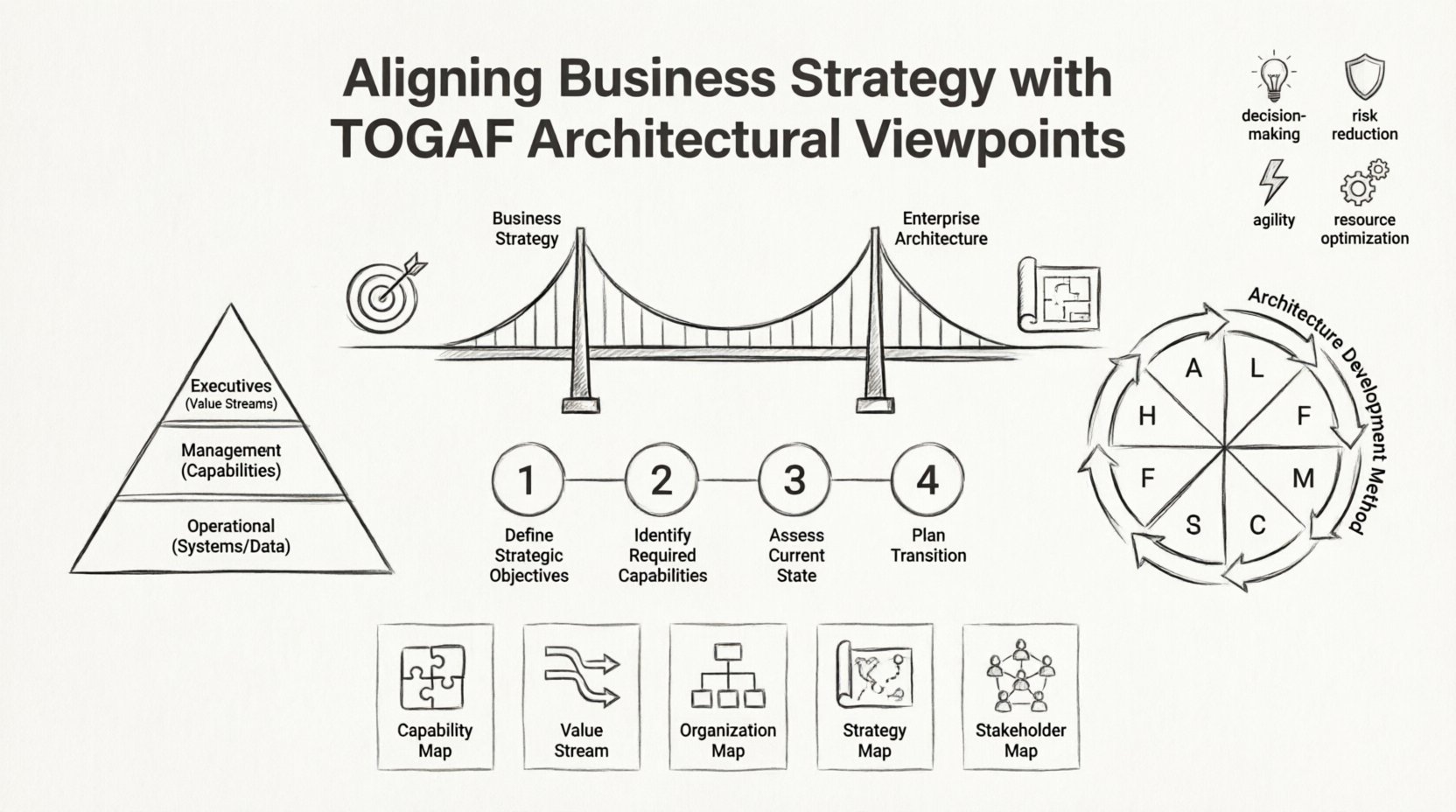
- Improved Decision Making: Leaders have clear visibility into how changes affect capabilities.
- Reduced Risk: Strategic initiatives are validated against architectural constraints before execution.
- Agility: A well-architected environment can adapt to market changes faster.
- Resource Optimization: Investment is directed toward capabilities that drive the strategy.
The TOGAF Business Architecture Domain 📊
In the TOGAF standard, the Business Architecture domain is the foundation for all other domains. It describes the business strategy, governance, organization, and key business processes. It is the primary interface between the executive strategy and the technical execution.
When aligning strategy, we focus heavily on three core artifacts within this domain:
- Business Capabilities: What the business must be able to do to achieve its goals. This is stable and does not change as frequently as processes.
- Business Processes: The specific activities performed to deliver value. These are more volatile than capabilities.
- Value Streams: The end-to-end sequences of activities that create value for the customer.
Selecting the Right Viewpoints 🧭
Not all viewpoints are created equal. Using a technical viewpoint to explain business strategy will lead to confusion. The architect must select viewpoints that resonate with the stakeholder group. The following table outlines common viewpoints and their strategic relevance.
| Viewpoint | Primary Concern | Strategic Relevance |
|---|---|---|
| Business Capability Map | What the organization can do | High. Identifies gaps in strategic capabilities. |
| Value Stream Map | How value is delivered | High. Connects activities to customer outcomes. |
| Organization Map | Who does the work | Medium. Aligns structure to strategy. |
| Strategy Map | How goals link to actions | Very High. Direct visualization of strategy. |
| Stakeholder Map | Who is affected | Medium. Ensures buy-in and communication. |
When choosing a viewpoint, ask: “Does this representation help the stakeholder understand how the strategy is being met?” If the answer is no, select a different viewpoint.
Mapping Strategy to Capability 🗺️
The most effective way to align strategy is through Business Capabilities. Unlike processes, capabilities are abstracted from the “how” and focus on the “what”. This makes them ideal for long-term strategic planning.
Step 1: Define Strategic Objectives
Start by listing the strategic objectives. These are typically high-level statements such as “Increase Market Share” or “Reduce Operational Costs”. These statements must be clear and measurable.
Step 2: Identify Required Capabilities
For each objective, identify the capabilities needed. For “Increase Market Share”, capabilities might include “Customer Segmentation” or “Product Innovation”. For “Reduce Costs”, capabilities might be “Supply Chain Optimization” or “Automated Billing”.
Step 3: Assess Current State
Map the current capabilities against the required ones. Use a maturity scale to rate the current state. This highlights the gaps that architecture must address.
Step 4: Plan the Transition
Define the architectural projects required to close the gaps. This moves the strategy from paper to action. Each project should be tagged to the specific capability it enhances.
Stakeholder Concerns and Viewpoints 👥
Stakeholders have different concerns. A CEO cares about ROI and growth. A CTO cares about scalability and integration. A Process Owner cares about efficiency. A single view cannot satisfy everyone.
TOGAF addresses this through the stakeholder management process. The architect must identify the key stakeholders and their specific concerns. Then, construct viewpoints that address those concerns directly.
- Executive Stakeholders: Focus on Value Streams and Strategic Objectives. They need to see the big picture.
- Management Stakeholders: Focus on Business Capabilities and Processes. They need to see resource allocation.
- Operational Stakeholders: Focus on Systems and Data. They need to see daily workflows.
By tailoring the viewpoint to the stakeholder, the architect ensures the strategy is understood at every level of the organization. This reduces resistance and increases adoption.
The Architecture Development Method (ADM) Cycle 🔄
The ADM is the core process of TOGAF. It is an iterative cycle that guides the development of architecture. Aligning strategy is not a one-time event; it is a continuous process integrated into the ADM.
Phase A: Architecture Vision
This phase sets the scope and defines the business context. It is crucial here to ensure the business strategy is clearly articulated. The Architecture Vision document should explicitly reference strategic goals. If the strategy is not defined here, alignment will fail.
Phase B: Business Architecture
This is the heart of the alignment process. The architect defines the baseline and target business architecture. The target architecture must directly support the strategic objectives defined in Phase A. Capabilities are mapped, and gaps are identified.
Phase C: Information Systems Architectures
Once the business architecture is defined, data and application architectures are developed. These must be designed to support the business capabilities. For example, if a strategic goal is “Real-time Customer Insights”, the data architecture must support real-time processing.
Phase D: Technology Architecture
The technology layer supports the applications. It must provide the performance and reliability required by the business processes. Strategic constraints, such as security or compliance, are enforced here.
Phase E: Opportunities and Solutions
This phase involves planning the transition. It selects the specific projects needed to move from the baseline to the target architecture. Projects are prioritized based on their contribution to the strategy.
Phase F: Migration Planning
The detailed plan is created. This includes schedules, budgets, and resource allocation. The alignment is verified to ensure the plan delivers the intended strategic value.
Phase G: Implementation Governance
During implementation, the architecture is monitored. If projects drift away from the architecture, they are corrected. This ensures the final solution matches the strategic intent.
Phase H: Architecture Change Management
Business strategy evolves. The architecture must evolve with it. This phase manages changes to the architecture in response to new strategic directives. It ensures the architecture remains relevant.
Common Pitfalls in Alignment ⚠️
Even with a robust framework, organizations can stumble. Awareness of common pitfalls helps avoid them.
- Ignoring the Business: Treating architecture as a purely technical exercise. Business leaders must be involved.
- Over-Engineering: Creating complex models that are too difficult to understand. Simplicity aids alignment.
- Static Planning: Creating a strategy that does not change. Market conditions shift, and the architecture must reflect that.
- Poor Communication: Using technical jargon with business stakeholders. Translate architecture into business value.
- Lack of Governance: Allowing projects to proceed without architectural oversight. This leads to shadow IT and fragmentation.
Measuring Success 📈
How do we know the alignment is working? We need metrics. These metrics should be tied to the strategic objectives.
Examples of alignment metrics include:
- Capability Coverage: Percentage of strategic capabilities fully supported by the architecture.
- Project Success Rate: Percentage of architecture projects delivered on time and within budget.
- Business Agility: Time taken to deploy new business capabilities.
- Stakeholder Satisfaction: Feedback from business leaders regarding the usefulness of the architecture.
Tracking these metrics over time provides data on the health of the relationship between business and technology.
The Role of the Architect 🛠️
The Enterprise Architect plays a pivotal role in this alignment. They act as a translator between the business and technology domains. They must possess a deep understanding of both.
Key responsibilities include:
- Facilitation: Leading workshops to define strategy and architecture.
- Documentation: Maintaining accurate and accessible architecture records.
- Advocacy: Championing the value of architecture to business leaders.
- Analysis: Continuously assessing the fit between current state and future goals.
The architect must remain neutral and objective. Their loyalty is to the integrity of the architecture and the success of the organization, not to a specific department.
Integrating with Other Frameworks 🔗
TOGAF is often used alongside other frameworks. This is common in large organizations.
- ITIL: Focuses on service management. Alignment ensures IT services support business goals.
- PRINCE2: Focuses on project management. Alignment ensures projects deliver architectural outcomes.
- Agile: Focuses on iterative development. Alignment ensures sprints deliver value aligned with the strategy.
When integrating frameworks, the architecture viewpoints serve as the common language. They define the boundaries and the deliverables that connect the different disciplines.
Future-Proofing the Strategy 🔮
Strategy is not static. Trends such as cloud computing, artificial intelligence, and data privacy are reshaping the business landscape. The architecture must be flexible enough to accommodate these changes.
To future-proof the strategy:
- Modularity: Design systems as loosely coupled components. This allows parts to be updated without breaking the whole.
- Scalability: Ensure the architecture can grow with demand.
- Compliance: Build regulatory requirements into the baseline architecture.
- Innovation: Reserve capacity for experimental initiatives that may become strategic priorities.
Conclusion 🏁
Aligning business strategy with TOGAF architectural viewpoints is a disciplined process. It requires clear definitions, appropriate tools, and continuous engagement. By focusing on business capabilities and tailoring viewpoints to stakeholder concerns, organizations can ensure their technology investments deliver real value.
The goal is not to create perfect documentation. The goal is to create a shared understanding that guides decision-making. When the architecture reflects the strategy, the organization moves with purpose. When they are misaligned, the organization drifts.
Start with the strategy. Define the capabilities. Select the right viewpoints. Govern the implementation. Review the outcomes. This cycle creates a resilient organization capable of navigating complexity.