Enterprise architecture relies on the disciplined integration of frameworks and modeling languages. When organizations deploy the TOGAF Architecture Development Method (ADM) alongside the ArchiMate modeling language, they establish a robust foundation for planning and execution. This guide details how to map ArchiMate constructs directly to TOGAF ADM phases, ensuring clarity and traceability throughout the lifecycle. By maintaining strict alignment, architects can avoid siloed documentation and foster a cohesive understanding of the enterprise landscape.
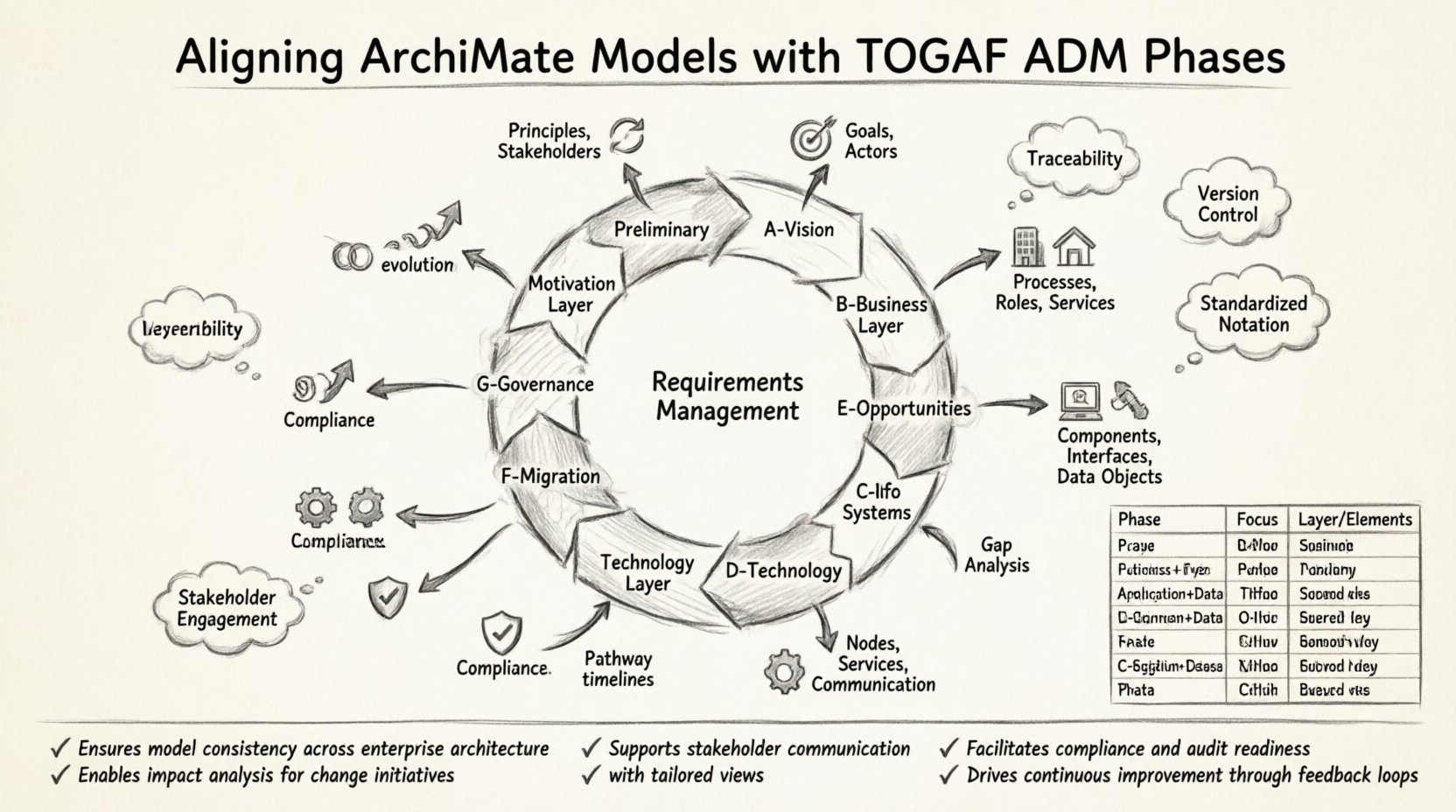
Understanding the Core Components 🔄
Before diving into phase-specific mapping, it is essential to grasp the distinct roles of the two standards involved. TOGAF provides the process framework, while ArchiMate offers the visual syntax to describe the architecture.
- TOGAF ADM: An iterative, cyclical approach to developing architecture. It consists of nine phases (Preliminary through H) plus Requirements Management.
- ArchiMate: A standard modeling language. It covers three core layers (Business, Application, Technology) and a Motivation layer, plus cross-cutting concepts like Relationships and Realization.
Aligning these two means using the right ArchiMate elements at the right stage of the ADM cycle. This ensures that every diagram serves a specific purpose within the architectural process.
Phase-by-Phase Alignment Strategy 📋
The following sections break down the specific ArchiMate deliverables and focus areas for each ADM phase. This structure ensures that modeling efforts remain targeted and relevant.
1. The Preliminary Phase: Setting the Stage 🚩
This phase defines the architecture framework and principles. It is not about modeling the enterprise itself, but rather modeling the environment in which the architecture will be built.
- Focus: Architecture Principles, Capabilities, and Governance.
- ArchiMate Elements: Use the Motivation Layer to document stakeholders and their concerns. Define Principles as nodes or rules within the motivation view.
- Deliverables: Architecture Principles Document, Governance Model.
Architects should define the scope of the modeling effort here. Establishing the Business Role for the architecture team ensures accountability. Without this groundwork, subsequent phases risk misalignment with organizational governance.
2. Phase A: Architecture Vision 🎯
The goal is to define the scope and identify the stakeholders. The output is an Architecture Vision.
- Focus: High-level scope, Stakeholder analysis, and Business Drivers.
- ArchiMate Elements:
- Business Actor: Identify key stakeholders.
- Business Goal: Document the drivers for the architecture.
- Business Process: High-level overview of current state.
At this stage, detailed technical modeling is unnecessary. The model should communicate the vision to leadership. Use Realization relationships to show how the vision is realized by the proposed architecture outcomes.
3. Phase B: Business Architecture 🏢
This phase develops the Business Architecture. It describes the business strategy, governance, organization, and key business processes.
- Focus: Business Processes, Roles, and Organization.
- ArchiMate Elements:
- Business Process: Detailed workflows.
- Business Role: Who performs the processes.
- Business Service: Value delivered to external actors.
- Business Function: Aggregated capabilities.
Traceability is critical here. Every Business Process should link to the Business Goals defined in Phase A. This demonstrates value. If a process does not support a goal, it may be a candidate for elimination or redesign.
4. Phase C: Information Systems Architectures 💻
This phase covers Application and Data Architecture. It defines the software and data required to support the business architecture.
- Focus: Application Portfolio, Data Objects, and Information Flows.
- ArchiMate Elements:
- Application Component: Software units.
- Application Interface: Connections between applications.
- Data Object: Information held by the business.
- Application Service: Functionality provided by software.
The alignment here is vital. Every Business Service from Phase B must be supported by at least one Application Service. This mapping validates that the business needs are technically feasible. Data objects must align with business entities to ensure consistent information semantics.
5. Phase D: Technology Architecture ⚙️
This phase details the hardware, network, and infrastructure required to support the application layer.
- Focus: Infrastructure, Nodes, and Communication.
- ArchiMate Elements:
- Technology Node: Hardware or virtual environment.
- Technology Service: Infrastructure capabilities.
- Communication Node: Network topology.
Mapping Application Components to Technology Nodes provides the physical deployment view. This helps infrastructure teams understand resource requirements. Security is often modeled here using Security elements to show protection mechanisms for the technology layer.
6. Phase E: Opportunities and Solutions 🧩
This phase involves gap analysis and defining the transition architecture. It bridges the current state to the target state.
- Focus: Gap Analysis, Migration Pathways, and Solution Selection.
- ArchiMate Elements:
- Gap Analysis: Visual comparison of As-Is and To-Be models.
- Implementation Event: Milestones in the transition.
- Assignment: Linking solutions to capabilities.
Here, the architecture model evolves. New Application Components or Business Processes are introduced. The model must clearly distinguish between existing elements and new additions. This distinction supports cost estimation and resource planning.
7. Phase F: Migration Planning 🗺️
This phase prioritizes projects and creates the implementation roadmap.
- Focus: Project Sequencing, Budgeting, and Resource Allocation.
- ArchiMate Elements:
- Pathway: Visual representation of the migration journey.
- Implementation Event: Specific project milestones.
- Constraint: Limitations on the transition.
Use the Motivation Layer here to show risks and requirements associated with specific projects. If a project is dependent on a specific Business Capability, model that dependency to highlight critical path items.
8. Phase G: Implementation Governance 🛡️
During implementation, the architecture must be monitored to ensure compliance with the design.
- Focus: Compliance, Adaptation, and Deviation Management.
- ArchiMate Elements:
- Compliance Relationship: Linking projects to standards.
- Guidance: Direction provided to implementers.
- Assignment: Who is responsible for the change.
The model acts as a baseline. If the implementation deviates, the model updates to reflect the As-Is reality. This maintains the integrity of the architectural record. Governance checks ensure that new solutions adhere to the defined Architecture Principles.
9. Phase H: Architecture Change Management 🔄
This phase manages changes to the architecture itself. It ensures the architecture evolves alongside the business.
- Focus: Monitoring, Change Requests, and Continuous Improvement.
- ArchiMate Elements:
- Requirement: New needs identified during operations.
- Goal: Long-term objectives.
- Principle: Rules updated based on experience.
Change requests often stem from the Requirements Management phase. The model must support versioning. Historical versions of the architecture allow architects to trace how decisions evolved over time.
Mapping Table: Quick Reference 📊
The following table summarizes the alignment between ADM phases and ArchiMate layers.
| TOGAF Phase | Primary Focus | Key ArchiMate Layers | Key Elements |
|---|---|---|---|
| Preliminary | Framework Setup | Motivation | Principles, Stakeholders |
| Phase A (Vision) | Scope & Vision | Motivation, Business | Goals, Actors, High-level Processes |
| Phase B (Business) | Business Design | Business | Processes, Functions, Roles, Services |
| Phase C (Info Systems) | Data & Apps | Application, Data | Components, Interfaces, Data Objects |
| Phase D (Technology) | Infrastructure | Technology | Nodes, Services, Communication |
| Phase E (Opportunities) | Gap Analysis | All Layers | Gap, Realization, Assignment |
| Phase F (Migration) | Planning | Motivation, Business | Pathways, Events, Constraints |
| Phase G (Governance) | Compliance | All Layers | Compliance, Guidance, Requirements |
| Phase H (Change) | Evolution | All Layers | Goals, Principles, Requirements |
Best Practices for Consistency 🛠️
Alignment is not a one-time event. It requires discipline and consistent application of modeling standards.
- Maintain Traceability: Ensure every model element traces back to a business driver. If a technology node cannot be traced to a business process, its justification is weak.
- Version Control: Architectural models change. Use a repository that tracks changes to specific elements, not just the whole model.
- Standardize Notation: Agree on naming conventions. Business Process names should match across all phases to avoid confusion.
- Layered Views: Do not mix layers unnecessarily. Keep Business, Application, and Technology layers distinct, using Access or Assignment relationships to connect them.
- Engage Stakeholders: Models are communication tools. Ensure that the views generated in Phase A are understandable to the business leaders who will review them.
Common Pitfalls to Avoid ⚠️
Even with a solid framework, architects can drift from best practices. Recognizing these patterns early prevents rework.
- Over-Modeling in Phase A: Creating detailed technical diagrams too early distracts from the vision. Keep Phase A high-level.
- Ignoring the Motivation Layer: Focusing only on the structural layers (Business, Application, Technology) leads to a lack of context. Always document the Goals and Drivers.
- Siloed Models: Creating separate models for each layer without linking them breaks traceability. Use Realization relationships to connect layers.
- Lack of Update Cadence: Architecture drifts when models are not updated during implementation. Phase G governance must enforce model updates.
- Vagueness in Requirements: Requirements must be specific. Requirements in ArchiMate should be linked to specific gaps or goals.
Integrating Requirements Management 📝
Requirements Management is a continuous cycle that runs through all ADM phases. It ensures that the architecture remains aligned with business needs.
- Collection: Gather requirements from stakeholders during Phase A.
- Analysis: Check for conflicts or gaps during Phase E.
- Validation: Verify requirements against the implemented solution in Phase G.
Using Requirement elements in ArchiMate allows architects to tag specific model parts with the requirements they satisfy. This creates a direct line of sight from a specific Application Component to a specific Business Requirement.
Governance and Compliance 🔐
Architecture governance ensures that projects adhere to the defined standards. This is most active in Phase G.
- Architecture Board: Reviews changes to the model.
- Compliance Checks: Use the Compliance Relationship in ArchiMate to link projects to standards.
- Deviation Management: If a project deviates, document the reason and the mitigation strategy.
This process protects the enterprise from technical debt. It ensures that short-term fixes do not compromise long-term architectural integrity.
Looking Forward: Continuous Evolution 🚀
Enterprise architecture is not static. As the business environment changes, the models must evolve. The alignment between ArchiMate and TOGAF provides the structure for this evolution.
By adhering to the phase-specific mapping described in this guide, organizations can ensure that their architectural assets remain relevant. The focus shifts from mere documentation to active guidance. The models become living documents that drive decision-making.
Regular reviews of the alignment process help identify areas where the framework or language may need adjustment. This flexibility is key to long-term success. Architecture is a discipline of clarity and communication. When the process and the language are in sync, the path to execution becomes significantly clearer.
Summary of Key Takeaways 💡
- Structure: Use TOGAF ADM as the process container.
- Language: Use ArchiMate to fill the container with specific details.
- Traceability: Link every technical element to a business driver.
- Discipline: Update models continuously through Phase H.
- Clarity: Avoid over-complicating early phases.
Implementing this alignment requires commitment. It is not a quick fix but a systematic approach to managing complexity. When executed correctly, it transforms architecture from a theoretical exercise into a practical engine for business change.